Chongqing Without Getting Lost: Hotpot, Hills and Night Views
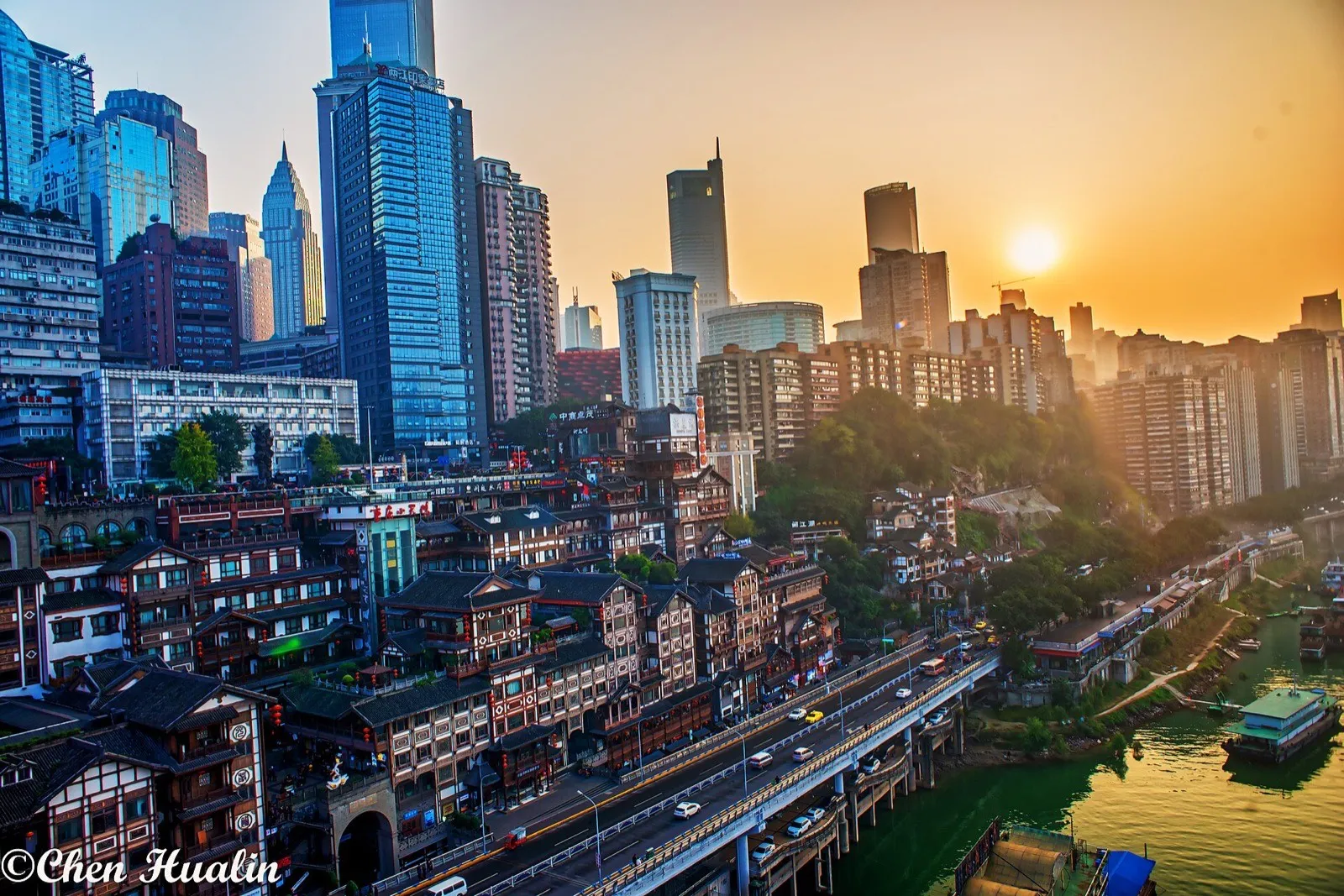
Chongqing is a city you navigate in three dimensions: a peninsula between two rivers, with roads stacked over rooftops, a monorail that threads through an apartment block, and a 'ground floor' that depends on which street you entered from. This practical guide covers how to eat hotpot like a local, which neighborhoods to base yourself in, how to use the metro and cableway without queueing for hours, what to book ahead, the day trips worth the drive, and the navigation mistakes that eat entire afternoons. It is written for independent travelers who want the city's energy without the tour-group script. Details are current as of November 2026.
The short version
- Chongqing's map lies about distance: a 500-meter walk can mean ten floors of stairs, so use the metro and double your walking time
- Order a divided pot or a mild broth on your first hotpot night — Chongqing's beef-tallow base is hotter and more intense than Chengdu's
- The Yangtze cableway costs ¥30 one-way or ¥50 round trip; buy through the official WeChat account and take a queue number at the gate
- Hongya Cave is free and best seen from Qiansimen Bridge; on holiday weekends it uses timed slots through the official mini-program
- Summer is brutal (38–40°C and above), winter is damp and foggy; March–May and September–November are the comfortable windows
Chongqing does not behave like a flat city. The center sits on a steep peninsula where the Yangtze meets the Jialing, and everything is stacked: roads pass over rooftops, escalators replace streets, a monorail runs through the sixth-to-eighth floors of an apartment block, and the view from your hotel window may be someone else’s ground floor. The terrain is the attraction and the obstacle. Learn to move in it, eat in it, and stay out late in it, and the city becomes one of the most memorable in China. Details are current as of November 2026.
The Map Is Not the City
Start with the mental model: Yuzhong peninsula is the old core, with Jiefangbei at its center, Hongya Cave on the Jialing side and the Yangtze cableway connecting to Nan’an across the river. North of the Jialing is Jiangbei, home to Guanyinqiao and the airport. South of the Yangtze is Nan’an, with Nanbin Road’s skyline views.
Mapping apps measure horizontal distance and ignore the vertical. A 500-meter line can mean staircases, sky bridges, escalators and several floors of elevation. Use Amap and search in Chinese, save your destinations as Chinese names, and set your pickup point to a road where cars can actually stop. When a driver asks where you are, giving a landmark plus “which floor” is more useful than a street number.
Do this before you leave the hotel: pin the metro station nearest your destination, not just the sight. In Chongqing, the station exit can matter more than the address.
Eat: Hotpot and the City’s Daily Food
Chongqing hotpot is the city’s defining dish. It was born on the wharves, where porters simmered cheap offal in a shared chili broth, and it remains unapologetically intense: a dark beef-tallow base, a heavy hand with chilies and Sichuan pepper, and a nine-grid pot for those who want to cook different ingredients at different speeds. Compared with Chengdu, the broth is stronger, the offal is more central, and the dipping bowl is simpler — usually just sesame oil and garlic, sometimes vinegar.
Order a yuanyang (divided) pot if you are unsure. Cook thin-sliced beef and vegetables at your own pace, dip in oil to cool the heat, and ask for wēi là if you want mild — though even mild will have a kick. A neighborhood hotpot runs roughly ¥50–90 per person; a tourist-area one can reach ¥100–150.
Beyond hotpot: Chongqing xiaomian (spicy noodles) is the breakfast and lunch staple, around ¥7–15 a bowl. Jianghu cuisine — robust, salty, chili-heavy dishes — and Wanzhou grilled fish are the other local staples, roughly ¥40–70 for a shared plate. Eat in the neighborhoods: Jiefangbei’s back basements, Guanyinqiao, Nanbin Road and the Jiujie bar district. The tourist strips near Hongya Cave charge more for the same food.
What to Book, and What Is Free
Hongya Cave is free. Weekdays usually need no reservation; around public holidays the official WeChat mini-program issues free timed slots. The lights come on around 19:00–23:00 in summer and roughly 18:30 in winter. The best view is not from inside the complex but from Qiansimen Bridge, a short walk away.
The Yangtze cableway costs ¥30 one-way or ¥50 round trip — prices set under a local government notice in 2025 and unchanged since. Buy through the official “长江索道” WeChat account, which lets you book up to two days ahead and take a queue number; then take a number at the gate as well. Go early, ride one way toward Nan’an, and return by metro for a different view.
Liziba is where Metro Line 2 runs through a residential tower. The viewing platform below is free and open roughly 06:30–23:00; it is a five-minute photo stop, not an afternoon.
Ciqikou is free, about twenty minutes from downtown by metro, and best on a weekday morning before the main lane fills. Huguang Guild Hall costs around ¥30 and closes Mondays. Three Gorges Museum is free, normally closes Mondays, and asks for your passport; holiday capacity rules can change, so check the official account.
Dazu Rock Carvings is the day trip that earns its full day: about two hours each way, with Baodingshan admission around ¥115 in peak season and ¥100 off-season, and a combined ticket with Beishan around ¥140. Wulong Karst is about 2.5 hours away; the Three Natural Bridges gate is roughly ¥70 peak / ¥40 off-season, with shuttle-and-lift packages around ¥125–155.
Getting In and Around
Fly into Jiangbei (CKG). Metro Line 10 reaches central areas in about 45–60 minutes; the new Line 15 opened in November 2026 and serves Terminal 3. The K01 airport bus costs ¥15 and takes 50–70 minutes. A taxi or Didi runs roughly ¥60–100 depending on traffic.
From Chengdu, high-speed rail is the easy link: fastest trains take about 1 hour 2 minutes, most 1–1.5 hours, with second class around ¥110–240 and commonly about ¥157. Watch the station name — Chongqing North, West and East serve different lines.
In the city, the metro is excellent and cheap: fares run ¥2–10, and Line 2’s monorail doubles as a sightseeing ride. Gates accept Alipay and WeChat Pay. Didi is cheap, taxis are metered, and river ferries are slow, scenic bargains. But plan for vertical walking: use transit for anything uphill and double the time your app suggests for anything on foot.
Yangtze cruises leave from Chaotianmen. A Chongqing-to-Yichang downstream trip typically takes four days and three nights; upstream runs longer. Book through the cruise line or a reputable platform, confirm which dock, and do not accept a “cheap cruise” sold on the street — the low-price version usually strips out meals, excursions or the cabin you thought you bought.
When to Go
Spring (March–May) and autumn (September–November) are the comfortable windows. Summer is genuinely extreme: 38–40°C is normal and heat waves push higher, so sightseeing shifts to early morning and after dark. Winter is damp and foggy, with temperatures around 5–12°C and little heating in southern-style buildings. The city’s famous night view works year-round, but summer nights are when it feels most alive — and most crowded.
Where to Base Yourself
Jiefangbei is the first-timer default: walkable to Hongya Cave, plugged into the metro, and surrounded by food at every price. Nanbin Road, across the Yangtze, trades convenience for the postcard view back at the skyline and easy access to the night-view platforms. Guanyinqiao, north of the Jialing, is the local choice, with better-value hotels and a less touristy feel. Wherever you stay, pick a place within a short walk of a metro station — in this terrain, that matters more than the hotel’s star rating.
Common Mistakes
- Trusting the distance on the map. A short line can hide a cliff of stairs; use the metro and add time.
- Queueing at Hongya Cave’s paid “fast lane.” There is no official paid shortcut; timed slots are free on the official mini-program.
- Buying cableway tickets from touts. Buy through the official account, take the queue number, and ignore “skip the line” offers.
- Assuming Chengdu-level spice. Chongqing’s beef-tallow base is hotter; order yuanyang or a mild broth.
- Underestimating summer. Heatstroke is a real risk in July and August; carry water and plan indoor breaks.
- Booking a station by city name only. North, West and East are far apart; check the station on your ticket.
- Taking a street-sold Yangtze cruise. Confirm the operator, dock, cabin and inclusions in writing before paying.
Sources & verification (15)
- https://www.fzggw.cq.gov.cn/zwgk/zfxxgkml/jgxx/jgzc/202503/t20250324_14434363.html
- http://mp.weixin.qq.com/s?__biz=Mzk1NzY4NjA0NA==&mid=2247500938&idx=2
- https://3gmuseum.cn/
- https://www.cq.gov.cn/gzh/csts/202611/t20261113_16403728.html
- http://cqwl.gov.cn/bmjz_sites/bm/wlw/zwgk_98942/zfxxgkml/jczwgkzl/ggwhfwly/ggfw/ggwljgmd/202601/t20260104_15286062.html
- https://www.travelchinaguide.com/climate/chongqing.htm
- https://www.travelchinaguide.com/attraction/chongqing/ciqikou.htm
- https://www.travelchinaguide.com/cruise/
- https://www.localkeytravel.com/china-guide/chongqing-vs-chengdu-hotpot-2026
- https://mychina.guide/blog/chongqing-vertical-city-navigation-guide
- https://www.qu17.com/news/3358.html
- http://cq.bendibao.com/tour/2019628/77112.shtm
- http://cq.bendibao.com/tour/201887/74196.shtm
- https://www.chinatravelsky.com/trains/chengdu-to-chongqing
- https://zhuanlan.zhihu.com/p/2075590668815163692