Money in China: Alipay, WeChat Pay and Cash — A 2026 Guide
China runs on two super-apps — Alipay and WeChat Pay — and since both opened their wallets to foreign cards, tourists can pay as easily as locals do. This guide walks through linking your Visa or Mastercard step by step before you fly, explains the fees and spending caps that apply to international cards, and covers where cash still matters, how credit cards fit in, and the sanest ways to use ATMs and currency exchange. One caveat to plan around: foreign-card payments above ¥200 carry a 3% service fee, and default caps apply unless you complete in-app passport verification. Fee and limit details are as of September 2026 — and for cultural calibration: nobody in mainland China wants a tip.
The short version
- Link a foreign Visa or Mastercard to Alipay and WeChat Pay before you fly — no Chinese bank account needed, and it works almost everywhere
- Foreign-card payments are fee-free at ¥200 or less; above that both apps add a 3% service fee on the full amount
- Default caps are around ¥5,000 per transaction and ¥50,000 per year; completing in-app identity verification with your passport raises them
- Carry ¥200–500 in small notes as a backup — cash is legal tender and must be accepted, even where QR codes dominate
- Tipping is not expected anywhere in mainland China; upscale restaurants add a 10–15% service charge instead
China is the world’s most advanced QR-code payment economy, and the good news for visitors is that the wall that used to exist between tourists and that system is gone. Since 2023, Alipay and WeChat Pay have both accepted internationally issued cards, and by 2026 setup takes minutes and works about as smoothly as Apple Pay back home. This guide covers everything you need to move money in China: which apps to set up and how, what foreign cards cost in fees, where cash still earns its place in your pocket, and how to handle the odd corners — ATMs, currency exchange, and the fact that nobody, anywhere, wants a tip. Details are as of September 2026; verify current fees in-app, as they can change.
Why Mobile Payment Comes First
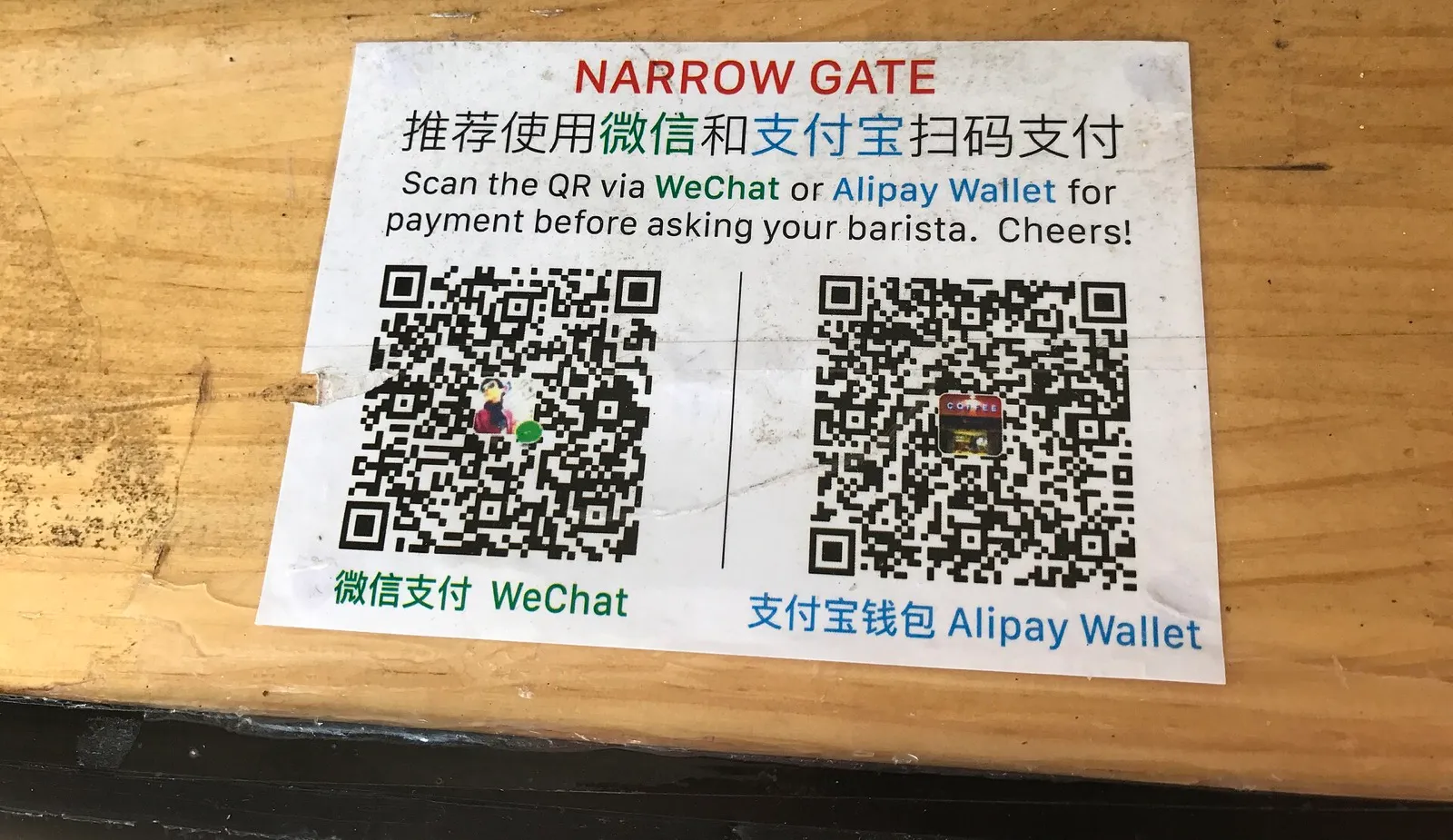
Grabbing a taxi, splitting a noodle bill, buying a subway ticket, paying for a scenic-area entry slot — in China, nearly all of it routes through a QR code. Cash works in most places and cards work in some, but mobile payment is the default that everything else is designed around. Two apps matter: Alipay (支付宝) and WeChat Pay (微信支付), the payment layer inside WeChat. Locals bounce between them; many merchants accept both, and the QR codes look identical.
Do locals carry cash? Barely. Do vendors refuse it? Legally they cannot — renminbi is legal tender and must be accepted — but in practice a stall that has not loaded change that morning may wave you toward the QR code. That is exactly why your setup order should be: apps first, cash second, cards third.
You do not need a Chinese bank account, a Chinese phone number, or a local ID for any of this. Your passport and your existing card are enough. If you want a head start on which apps to install beyond payment, see our essential apps guide.
Setting Up Alipay and WeChat Pay with a Foreign Card
Do this at home on good Wi-Fi, a few days before departure, so you are not debugging verification codes from an airport floor. Both apps follow the same broad pattern:
- Download Alipay and WeChat from the App Store or Google Play. Register with your regular phone number and your passport details — international numbers work fine for sign-up.
- Open the wallet section. In Alipay, go to Me → Bank Cards → Add Card. In WeChat, go to Me → Services → Wallet → Cards → Add a Card.
- Enter your card details — Visa and Mastercard are universally supported; Alipay additionally accepts JCB, Diners Club, and (at time of writing) American Express.
- Verify the card through your bank’s 3-D Secure step (a code sent by your bank, exactly like an online purchase at home). Have your phone unlocked and reachable — verification fails most often when your bank’s SMS is delayed.
- Pay a tiny test transaction once you land — a bottle of water at the airport convenience store. This confirms the pipeline works before you are in a taxi with a driver waiting.
That is the whole process. Since 2023 the flow has been progressively simplified, and by 2026 identity verification inside the apps is largely automated and typically completes in under ten minutes. A few international airports, including Hangzhou, have staffed service points that will walk you through setup on arrival if something went wrong at home.
One habit worth building immediately: when a merchant shows you a QR code, you scan it with the app’s built-in scanner and enter the amount they quote. When a cashier wants to charge you, they scan your code. Both directions work with a foreign card attached.
Fees and Limits: What Foreign Cards Cost You
International-card payments through the two apps are not free, but the terms are simple and identical on both platforms:
- Transactions of ¥200 (about US$28) or less: no platform fee. A ¥200 payment costs exactly ¥200.
- Transactions above ¥200: a 3% service fee on the full amount. A ¥201 coffee-plus-snack run costs about ¥207 — the fee applies to the whole payment, not just the excess over the threshold. The threshold is per transaction, so a ¥190 payment carries no fee even on a day when you have already spent thousands.
On top of that, your own bank may add its usual foreign-transaction fee (often 0–3% depending on your card), and card-network currency conversion applies. A no-foreign-fee credit card is the obvious pairing here.
Spending limits for foreign cards are set by the platforms and the payment regulator: roughly ¥5,000 per transaction and ¥50,000 per year per user as of September 2026. That is plenty for a two- or three-week trip, but if you are staying longer or making big purchases, complete the in-app identity verification (upload your passport, a quick face check) — this raises your caps and also tends to make high-value payments decline less often. If a payment is declined anyway, try a smaller amount first; merchant category also plays a role in how foreign-card payments are processed.
For a month-long or heavier-spending trip, some travelers add a second funding route — see the cash and ATM section below — rather than pushing the annual cap.
Where Cash Still Matters
Cash is not dead in China, it is just demoted. Here is where physical renminbi genuinely helps:
- Tiny vendors and markets. The legally-must-accept-cash rule means a cash note always works, even when a farmer’s market stall’s QR sticker is locally branded in ways that trip up foreign apps.
- Dead zones. Remote parts of national parks, some temples, and the occasional dead-phone-battery moment.
- Emergencies. If your bank flags your card mid-trip and freezes it, cash is what gets you through the 24 hours until support answers.
Carry ¥200–500 in small notes (¥10s and ¥20s), not one crisp ¥100. Convenience stores and pharmacies are the easiest places to break a large note early in the trip. Get a small amount from an airport or bank counter on arrival, then top up from ATMs as needed — you rarely need more than a buffer.
And for the moment a payment genuinely fails at the counter, our Survival Cards have a script ready: the Alipay rescue card tells the vendor your app won’t scan and offers cash instead, in polite large-print Chinese.
Credit Cards, ATMs and Currency Exchange
Credit cards are accepted where you would expect: international hotel chains, airlines, upscale restaurants, department stores, and larger shops in tier-1 cities increasingly take Visa, Mastercard, and Amex directly. They are not accepted where you might wish they were: taxis, noodle shops, convenience stores, and most transit gates. Treat a credit card as a large-purchase tool, and mobile payment as the daily driver. A growing number of metro systems now accept foreign contactless cards at the gate, but this is rolling out city by city — do not count on it as your primary transit method.
ATMs are everywhere, and major banks’ machines — look for Bank of China, ICBC, or China Construction Bank — generally support Visa, Mastercard, and UnionPay networks for renminbi withdrawals. Choose an ATM attached to a bank branch during opening hours, decline the machine’s currency-conversion offer (always pay in CNY), and expect fees from both your home bank and possibly the local bank. Withdraw larger amounts less often rather than small amounts daily.
Currency exchange is straightforward at Bank of China branches and airport exchange counters — bring your passport, which is required for the transaction. Airport rates are noticeably worse than city-branch rates, so exchange just enough at the airport to cover a day or two, then do the main exchange in town. Exchanging leftover renminbi back before departure requires your original exchange receipts and your passport, so keep both if you plan to convert back.
Tipping: Don’t
Mainland China has no tipping tradition, and this is one cultural gap where the easiest approach is also the correct one. Restaurant servers, taxi and ride-hailing drivers, hotel housekeeping, tour guides — nobody expects a tip, and offering one can produce genuine confusion or an awkward chase to return your money. The price on the menu or the meter is the price.
Two footnotes. Upscale restaurants, especially in international hotels, typically add a 10–15% service charge to the bill — that charge is the tip, and nothing further is needed. And the norms change in Hong Kong and Macau, where a 10% service charge at restaurants is standard and small tips are more customary than on the mainland.
Common Mistakes
- Setting up the apps at the airport on day one. Do it at home. Verification SMS codes are the usual failure point, and debugging that from a taxi queue is misery.
- Ignoring the ¥200 fee threshold. Many small payments dodge the 3% fee entirely; one giant meal bill eats it. It is not worth restructuring your life around, but knowing the rule helps you read your statements.
- Assuming “cash is useless” or “cards are fine.” Both extremes are wrong. Cash is accepted everywhere but used by no one; foreign cards work in fewer places than you would guess. The winning stack is apps + a cash buffer + a credit card for hotels and flights.
- Letting the app pay in your home currency. When a terminal or ATM offers to charge you in dollars or euros instead of CNY, always choose CNY — dynamic currency conversion quietly adds several percent.
- Forgetting the annual cap on a long trip. ¥50,000 sounds enormous until a month of high-speed rail tickets, hotels, and dinners adds up. Complete in-app passport verification early rather than hitting a decline with a train to catch.
- Trying to tip your way to good service. It is not expected, not needed, and often refused. Your patience and a friendly thank-you do the job.
- Leaving China without spending spare cash. Converting renminbi back requires receipts and paperwork; it is easier to spend the last ¥200 at the airport on snacks and data plans. And before you fly out, make sure your phone is ready too — see our internet and eSIM guide.
Sources & verification (12)
- https://www.visaforchina.cn/
- https://www.traveltochina.net/
- https://www.globaltimes.cn/
- https://chinatravelmadeeasy.com/
- https://business-trip-to-china.com/
- https://roamchinatravel.com/
- https://www.aethovpn.com/
- https://www.chinatours.com/
- https://sg.trip.com/
- https://intotravelchina.com/
- https://www.cathaypacific.com/
- https://www.ehangzhou.gov.cn/