Trains in China: How Foreigners Book and Ride the High-Speed Rail
China's high-speed rail is faster than flying for most intercity trips, and booking it as a foreigner is easier than you think. This guide covers the official 12306 app and its English version, the Trip.com trade-off, seat classes, how your passport works as your ticket at the gates, the 15-day release window, and how to survive station security and holiday rush with your sanity intact.
The short version
- High-speed rail beats flying between major Chinese cities: city center to city center, often in half the door-to-door time
- Book at face value on the official Railway 12306 app (full English version), or use Trip.com for a small fee and an easier first booking
- Your passport is your ticket: e-tickets are tied to your passport number and you scan the physical passport at the gate
- Tickets go on sale only 15 days before departure, and holiday trains sell out in minutes
- Arrive at big stations 45-60 minutes early for security and the long walk to your platform
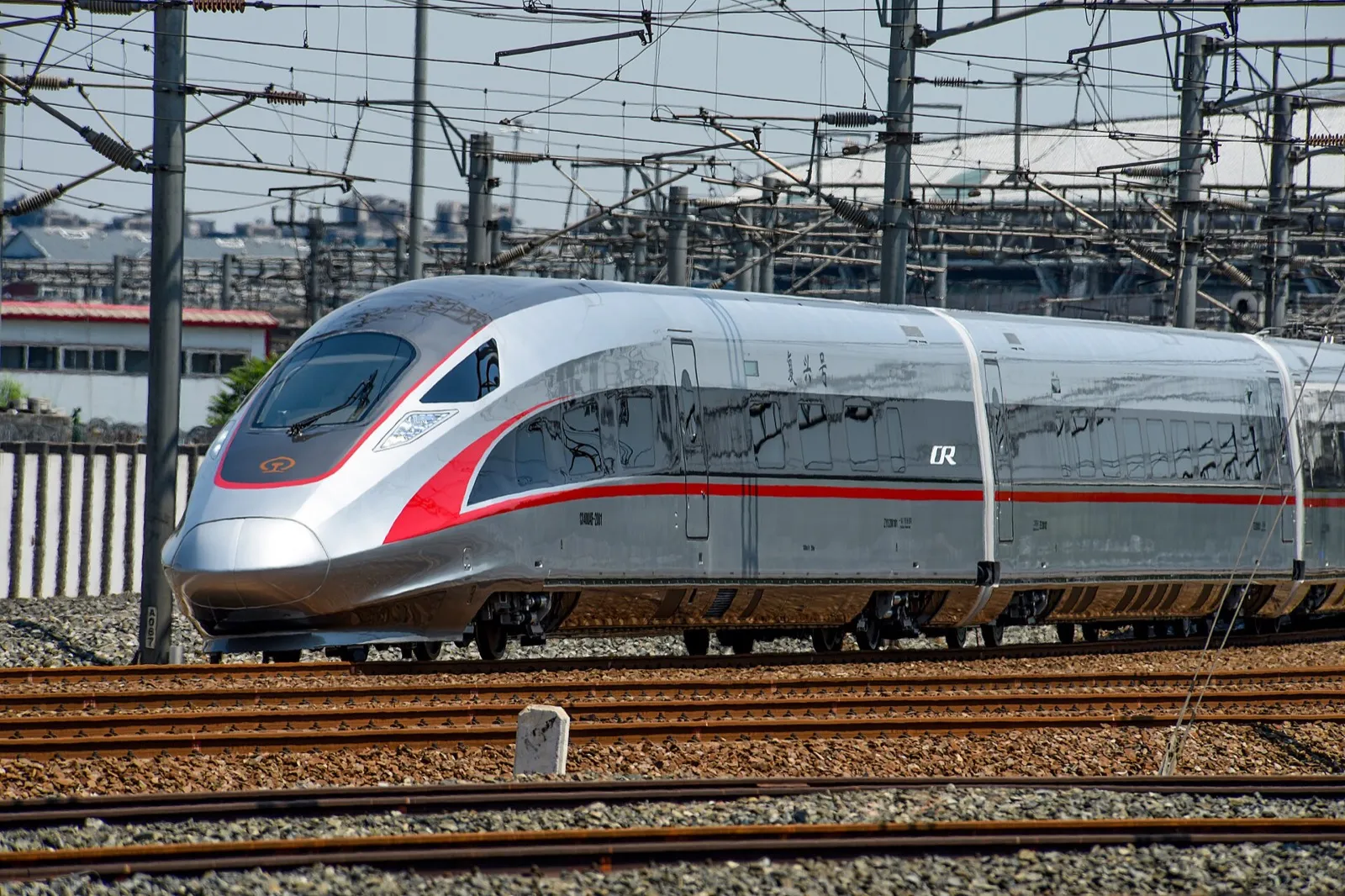
China built the world’s largest high-speed rail network in under two decades — more than 45,000 km of it — and for a first-time visitor it is the single best reason to skip domestic flights. Trains run at 300-350 km/h, stations sit in city centers, and Beijing to Xi’an takes about 4.5 hours instead of half a day of airport logistics. The catch for foreigners used to be buying tickets. That era is over: the official booking system now has a full English version, and your passport does everything a paper ticket used to do. Here is how it all works, as of September 2026.
Why the Train Beats Flying
For trips under 1,000 km, the math is not close. A flight from Beijing to Xi’an lasts about 2 hours in the air, but add a ride to an airport far outside town, security, boarding delays, and the trip back from the arrival airport, and the real door-to-door time often stretches past 6 hours. The high-speed G train does the same route in roughly 4.5 hours, from Beijing West station — connected to the subway — to Xi’an North, a 30-minute metro ride from the old city walls.
Two more things tilt it further. First, punctuality: China’s high-speed services run with airline-style discipline, and delays of more than 30 minutes are uncommon outside severe weather. Second, stations themselves are destinations of efficiency — Shanghai Hongqiao has the airport attached to it (literally: the railway station shares a complex with Hongqiao Airport’s Terminal 2), and Beijing South is one of the largest station buildings in Asia, with its own metro lines underneath. You arrive 45 minutes early, not 2.5 hours.
Fly instead when the train ride exceeds about 7 hours (Chengdu, Guilin from the north) or for routes into the mountains like Zhangjiajie, where trains are slower.
Booking on 12306: The Official Route
Railway 12306 (12306.cn and the “China Railway 12306” app) is China Rail’s own booking platform. It sells every train at face value with zero booking fee, and as of September 2026 it has a complete English interface and accepts Alipay, WeChat Pay, and international bank cards. Booking directly:
- Download the “China Railway 12306” app and switch the language to English, or use the English site at www.12306.cn/en.
- Register with your passport details. Identity verification is usually done within a few hours but can take up to 24 hours — so register a few days before you book, not 20 minutes before tickets go on sale.
- Add passengers, entering your name exactly as it appears in the passport’s machine-readable zone (surname and given name in separate fields).
- Search your route, pick a train, choose a seat class, and pay. Learn the prefixes: “G” trains are the fastest (up to 350 km/h); “D” trains are slightly slower and cheaper; “C” trains run on intercity lines around big cities.
- That is it. There is no paper ticket and nothing to collect — the booking lives in your passport number.
One quirk: a few smaller stations’ gates cannot read foreign passports, in which case a staffed lane next to the gates waves you through after glancing at your passport and booking. At major stations this is routine and quick.
The Trip.com Trade-Off
Trip.com books the same trains, in English, with international card payment, live English-speaking customer service, and no registration wait — useful if you land in China tomorrow and have not touched 12306. The cost is a small booking fee per ticket on top of face value (a few dollars on a typical fare), and occasionally bundled “insurance” you can untick. Both platforms show the same seat inventory for regular sales.
A reasonable strategy many travelers use: make your first, time-pressured bookings on Trip.com, then register on 12306 during the trip and use it for everything afterward. Note that changes and refunds are handled by whichever platform issued the ticket, so keep your bookings in one place when you can. Prices and fee policies current as of September 2026 — check before booking.
Choosing Your Seat Class
All G trains offer three classes. On a Beijing–Shanghai run, typical one-way fares are roughly: second class ¥550-660, first class ¥900-1,100, business class ¥1,700-2,300 (fares on some trains now float with demand, so treat these as ballparks as of September 2026).
| Class | Layout | Best for | Verdict |
|---|---|---|---|
| Second class | 3+2 seats, tray tables, power sockets shared per row | Almost everyone | Comfortable for rides up to 6 hours; book this by default |
| First class | 2+2 seats, ~60-80% dearer, more legroom, per-seat power | Rides over 5 hours, working on board | Worth it on long legs; big step up in space |
| Business class | 1+2 lie-flat pods, ~3x the fare, lounge access at some stations | Splurges, overnight-adjacent long hauls | Fun once; hard to justify routinely |
For the classic Beijing–Xi’an (about 4.5 hours) and Xi’an–Shanghai (about 6 hours) legs, second class is what most locals and seasoned travelers ride. If you are tall or traveling with lots of luggage, first class for the longer leg is money well spent.
At the Station: Security, Gates, and Boarding
Chinese railway stations work like airports minus the boarding passes. Expect this sequence:
- Entry security. Bags go through an X-ray at the station entrance and you pass a metal detector. This is true even before you can reach the departure hall, and it exists at metro stations too.
- Real-name check. Somewhere between the entrance and the gates, staff check that your physical passport matches a ticket in the system. The physical passport is mandatory — a photocopy or phone photo will not get you on a train.
- Waiting hall. Big stations are enormous; screens list each train’s gate (检票口) about 15-30 minutes before departure. Give yourself 45-60 minutes at stations like Beijing South or Shanghai Hongqiao — walking from security to a distant gate can take 15 minutes alone.
- Gate scan. Automatic gates scan the photo page of your passport. If the reader balks, use the staffed lane.
- Platform. Escalators down to the platform; locate your car number (painted on the platform floor) before the train arrives. Boarding stops 5 minutes before departure — the doors close early and the train leaves on the second, to the point that latecomers watch it pull away.
On board, announcements are in Mandarin and English, and screens show the next stop. Food: instant noodles and boxed meals on the dining car or from trolleys, plus convenience stores in the waiting halls. Bring your own snacks for anything over four hours.
Release Times, Waitlists, and Holiday Rush
Tickets go on sale 15 days before departure (counting the travel day), and each departure station releases its tickets at a fixed time of day — commonly in the morning or early afternoon Beijing time. Check your station’s release time in the 12306 app, then be online at that minute for any competitive date.
The dates that require this discipline:
- Chinese New Year (late January-February, dates shift yearly) — the largest human migration on Earth
- Golden Week, October 1-7
- May Day holiday (early May)
- Summer weekends in July-August on popular routes
On these dates, popular trains sell out within minutes of release. Two lifelines: 12306’s official waitlist (candidate tickets) automatically assigns you a seat when someone refunds, and Trip.com offers pre-orders before the 15-day window opens. During peak periods, some trains also accept reservations further ahead through 12306’s reservation service. If all else fails, look at less popular departures (before 8:00 or after 19:00) or split the journey with a stop in a smaller city — which is sometimes the best part of the trip anyway.
Common Mistakes
- Not carrying the physical passport. The single most common failure. Your phone booking confirmation is not a ticket; the passport is. If you lost it, you cannot board until a replacement is issued.
- Registering on 12306 too late. Verification can take up to 24 hours. Doing it at the station, in a hurry, while your train sells out is a preventable tragedy.
- Arriving 15 minutes before departure at a mega-station. Security queues plus a 1 km walk to the gate make this a coin flip. Budget 45-60 minutes.
- Assuming you can wing it during Golden Week. In the first week of October, the “just show up and buy” era is long dead — book the full 15 days ahead, including return tickets.
- Booking the wrong station. Big cities have multiple stations. Beijing to Xi’an usually departs from Beijing West (not Beijing South or Beijing North); Shanghai trains use Hongqiao (not Shanghai or Shanghai South). Check the station name on every booking.
- Forgetting the last metro home. If your train arrives after 23:00, check metro closing times — otherwise budget for a taxi or DiDi from the station.