Xishuangbanna in 3 Days: Rainforest, Villages, Night Markets
A three-day Xishuangbanna itinerary based in Jinghong, the prefectural capital on the Lancang River. It covers the old royal garden at Manting Park, the lantern-lit lanes and night market at Gaozhuang, a full day among more than 13,000 plant species at the Tropical Botanical Garden, and a half day in the Dai villages of Ganlanba, where water-splashing sessions run daily. Every day ends with a concrete booking or timing detail: how to reserve the botanical garden through its official mini-program, where to catch the bus, and when the water fight starts. It suits independent travelers with three or four nights in southern Yunnan who want rainforest, Dai culture, and street food without rushing. Prices, hours, and transport are current as of November 2026.
Route: Xishuangbanna
Route map
Xishuangbanna is where China turns tropical: the Lancang River slides toward Laos, Theravada pagodas rise over palm-lined lanes, and Jinghong’s night markets smell of lemongrass and charcoal. Three days is the right dose for most travelers. You do not need to race between attractions; the prefecture’s best days each return you to the same riverside city for dinner. This plan uses Jinghong as a base, gives one full day to the rainforest, one to a Dai village on the river, and keeps the first evening free for the lantern-lit spectacle at Gaozhuang. It suits independent travelers who would rather see three places properly than six through a bus window, and who are comfortable booking tickets on Chinese mini-programs.
Day 1: Arrive in Jinghong, Temples and the Night Market
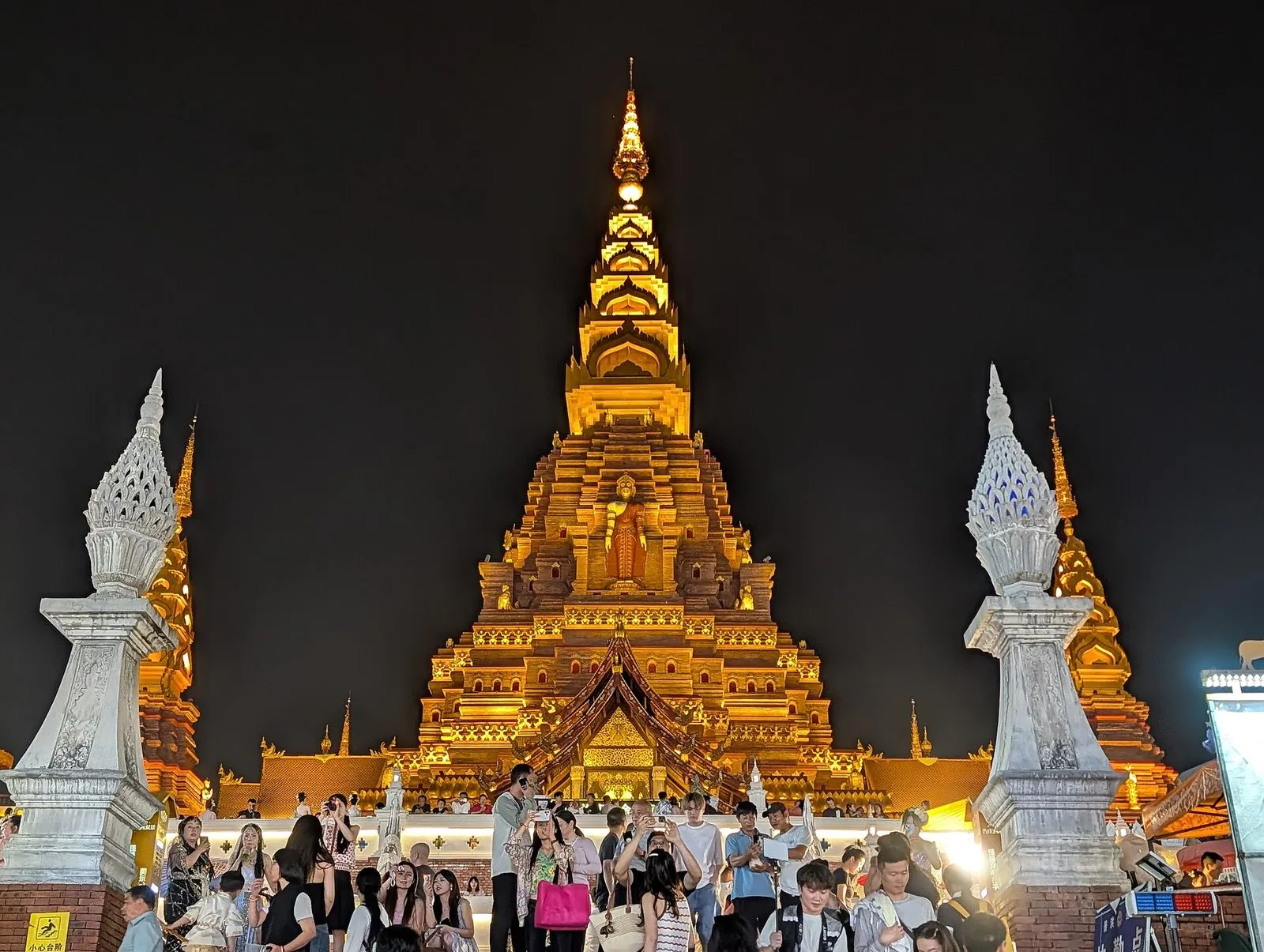
Land at Gasa Airport, 5–8 kilometers from downtown, and take a 15–20 minute taxi or DiDi into Jinghong for roughly ¥30–40; the railway station sits about 10 kilometers out, with taxis around ¥15–40 and a local shuttle. Check in near the riverfront, then spend the late afternoon at Manting Park (¥40, open 8:00–18:00, last entry 17:00), where the 1,300-year-old royal garden and the working Zongfo Temple share one ticket. At dusk, walk or ride 10 minutes to Gaozhuang Xishuangjing for the lantern light-up, then graze the Starlight Night Market — grilled river fish, pineapple rice, coconut desserts — for ¥30–80. Entry is free; bring Alipay or WeChat Pay.
Practical tip: Before dinner, open the official botanical garden mini-program (search 中国科学院西双版纳热带植物园 in WeChat), enter your passport details, and book tomorrow’s ticket.
Day 2: The Tropical Botanical Garden
Spend the day at the Academy of Sciences’ garden at Menglun, about an hour north of Jinghong and the largest tropical collection in China: 900-plus hectares and more than 13,000 species. The west zone packs the spectacle — giant waterlilies, dancing plants, orchid houses — into a compact loop; the east zone is real rainforest with boardwalks. Tickets are ¥80 (students and seniors half price), the west gate opens 8:00–18:00 with last entry 17:30, and entry is by passport via the official mini-program. Electric carts cost ¥50 per zone or ¥100 for a full-garden pass — take the pass. The separate night tour needs its own advance reservation.
Practical tip: Catch an early bus or pre-booked shuttle from Jinghong (about an hour), and buy the ¥100 cart pass with your ticket — walking the whole estate in one day is a false economy.
Day 3: Dai Villages at Ganlanba
Head about 30 kilometers southeast to Ganlanba (Menghan), where bamboo stilt houses, coconut palms and village temples make the classic Dai landscape. The Dai Ethnic Garden collects five villages into one park and runs water-splashing sessions daily — usually around 14:00 and 15:40 — so you can join in November without waiting for April’s festival. Admission is ¥45, plus ¥40 for the shuttle cart that covers the three-kilometer route; budget three to four hours. If you would rather spend the morning with wildlife, swap this for Wild Elephant Valley (entry about ¥60, cableway ¥50 one-way), where wild sightings are luck and the rainforest boardwalk is the reliable draw.
Practical tip: Confirm the day’s splashing times at the gate, join the 14:00 session, and pack a dry bag and a change of clothes — everyone gets soaked. Catch the last bus back before dark.
Practical Notes
Getting there
C/D trains on the China-Laos Railway run from Kunming and Kunming South to Xishuangbanna station in roughly 3.5–4.5 hours; second class costs about ¥180–250 depending on train and date. Buy through the 12306 app or Trip.com using your passport. Flights from Kunming take about an hour and often cost US$80–130 one-way; see our domestic flights guide for booking.
From Xishuangbanna station, a taxi to the riverfront runs roughly ¥15–40, or take the local shuttle for a few yuan. Gasa Airport is 5–8 kilometers from downtown and a ¥30–40 taxi ride. Within Jinghong, DiDi hops between Gaozhuang, Manting Park, and the night market cost about ¥10–20; set up Alipay before you arrive, because almost nothing takes cash.
Where to base yourself
Stay central, between Manting Park and Gaozhuang, where you can walk to the night market and reach both the bus station and the sights easily. Book ahead for the November–March dry season and months ahead for the mid-April Water-Splashing Festival, when rooms multiply in price; see our hotels and booking guide for how Chinese booking platforms work.
Budget
Mid-range travelers should budget roughly US$60–100 per person per day (about ¥430–720), covering a comfortable room, three meals, local transport, and one paid attraction. That makes three days roughly US$200–300, excluding trains or flights to Xishuangbanna. Festival weeks and Chinese public holidays run higher.
For the full city guide, see Xishuangbanna.
Sources & verification (15)
- https://www.gaotie.com.cn/lieche/kunming-xishuangbanna.html
- https://my.trip.com/guide/train/kunming-to-xishuangbanna-train.html
- https://www.news.cn/world/2023-04/13/c_1129521115.htm
- https://www.xtbg.ac.cn/2022/ykfw/ryxz/202210/t20221015_6531591.html
- https://www.xtbg.ac.cn/2022/ykfw/dzsw/202211/t20221117_6550332.html
- https://yunnanjourney.com/xishuangbanna-tropical-botanical-garden-chinese-academy-of-sciences/
- https://travelchinawith.me/attractions/yunnan/xishuangbanna/wild-elephant-valley/
- https://www.travelchinaguide.com/attraction/yunnan/jinghong/manting-park.htm
- https://chinafootprints.com/xishuangbanna/xishuangbanna-starlight-night-market
- https://chinafootprints.com/xishuangbanna/xishuangbanna-dai-garden
- https://www.chinatour101.com/2026/06/xishuangbanna-travel-guide-2026/
- https://chinamustsee.com/posts/2026-08-17-xishuangbanna-tropical-yunnan/
- https://www.flights.com/lp/flights/kmg/jhg/kunming-to-jinghong
- https://www.budgetyourtrip.com/china/jinghong/expensive-1785710
- https://www.rome2rio.com/s/Xishuangbanna/Jinghong