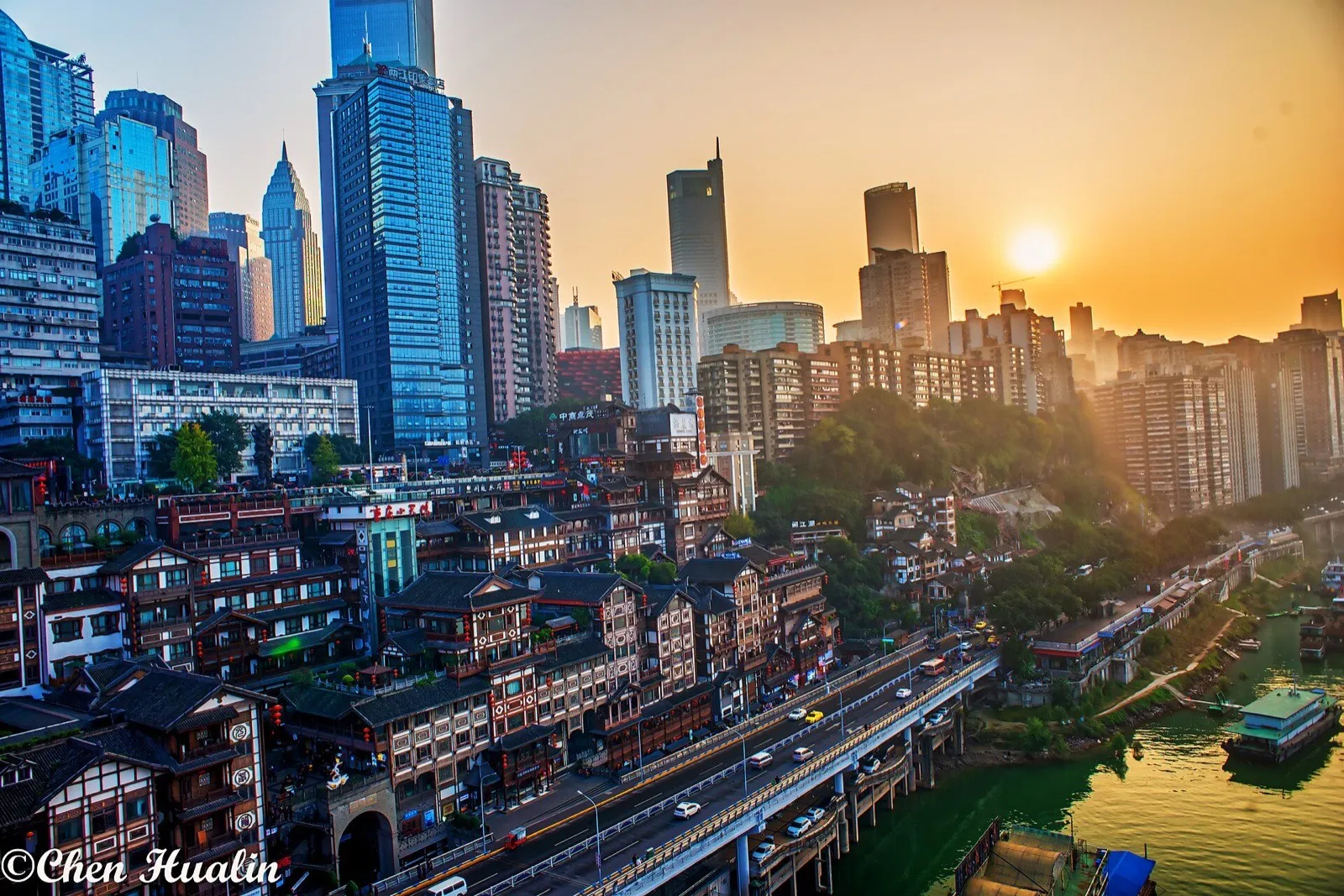
Chongqing is the city that broke the internet: a vertical metropolis of 30 million where monorails thread through apartment blocks, stilt-towers glow gold above the Jialing River, and the night skyline has made it China's social-media darling. The terrain is the story — a steep peninsula at the meeting of the Yangtze and Jialing rivers, stacked with bridges, stairs, and cable cars — and it shapes everything you will do, from the Hongya Cave photo ritual to the ten-minute walk that takes thirty. Between viewpoints, ride the Yangtze cable car, wander the porcelain-port lanes of Ciqikou, and day-trip to the UNESCO-listed Dazu Rock Carvings. Then there is hotpot: born on these docks, defended against Chengdu's rival claims, and best eaten in a basement full of locals. This guide covers the essentials for a well-planned two to three days.
Top sights at a glance
No. 1
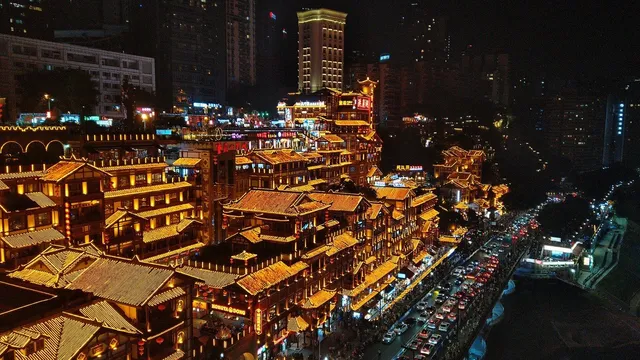
Hongya Cave
An eleven-story stack of golden stilted houses built into a cliff above the Jialing River, Hongya Cave is the image that made Chongqing go viral. By day it is a busy retail complex; at night, when thousands of lights come on, it becomes something out of a Studio Ghibli film — visitors constantly compare it to the bathhouse in Spirited Away. The classic view is actually from the Qiansimen Bridge across the river, not from inside the complex itself.
Good to know · Entry is free, and no reservation is usually needed on weekdays as of September 2026 — around Chinese public holidays, claim the free timed slot via the official WeChat mini-program in advance. Lights typically run from about 6:30–7:30 p.m. until 10–11 p.m., varying by season. For photos, walk out onto Qiansimen Bridge; Metro Line 1 to Xiaoshizi is the closest station.
No. 2
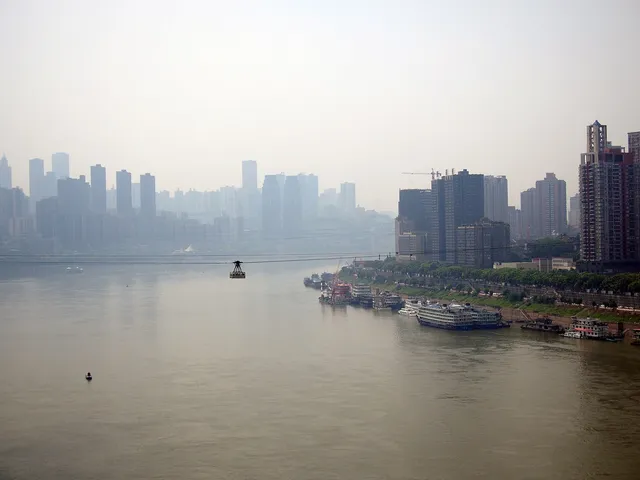
Yangtze River Cableway
Chongqing's surviving river cable car dates from the late 1980s, when it carried commuters across the Yangtze; today it carries travelers on a four-minute glide between skyscrapers, shipyards, and apartment towers stacked up the far bank. The north station sits on Xinhua Road in Yuzhong district; the south station is across the river in Nan'an. It is part transit relic, part theme-park ride, and one of the best-value views in China.
Good to know · Tickets cost 20 yuan one-way or 30 yuan round-trip as of September 2026; buy via the official WeChat mini-program and remember to take a queue number at the gate, since staff cannot scan a ticket without one. Go before 9 a.m. to dodge multi-hour queues. Metro Line 1 to Xiaoshizi, then about a ten-minute walk to the Xinhua Road station.
No. 3
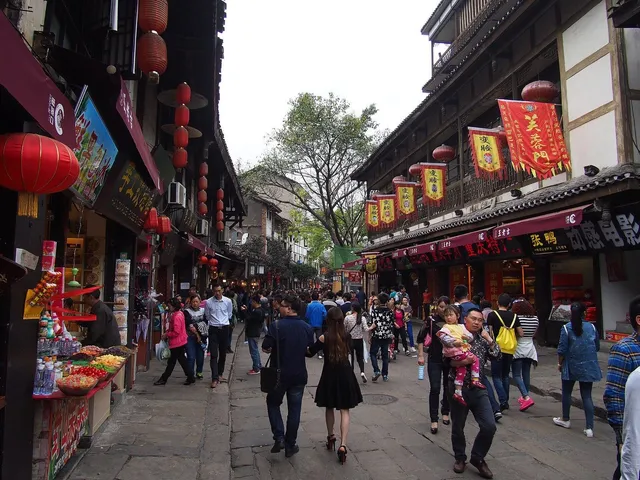
Ciqikou Ancient Town
A porcelain-trading port on the Jialing River with roots going back about a thousand years, Ciqikou packs Ming-and-Qing-style streets, teahouses, snack stands, and temple courtyards into a walkable old town at the edge of the city. It is free to enter, twenty minutes by metro from downtown, and famously crowded — go early on a weekday. The riverside teahouses and the freshly fried dough twists are why locals still come.
Good to know · Free entry, open all day; shops mostly run from 9 a.m. to 9 p.m. Metro Line 1 to Ciqikou station is a short walk from the main gate. Weekday mornings are calm, weekends are shoulder-to-shoulder, and the side stair-streets toward the river are quieter than the main drag.
No. 4
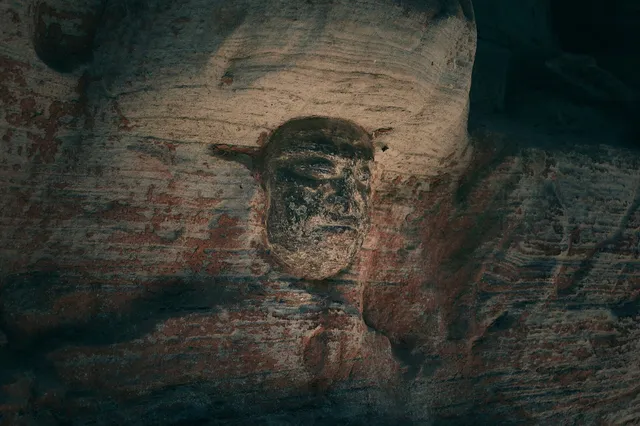
Dazu Rock Carvings
Two hours from downtown, the UNESCO-listed Dazu Rock Carvings are among China's greatest rock-art sites: tens of thousands of Buddhist, Taoist, and Confucian figures chiseled into cliff faces from the Tang and Song dynasties. The Baodingshan section is the unmissable one — a monumental reclining Buddha and the astonishing Thousand-Hand Guanyin, restored in gold — and the on-site museum is genuinely excellent. It is a full-day trip, but an easy and deeply rewarding one.
Good to know · Baodingshan admission runs about 115 yuan including the museum and site shuttle as of September 2026; a combined ticket with the Beishan section is roughly 140 yuan depending on season — check current prices before you go. Get there by direct bus (about two hours from Chongqing's main bus stations) or high-speed rail to Dazu South station plus taxi, and start early to stay ahead of tour groups. Pay on site with Alipay or WeChat Pay.
No. 5
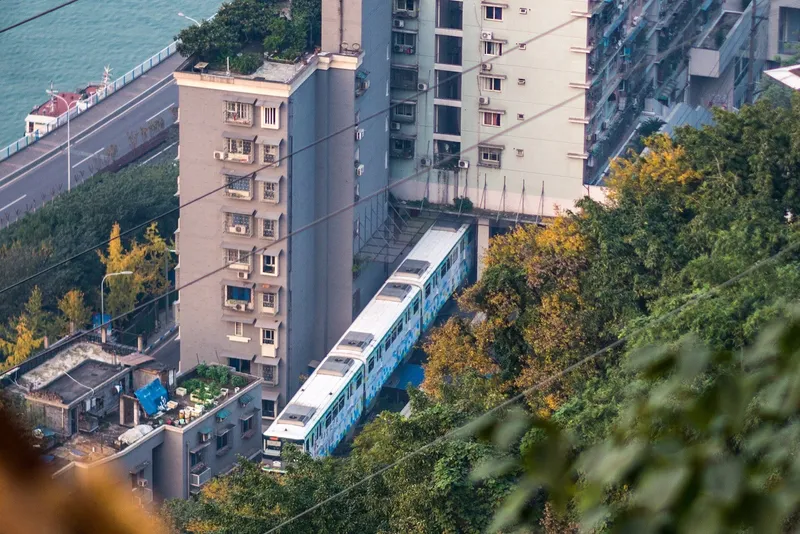
Chongqing's Mountain City Terrain
Chongqing's defining attraction is its geography. The city core occupies a steep peninsula between the Yangtze and Jialing rivers, and roads, buildings, and metro lines stack on top of one another in ways no flat city attempts. At Liziba, Metro Line 2 drives straight through the sixth-to-eighth floors of a residential tower; elsewhere, escalators, elevators, and sky bridges function as public streets. Accept that a 500-meter walk on the map may involve ten flights of stairs.
Good to know · Ride Line 2 to Liziba and watch from the official viewing platform below the tracks; trains pass every few minutes. The full Line 2 monorail loop doubles as a cheap skyline tour — grab a window seat. For the classic two-river panorama after dark, head to a viewpoint in the Nanshan hills across the Yangtze.
See it in motion
Some places earn a moving picture
Stills can't show how this place moves — the drift, the light show, the crowd flow. We picked a recent, high-quality walkthrough rather than a promotional cut.
Hongyadong at Night - Chongqing's Golden Cliffside View (4K HDR)
VIRTUAL CHINA · YouTube · plays on click
Embedded via YouTube's official player (privacy-enhanced mode). Video: Hongyadong at Night - Chongqing's Golden Cliffside View (4K HDR) by VIRTUAL CHINA. Not affiliated with China Travel Copilot; screened for quality and accuracy on 2026-09-28.
At night, Chongqing does not look entirely real. Golden stilt-towers hang above the Jialing River, monorail trains glide past apartment windows halfway up their floors, and the skyline climbs the valley walls in stacked neon. Clips of this city have collected billions of views on TikTok and Instagram, and standing on Qiansimen Bridge at dusk you will stop questioning why. But Chongqing is more than a screensaver: it is a working municipality of over 30 million people, with a fiery food culture, a dramatic wartime past, and terrain that will humble your fitness tracker. Give it two to three days, wear real shoes, and prepare to walk further vertically than horizontally.
A Bit of History
Chongqing’s story begins with the Ba kingdom, whose river people settled the Yangtze–Jialing confluence more than two millennia ago; the city received its present name, meaning “double celebration,” in 1189 after the prince who had ruled here became emperor. Opened as a treaty port in 1891, it industrialized early on river trade, steamships, and the export of Sichuan’s goods downriver to the coast. By the 1930s it was the commercial capital of the southwest, its docks jammed with salt, cloth, and an army of bamboo-pole porters.
Its defining century was the twentieth. When Japan’s invasion drove the Nationalist government from Nanjing in 1937, Chongqing became China’s wartime capital, absorbing refugees, universities, and factories that escaped up the Yangtze. Japanese bombers flattened neighborhoods for five years; the city dug in — literally, in air-raid caves — and held, and the resistance became central to its modern identity. General Joseph Stilwell ran the China theater from here, and the wartime alliance with the United States still surfaces in museum halls around town.
After 1949 came heavy industry, then in 1997 a promotion to China’s fourth directly administered municipality, created in large part to administer the vast Three Gorges Dam resettlement — well over a million people moved, many through or to Chongqing. The municipality grew to roughly the size of Austria — stretching from downtown towers to Yangtze gorge towns hundreds of kilometers away — even though the urban core is compact enough for a short visit. The city became the laboratory of western-China development: bridges by the dozen, monorails, and a skyline that rebuilt itself every few years.
Then social media found it. In the late 2010s, Hongya Cave, the Liziba train-through-building, and the impossible road stacks turned Chongqing into one of China’s most-photographed cityscapes — a reputation that now shapes the visitor experience, for better (stunning night scenes) and worse (weekend crowds at the viewpoints). Domestic tour groups now arrive with “cyberpunk city” printed on the itinerary. The oldest layers, Ba tombs and Song walls, take some effort to find. The newest layer, neon on water, announces itself nightly.
Culture & Daily Life
Chongqing’s character is the product of rivers, hills, and heat. The city is nicknamed the Fog Capital for the mist that steams off its rivers much of the year, and it is routinely listed among China’s “furnace cities” in summer, when life shifts decisively to the night. Because flat land was scarce, the city built vertically: housing on cliff faces, stairs as public streets, cable cars and long escalators as ordinary commuter infrastructure. Generations of porters — the bangbang army, hauling loads on bamboo poles up the slopes — became a civic symbol; their numbers are shrinking, but you may still meet one on the stair-streets below Chaotianmen.
The temperament is famously direct. Locals speak a fast, lilting dialect, and the Chengdu–Chongqing rivalry is the great in-joke of the southwest, usually summarized as: Chengdu sips, Chongqing devours. Hotpot is the social glue — boiling, communal, and loud — and night-viewing is close to a civic ritual. On any clear evening, crowds gather at platforms on both rivers simply to watch the city light up; nobody seems to tire of it.
For travelers, this culture is unusually easy to join. Ride the river ferries, sit in a riverside teahouse, eat where the menu is laminated and the clientele is local. Mandarin helps; English is thinner here than in Shanghai or Beijing, and a translation app smooths most gaps.
Morning has its own rituals: tai chi on the river steps, noodle shops steaming open at dawn, commuters riding long outdoor escalators up the cliffs with the unreadable calm of people who have done it all their lives. The one daily-life warning: give your feet more credit than your map does. A “ten-minute walk” in Chongqing can mean ten minutes of stairs and overpasses, and locals will nod sympathetically when you say so.
Nature & Day Trips
The headline excursion — the UNESCO-listed Dazu Rock Carvings — gets its own section below, and it deserves the full day it demands. Beyond Dazu, Chongqing’s surroundings are mountain country. The Wulong Karst, a UNESCO site of limestone gorges and the colossal Three Natural Bridges, sits roughly two and a half hours away and works as a long day trip or an overnight; tickets are reservation-based and sell out on peak days. Bring layers — the gorges run several degrees cooler than downtown — and expect the walk into the gorge to be easier than the walk out, though a shuttle shortens the climb. Closer in, the Nanshan hills across the Yangtze hold the classic night-view platforms, and Jinyun Mountain offers forest hiking about an hour to the north.
The river itself is the region’s grandest natural feature. Chongqing’s Chaotianmen docks, at the two-river confluence, are the main boarding point for Three Gorges cruises running downstream to Yichang — typically three to four days through the gorges and the dam’s ship locks, one of the great slow journeys in Asia. Book cabins through reputable operators, and note that water levels and schedules shift seasonally. Within the city, the riverside promenades on both banks double as the best free walk in southwest China — especially after dark.
Food & Drink
Chongqing hotpot is the city’s calling card, and its origin story is delightfully unglamorous. In the late nineteenth century, dock porters around the Yangtze wharves bought cheap water-buffalo offal and simmered it in shared pots of chili broth; the dish climbed from the docks to restaurants, and Chongqing has feuded with Chengdu over hotpot bragging rights ever since. Chongqing’s version is the maximalist one: a dark beef-tallow broth thick with chilies and Sichuan pepper, offal front and center, “nine-grid” pots for the devoted. First-timers should order a divided yuanyang pot, cook thin-sliced beef and vegetables at their own pace, and dip the pieces in sesame oil with garlic. Expect roughly 80–120 yuan per person.
The daytime canon is just as strong. Xiaomian — the city’s small-noodle breakfast, tossed with chili, peanuts, and pickled mustard greens — costs 12–18 yuan and fuels the municipality; once you have found your spice ceiling, order it “dry-tossed” (gan liu) for maximum flavor per bite. Add hot-and-sour glass noodles (suanlafen), Wanzhou-style grilled fish, street BBQ, and night markets. One calibration: even “mild” (wei la) in Chongqing is genuinely hot by Western standards; “clear broth” (qing tang) is the actual escape hatch, not a polite medium. To recover, order smashed cucumber salad or sweet ice jelly (bingfen) at any stall.
Where to eat matters more than what. The streets around Jiefangbei hide serious old-school hotpot basements down unmarked stairwells — if a place is packed with locals at 9 p.m., you have found it. Ciqikou is good for grazing, though priced for foot traffic. If you want a breather between rounds of spice, the city’s old teahouses pour good green tea, and the riverside coffee scene has grown fast; the peninsula’s arcade streets hide both. As everywhere in China, small restaurants are cashless-first, so have Alipay or WeChat Pay ready. And pace yourself: Chongqing food punishes the greedy and rewards the steady.
Top Sights
Hongya Cave
An eleven-story complex of golden stilted houses built into the riverbank cliff, Hongya Cave is Chongqing’s signature image and the single most photogenic spot in the city. By day it is a cramped retail maze — fine for snacking, not much more. By night, when the lights come on, it justifies the trip: thousands of amber bulbs tracing every eave of the stacked towers above the Jialing River, scenes that visitors endlessly compare to the bathhouse in Miyazaki’s Spirited Away. The essential move is not inside the building but across the water — walk out onto Qiansimen Bridge and look back, or shoot from the far riverbank. Expect dense crowds on weekend evenings and Chinese holidays, and give yourself an hour to absorb it at street level too, where the stilted architecture is easiest to appreciate up close. The crowds thin noticeably after the lights start switching off, so a late dessert stop in the complex’s alleys is its own reward.
Yangtze River Cableway
Before the bridges, this cable car was how ordinary Chongqing residents crossed the Yangtze; the line opened in the late 1980s as commuter transit and survives today as one of the city’s most beloved experiences. The four-minute crossing, about a kilometer of cable suspended above the river between the Yuzhong towers and the hills of Nan’an, delivers a slow-motion aerial tour of the skyline, the shipyards, and the apartment blocks stacked to the waterline. Stand at a window, not the middle — half the ride is watching the city itself rotate past. Practicalities matter here more than romance: queues stretch for hours on weekends and holidays, tickets are bought through the official WeChat mini-program, and you must take a queue number at the gate for staff to scan. Go early in the morning, ride one way toward Nan’an, and return by metro across one of the river bridges for a second, different view of the same water.
Ciqikou Ancient Town
A thousand years ago, this riverbank settlement shipped porcelain down the Jialing; today its Ming-and-Qing-style lanes ship snacks, tea, and souvenirs to several million visitors a year. Strip away the crowds and Ciqikou still earns its stop: grey-brick gates, teahouses with Sichuan opera in the back rooms, monks’ incense at the temples, and riverside terraces that recall the port it once was. The freshly fried dough twists, cracked loud by vendors with wooden mallets, are the local icon — buy one warm. It is free to enter and barely twenty minutes from downtown by metro, which is both the appeal and the problem. Allow two unhurried hours, more if you stop for tea; the town is small but the stairs add up. Visit on a weekday morning, arrive when the shutters open, and walk the quieter stair-streets toward the river; by late morning the main lane turns shoulder-to-shoulder and the charm thins out.
Dazu Rock Carvings
The best day trip in western China, and the sight that justifies adding a day to your Chongqing plans. Beginning in the Tang dynasty and peaking in the Song, craftsmen carved tens of thousands of figures into the cliffs around the district of Dazu — Buddhist, Taoist, and Confucian scenes unlike anything else in Chinese religious art. The Baodingshan section is the masterpiece: a grotto corridor of Song-dynasty tableaus culminating in a monumental reclining Buddha and the Thousand-Hand Guanyin, a wall of gilded hands radiating behind the goddess of mercy, painstakingly restored over eight years and unveiled in 2015. The on-site museum ranks among the best in China. Allow half a day at the site itself — the shuttle between gates, the museum’s exhibits, and the slow read of each grotto deserve the time. As a UNESCO World Heritage site since 1999, Dazu draws tour groups, so start early — but even shared, it is quieter and far more moving than most headline sights in the country.
Chongqing’s Mountain City Terrain
Give the geography itself a slot in your itinerary — it is the show. The Yuzhong peninsula wedges between the Yangtze and Jialing rivers, and the city climbs its slopes in layers: roads that pass over rooftops, an eight-story building whose roof is a public plaza, metro lines swinging between towers. At Liziba station, Line 2’s monorail threads directly through the sixth-to-eighth floors of a residential building, engineered so cleanly that residents barely hear it; an official viewing platform below catches the moment trains vanish into brick. Elsewhere, sky bridges connect hillsides, long public escalators replace staircases, and a “ground floor” depends entirely on which street you started from. The terrain explains the city’s quirks too: why Chongqing is nicknamed China’s bridge capital, why hotpot runs heavy on offal, and why the night view beats the day view. Rely on the metro, budget double the walking time your app suggests, and let yourself get lost once — in Chongqing, wrong turns are the sightseeing.
Getting There & Around
Chongqing Jiangbei International Airport (CKG) sits north of the city; Metro Line 3 or 10 reaches downtown in about 40 minutes, and a DiDi ride runs roughly 30–60 yuan depending on traffic. Rail is the main intercity link: the Chengdu–Chongqing corridor runs trains almost continuously, one to two hours door to door, second class from around 154 yuan. Watch station names carefully — Chongqing North, Chongqing West, and the newer Chongqing East serve different lines, and a wrong guess can cost half an hour across this terrain.
The metro network is superb, and the Line 2 monorail doubles as a sightseeing ride; fares run 2–7 yuan and gates accept Alipay and WeChat Pay. DiDi is cheap, metered taxis are honest, and river ferries survive as slow, scenic bargains. The big caveat is walking: mapping apps measure horizontal distance, and Chongqing lives vertically. A 500-meter straight line can mean staircases, sky bridges, and major level changes — use transit for anything uphill and double the expected time for anything on foot.
Where to Stay
Three bases work well. Jiefangbei, the central peninsula CBD, is the first-timer default: walkable to Hongya Cave, plugged into the metro, surrounded by food at every price, with the widest hotel choice — busy, but unbeatable for a two-night stay. Across the Yangtze, the Nan’an riverside (Nanbin Road) gives you the postcard in the other direction: rooms and rooftops facing back at the Yuzhong skyline, quieter streets, and easy access to the night-view platforms. North of the Jialing, Guanyinqiao is the local’s choice — a big shopping and food district with better-value hotels and a far less touristy feel, at the cost of a metro ride to the main sights. Whatever you pick, stay within walking distance of a station: in this terrain, proximity to a metro stop matters more than the hotel’s star rating. On holiday weekends everything books out early, so reserve rooms and train seats together.