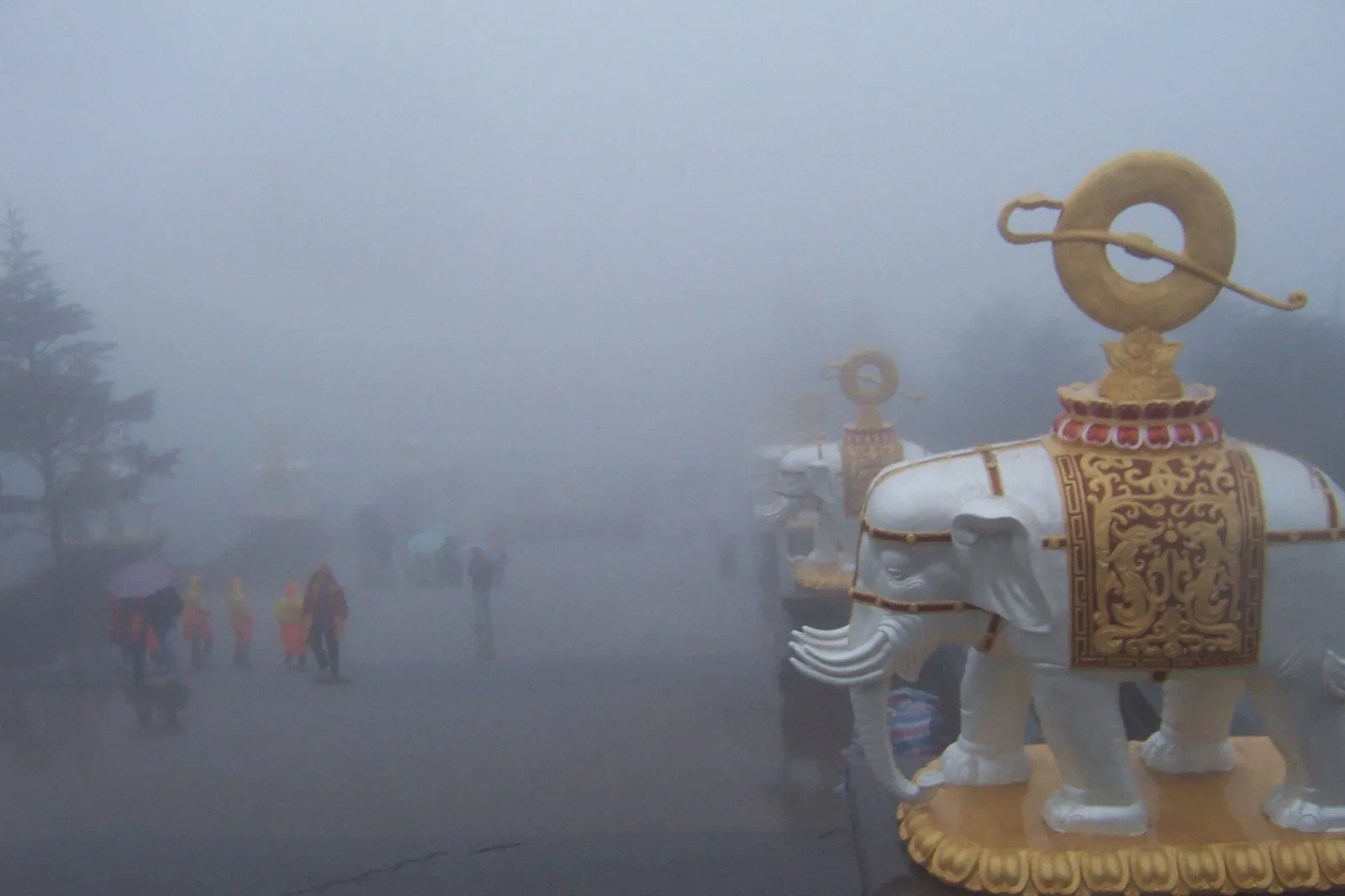
One hour south of Chengdu by high-speed train, two of China's most remarkable UNESCO World Heritage sites share a single valley: the 71-meter Leshan Giant Buddha carved into a river cliff, and Mount Emei, one of the country's four sacred Buddhist mountains, whose Golden Summit floats above the clouds at around 3,079 meters. Most visitors cram both into one exhausting day trip from Chengdu and see neither properly. The smarter move is to sleep here for two or three nights — ride the cable car up for sunrise above a sea of clouds, walk the forested temple trails below the cloud line, and eat through Leshan, one of Sichuan's great food towns, where locals queue for sweet-skin duck and bobo chicken that Chengdu residents carry home by the box. This guide covers the tickets, the 2026 construction-era booking rules on the mountain, the monkeys, and how to split the days.
Top sights at a glance
No. 1
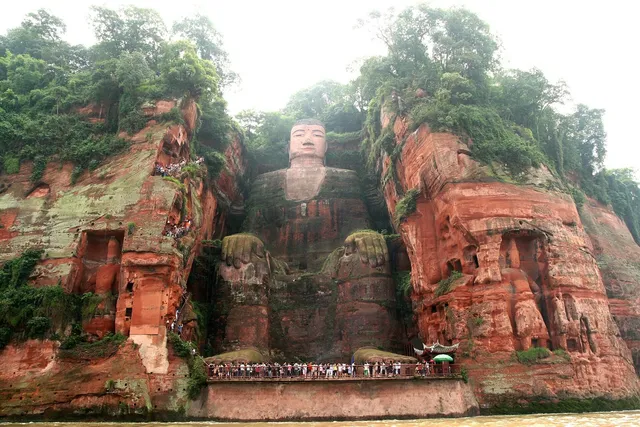
The Leshan Giant Buddha
A 71-meter seated Maitreya Buddha carved into a cliff where three rivers meet, begun in 713 by a monk who believed a Buddha would calm the dangerous confluence, and finished roughly 90 years later. It is the largest pre-modern stone statue on Earth, and its hidden drainage system still works. Seen from the river, the whole figure reads at once; from the top of the cliff you descend a narrow Tang-era stairway, single file, to stand between its toes.
Good to know · Entry costs 80 yuan as of September 2026, sold real-name against your passport up to 30 days ahead via official channels or Trip.com; book the earliest slot. Peak-season hours run about 7:30 a.m. to 6:30 p.m. (April 1–October 7), shorter in winter. The boat costs 70 yuan separately and needs no park ticket — take the boat first, then decide whether the stairway queue is worth it.
No. 2
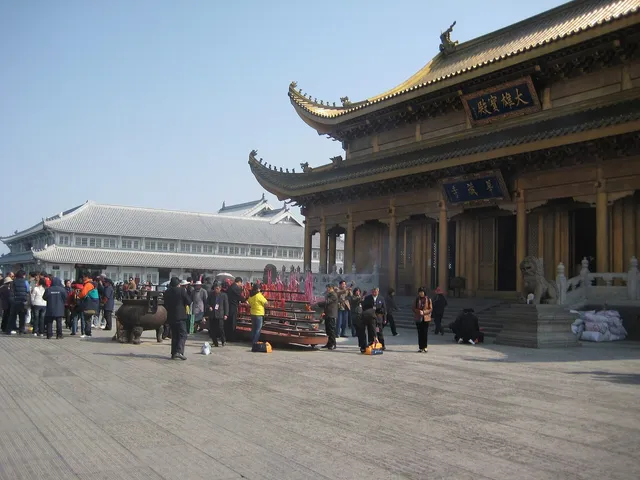
The Golden Summit
At 3,079 meters, the Golden Summit (Jinding) is the payoff of Mount Emei: a terrace of golden-roofed halls beside a 48-meter gilded statue of the Bodhisattva Puxian facing ten directions, above a sea of clouds that swallows the valleys whole. Sunrise, the cloud ocean, Buddha's halo, and the rare 'saint lamps' are the mountain's four spectacles. Reaching it means a roughly two-hour scenic bus ride, a stone path through monkey territory, and a short cable car.
Good to know · As of September 2026, renovation of the Golden Summit cableway and Leidongping bus station caps the summit at 8,000 entry slots per day through 2027 — book the entry, bus, and cableway together in advance on the official Emeishan WeChat mini-program with your passport, paying with Alipay or WeChat Pay. Mountain buses run on reserved time slots. The cableway runs 65 yuan up and 55 yuan down in high season.
No. 3
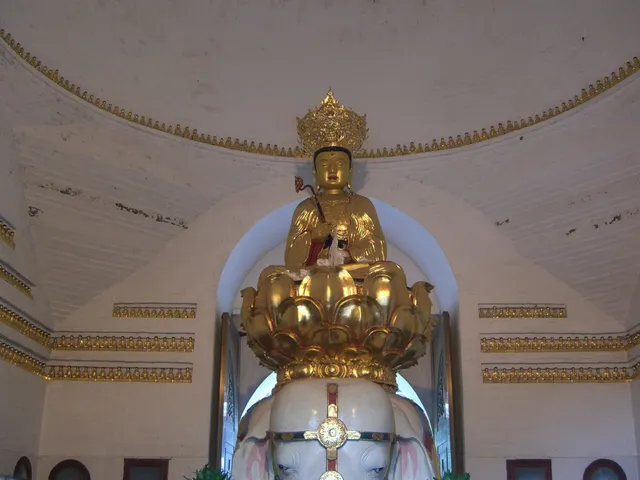
Wannian Temple
Mount Emei's oldest great temple, founded around 400 AD and rebuilt again and again after fires and lightning. Its star is the Beamless Brick Hall, raised in 1601 without a single wooden beam, and inside it a towering Song-dynasty bronze statue of Puxian riding a six-tusked white elephant — the image this mountain has been pilgrimaging toward for a thousand years. The temple sits at the top of its own cable car, which makes it the best mid-mountain anchor on a foggy day.
Good to know · The temple charges 10 yuan on top of the mountain ticket as of September 2026; the Wannian cableway runs 65 yuan up and 45 yuan down in high season. Come via cable car and walk down the trail toward Qingyin Pavilion — downhill, forested, and far quieter than the Golden Summit route. Temples generally welcome visitors from early morning to late afternoon; confirm locally.
No. 4
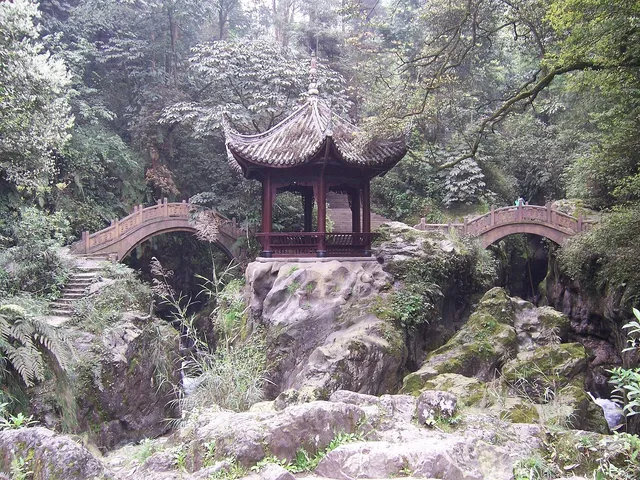
Qingyin Pavilion
Where two streams meet beneath old pavilions, Qingyin Pavilion is the most graceful spot on the mountain's lower slopes — black stone bridges, splitting water, and a sound locals compare to played music. The trail from Wannian Temple drops through bamboo and old-growth forest to reach it, passing the ecological monkey zone where the mountain's Tibetan macaques hold court. On days when the summit is socked in fog, this mid-mountain world is the better mountain.
Good to know · Included in the mountain entrance ticket; no separate booking. Watch your bags here — macaques work this stretch, so seal food in your pack and never open a plastic bag in front of them. Vendors sell bamboo walking sticks for a few yuan. Combine with Wannian Temple as a half-day loop from the Wannian cableway station.
No. 5
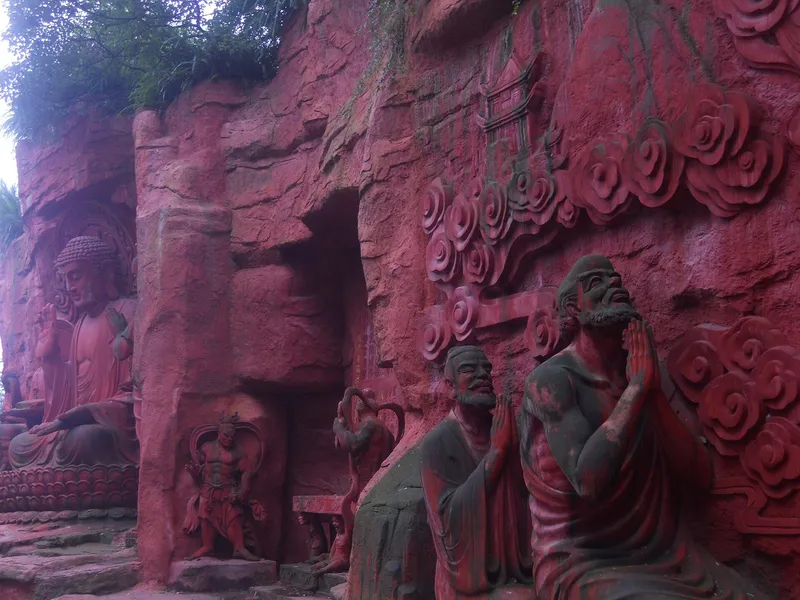
Baoguo Temple
The gateway temple at the mountain's foot, where every bus, ticket line, and pilgrimage begins. First built in the early 1600s and repeatedly rebuilt since, Baoguo is an active monastery of serene courtyards, bonsai gardens, and a hall holding a giant porcelain Buddha — a calm first evening's walk when you arrive from Chengdu, with the peaks stacked dark above. The scenic area's visitor center and bus station stand right beside it.
Good to know · Admission is 8 yuan as of September 2026, payable with Alipay or WeChat Pay; the scenic-area ticket office and the mountain buses depart from the visitor center here. Visit after dusk when the courtyards are lit and quiet. It is also the practical base for buses to Leidongping — confirm your reserved bus slot here the evening before.
An hour south of Chengdu, the Sichuan Basin bunches up into one of the densest concentrations of wonder in China. At the bottom sits Leshan, a river city with a 71-meter Buddha carved straight into a cliff; at the top stands Mount Emei, one of China’s four sacred Buddhist mountains, its Golden Summit riding above the clouds at around 3,079 meters. They share a single UNESCO World Heritage listing from 1996, and a high-speed rail line connects the whole valley to Chengdu in under an hour. The mistake most travelers make is doing both in one day — doable, but you will remember the bus seats, not the Buddha. Give the valley two or three nights: a dawn cable car above a sea of clouds, temple trails under old-growth forest, monkeys working the crowds, and a food scene Sichuan itself takes seriously.
A Bit of History
The Buddha came first. In 713, a monk named Haitong looked at the churning confluence of the Min, Dadu, and Qingyi rivers at Leshan — water that capsized the trading boats of his day — and decided the answer was faith on a monumental scale: a Maitreya Buddha carved into the cliff to calm the waters. He raised funds for twenty years and died long before the work was done; disciples and military governors carried it on, and the statue was completed in 803, roughly ninety years after it began. The engineering was as serious as the devotion: a system of hidden drainage gutters carved into the statue’s body still sheds rainwater today, which is why a soft sandstone Buddha has survived twelve centuries.
Mount Emei’s story is older. Buddhist temples began appearing on its slopes as early as the first century AD, and by the Song dynasty the mountain had settled into its role as the bodhimanda — the earthly seat — of the Bodhisattva Puxian, who rides a six-tusked white elephant. Wannian Temple was founded around 400 AD; its Song-era bronze Puxian survives in a Ming-dynasty brick hall built without beams. At its height the mountain held dozens of monasteries, stitched together by pilgrim paths — stone stairs, arched bridges, teahouses — across some 50 kilometers of slopes, much of it still walkable.
For centuries the two sites drew different crowds — merchants to the Buddha, pilgrims to the mountain — until the modern chapter welded them together. In 1996, UNESCO inscribed Mount Emei and the Leshan Giant Buddha as a single mixed World Heritage site — recognized for both culture and nature, a rare double listing in China. Cable cars and hotels followed; what has not changed is the hospitality — the mountain still feeds and lodges pilgrims, the temples still ring their bells at dawn.
Culture & Daily Life
Mount Emei is a working religious mountain, not a museum. Monks chant behind the halls while tour groups file past; temple courtyards double as tea gardens; on lunar holy days the incense burners run shoulder-high. Pilgrims still climb — some prostrating themselves every third step, a humbling thing to meet on a narrow stairway — and the monastery guesthouses that bed them down for 40 to 80 yuan a night will happily take you too. Stay in one if you can: thin walls, early bells, plain vegetarian food, and the mountain to yourself at the hours that matter.
The monkeys are the mountain’s other culture. Tibetan macaques — big, confident, and thoroughly habituated — concentrate in the ecological monkey zone near Qingyin Pavilion and along the path between Leidongping and the Golden Summit cable car. The advice from every recent report converges: zip all food deep into your bag before they see it, never rustle a plastic bag in their presence, keep phones gripped, and give mothers with babies a wide berth. Vendors sell bamboo poles for a few yuan.
Down in the valley, daily life runs on food and a relaxed Sichuan tempo — mahjong in doorways, tea in the parks, an eating calendar that stretches from noodle breakfast to late-night skewers. Leshan’s food streets belong to locals; you will see more construction helmets than selfie sticks at lunchtime. English is thin throughout the valley — the price of being off the first-timer circuit — but payment is frictionless, DiDi works everywhere, and the ticket infrastructure is more organized than the language gap suggests.
Nature & Day Trips
The valley’s nature is why UNESCO added the word “natural” to the listing. Mount Emei spans nearly everything a subtropical mountain can offer: old-growth forest on the lower slopes, bamboo and rhododendron in the middle, and a cold, misty montane zone at the top where the trees give up. The biodiversity is serious — the mountain shelters rare species from golden cats to red pandas, though hikers mostly meet the macaques, songbirds, and summer butterflies on the Qingyin trails. Azaleas bloom high on the mountain in May and June; autumn color peaks in October. The summit itself is a weather event. On a clear day the Golden Summit looks out over an ocean of clouds with snowy peaks on the far horizon; the “Buddha’s halo” — your own shadow ringed in rainbow light on the cloud deck below — appears on a handful of afternoons a month. Check the mountain’s live webcam before committing a morning to the summit bus; if the top is socked in, spend the day below the cloud line instead, where the forest is beautiful in any weather.
Day trips run on the same rail line: Chengdu, 45 minutes to an hour away, holds the pandas and the teahouse parks. Honestly, the valley’s own walks — the Wannian-to-Qingyin loop, the summit terraces, Leshan’s riverside parks — are enough nature for a long weekend; lake scenery is a separate trip.
Food & Drink
Leshan eats above its weight class, and Sichuan knows it. The city is famous twice over — once for the Buddha, once as the town Chengdu residents ride the train to for lunch — and the flavor differs from Chengdu’s: the chili runs colder and oilier, the red oil more patient. The headline dish is sweet-skin duck (tianpi ya), brined, fried, and painted with molten maltose so the skin sets into a caramel shell; buy it by the half from a counter that glazes in real time and eat it standing up. Bobo chicken — cold skewers of chicken and vegetables marinating in red oil inside ceramic pots — is the other essential, along with qiaojiao beef, a ginger-and-pepper broth served with a stool cut into the table so you can rest a leg while you eat.
The place to run this gauntlet is Zhanggongqiao food street, a canal-side stretch that becomes the city’s open-air dinner table after dark: duck counters, bobo pots, grilled skewers, and ice jelly — a cool, lemon-scented dessert under brown-sugar syrup — to put the fires out. The crawl has a rhythm: duck first while the skin crackles, pots mid-evening, jelly to finish, and a street still half-full at 10 p.m. Budget 40–80 yuan per person; whole ducks pack neatly into boxes for the train home, which is exactly what the Chengdu commuters around you will be carrying.
On the mountain, expectations should adjust: temple kitchens serve filling vegetarian meals at pilgrim prices, and the guesthouse restaurants at Leidongping and the summit are functional rather than memorable. Eat your best meals in Leshan, stock sealed snacks for the mountain, and treat a temple lunch as part of the experience. Everywhere takes Alipay or WeChat Pay.
Top Sights
The Leshan Giant Buddha
The reason the valley makes most itineraries. A 71-meter Maitreya Buddha sits carved into the red sandstone cliff where the Min, Dadu, and Qingyi rivers braid together, begun in 713 and finished in 803 — the largest pre-modern statue on Earth. Experience it two ways, and do both. From the river, sightseeing boats (70 yuan, about 30 minutes, with 10–15 minutes holding position in front of the statue) deliver the full-figure view: the Buddha, two carved guardian warriors flanking the cliff. From inside the park, a walkway descends the Nine-Turn Plank Road — a narrow, single-file Tang-era stairway cut into the cliff — to the platform between the statue’s toes.
The catch is the queue. On busy days between 10 a.m. and 2 p.m., the stairway backs up for an hour or more in direct sun, and holidays can mean a multi-hour wait; the forum advice — never attempt this during Golden Week — is correct. Entry costs 80 yuan as of September 2026, sold real-name against your passport up to 30 days ahead through official channels or Trip.com; the boat is a separate 70 yuan and needs no park ticket. Peak-season hours run roughly 7:30 a.m. to 6:30 p.m. (April 1 to October 7), shorter in winter. The fix is timing: take an early train and be inside the gate before 9 a.m., or flip the day and walk in after 3 p.m. as the coaches leave.
The Golden Summit
Everything on the mountain aims here. The Golden Summit sits at 3,079 meters — high enough that some travelers feel mild altitude effects — and it delivers the mountain’s four spectacles: sunrise, the sea of clouds, the Buddha’s halo, and the rare evening “saint lamps.” Golden-roofed halls, a cliff-edge terrace, and the 48-meter gilded statue of Puxian facing ten directions; clear mornings fill every valley with a cloud ocean. Getting up is a chain — a two-hour scenic bus to Leidongping (2,430 meters), a monkey-country stone path to Jieyin Hall, then a five-minute cable car. In fog the summit is a wet parking lot; mid-mountain is the better day.
Two things changed as of September 2026. The Golden Summit cableway and Leidongping bus station are under renovation expected to last into late 2027; while work runs, the operator caps the summit at 8,000 entry slots a day and limits Leidongping bus tickets to match. Since March 2026 the buses have also run on reserved time slots. In practice you now book the summit like a train: in advance, real-name, against your passport, on the official Emeishan WeChat mini-program with Alipay or WeChat Pay. The cableway costs 65 yuan up and 55 yuan down in high season (30/20 in the December–mid-January low season); the mountain entrance is 160 yuan in high season, 110 in low. If sunrise matters, sleep up here — the first cable car leaves about 20 minutes before dawn.
Wannian Temple
The mountain’s spiritual center of gravity, and the best single temple to spend time in. Founded around 400 AD and rebuilt repeatedly, its surviving glories are two: the Beamless Brick Hall, raised in 1601 on imperial order with a vault that needs no wooden beams, and the Song-dynasty bronze it shelters — Puxian on his six-tusked white elephant, one of the great bronzes of medieval China and the icon this entire mountain is dedicated to. The courtyards around it are quiet enough to sit in, with a teahouse and incense drifting through. The temple anchors the mid-mountain cable car (65 yuan up, 45 yuan down in high season) and charges 10 yuan admission on top of the mountain ticket as of September 2026.
The smart move is a downhill loop: cable car up in the morning, temple, then the forested trail down toward Qingyin Pavilion — old-growth canopy, mossy stairs, and almost none of the summit crowd. On fog days this is simply the better mountain. Allow a relaxed half-day.
Qingyin Pavilion
Two streams, two stone bridges, and a sound the Chinese name turns into music: Qingyin Pavilion is the mountain at its most graceful, where water splits around black rock and the pavilions sit on stilts above the current. It is also the gateway to the ecological monkey zone, where the Tibetan macaques hold daily court — genuinely fun from a distance, provided your snacks are zipped away and you do not wave a plastic bag. The trails radiating from here, through bamboo and old-growth forest, are the best low-altitude walking on the mountain and stay below the cloud line when the summit does not.
There is no separate ticket; the pavilion is included in the mountain entrance as of September 2026. Come as part of the Wannian loop, or as the walking leg of a mid-mountain day. Bring the bamboo stick if your knees vote for it — the stairs are old, worn, and occasionally slick.
Baoguo Temple
The mountain’s front door. Baoguo Temple stands at the foot of the slopes, first built in the early 1600s, where the practical and the spiritual mountain meet: the visitor center, ticket offices, and mountain-bus departure point are all beside its gates, yet inside it is a serene working monastery of symmetrical courtyards, bonsai gardens, and a hall holding a tall porcelain Buddha. Come on your first evening, after the tour coaches have gone, when the lamps come on and the courtyards empty out — the calmest introduction to the mountain you can buy for 8 yuan as of September 2026.
Baoguo is also where the 2026 logistics get untangled: reserved bus slots, the Golden Summit entry cap, and cableway tickets are all confirmed through the official mini-program, and visitor-center staff here can fix a wrong slot faster than any hotline. Stay nearby — the most practical base on the mountain — and walk over the night before your summit day to re-check your booking.
Getting There & Around
The valley sits on the Chengdu–Leshan–Emeishan intercity high-speed line. From Chengdu East or Chengdu South, Leshan is 45 minutes to about an hour (second class around 54 yuan, roughly 70 departures a day), and the line continues to Emeishan station in 60 to 90 minutes total from Chengdu (around 65 yuan). Between the two towns, trains take 11 to 23 minutes and cost 11 to 32 yuan. Book on the official 12306 app or Trip.com with your passport — sales open about two weeks out, and weekend trains genuinely sell out.
At the Leshan end, bus K1 runs from the rail station to the Giant Buddha area in about 30 minutes for 2 yuan; a DiDi takes 20 minutes for 25–30 yuan. At the Emeishan end, city bus 5A or 12 reaches the Baoguo Temple visitor center in about 20 minutes, or a taxi for 10–16 yuan. On the mountain, you are on the scenic-area buses — now running on reserved slots — plus the two cableways; the summit chain is not a walk-up proposition. Everything takes Alipay or WeChat Pay, buses included.
Where to Stay
Split your nights between the two halves of the valley. In Leshan, stay central near the river and Zhanggongqiao food street: walking distance from the night-market crawl, a short DiDi from the Buddha, positioned for the morning train onward. On the mountain, the practical base is the Baoguo Temple visitor-center area: the widest choice of hotels and guesthouses, buses at the doorstep, and restaurants that stay open past temple hours. If sunrise above the clouds is the point of the trip, add a night high on the mountain instead — a monastery guesthouse for atmosphere, a room at Leidongping to shorten the morning, or a summit hotel that lets you walk out the door to the viewing terrace. Monastery beds run roughly 40–80 yuan and sell out in autumn. Wherever you sleep, book ahead for weekends and the early-October Golden Week, when the valley fills and the summit cap bites hardest.
Sources & verification (9)
- https://www.travelchinaguide.com/attraction/sichuan/leshan/mt_emei.htm
- https://www.travelchinaguide.com/attraction/sichuan/leshan/buddha_statue.htm
- https://www.travelchinaguide.com/attraction/sichuan/leshan/
- https://travelwithkaede.com/blog/emeishan-day-trip-from-chengdu
- https://travelwithkaede.com/blog/leshan-day-trip-from-chengdu
- https://www.pandavoyage.com/blogs/destination-guides/mount-emei-golden-summit-one-day-guide-2026
- https://en.wikipedia.org/wiki/Leshan_Giant_Buddha
- https://en.wikipedia.org/wiki/Wannian_Temple
- https://whc.unesco.org/en/list/779/