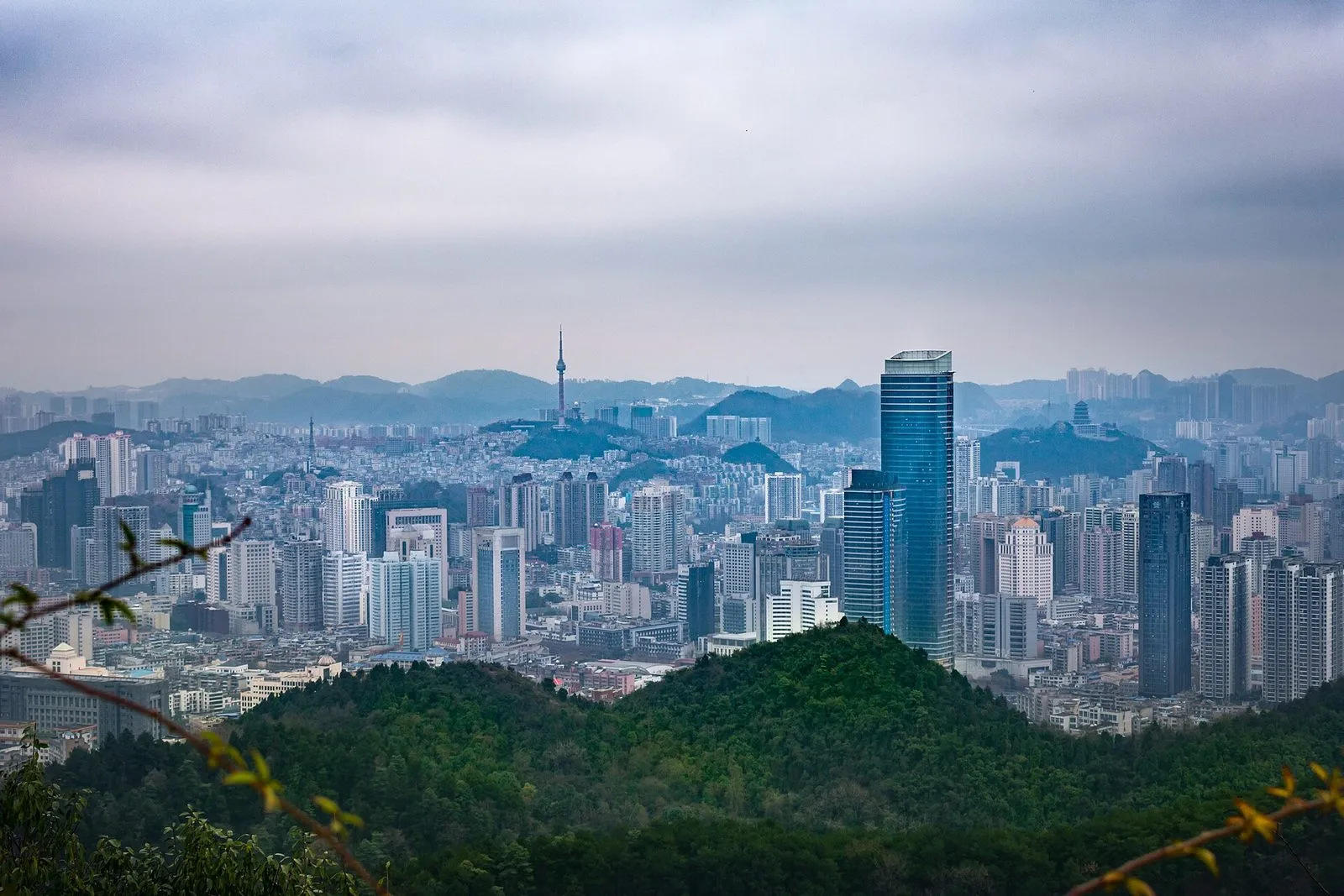
Guiyang, the capital of Guizhou in China's southwest, is the rare Chinese city travelers visit on purpose in summer. At about 1,100 meters elevation, its June-to-August temperatures hold in the low-to-mid twenties Celsius while the rest of the country bakes — the origin of its official slogan, 'Cool Guiyang' — and the cool, wet climate powers one of Asia's largest waterfalls just over an hour away: Huangguoshu, where you can walk behind the falling water. The city itself fills a good day or two: a forested karst mountain full of wild macaques, a Ming-dynasty garrison town known for its snacks, a pavilion balanced on a rock mid-river, and night markets built around the province's signature sour soup fish. Guiyang is also, unexpectedly, one of China's big data hubs — Apple, Huawei, and Tencent all run data centers nearby. This guide covers the tickets, the reservation rules, and how to spend two well-planned days.
Top sights at a glance
No. 1
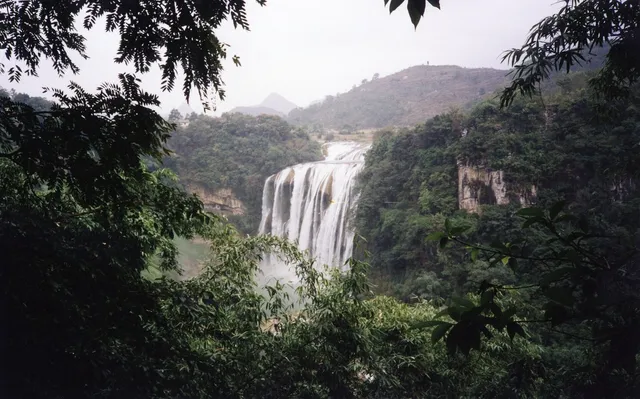
Huangguoshu Waterfall
One of Asia's largest waterfalls drops about 78 meters into Rhinoceros Pool — up to 101 meters wide at peak flow — at the heart of a three-part scenic area spread along six kilometers of river. The signature move is Water Curtain Cave, a 134-meter passage carved into the cliff directly behind the falling water. Upstream sits the broad 105-meter curtain of Doupotang, familiar from the 1986 Journey to the West series; downstream, the karst miniature-landscape of Tianxingqiao rewards a slow three-to-four-hour walk many visitors rank above the main falls.
Good to know · As of September 2026, tickets cost 160 yuan in peak season (March 1–November 30) and cover all three areas; the internal shuttle bus (50 yuan) is effectively mandatory. Book one to 15 days ahead on the official 'Anluetong' (安旅通) mini-program in WeChat or Alipay — note the official site directs foreign-passport visitors to buy in person — and reserve Water Curtain Cave separately, as it can close after heavy rain. Trains from Guiyang North take about 30 minutes to Anshun West.
No. 2
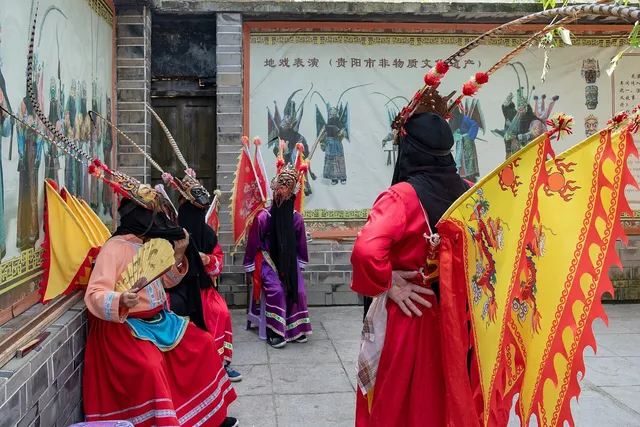
Qingyan Ancient Town
A 600-year-old stone garrison town founded as a Ming-dynasty military outpost, 40 minutes south of downtown. Granite alleys wind past city gates, temples, a Catholic church, and the former residence of Zhao Yikui, Guizhou's first imperial-exam champion — but the real sightseeing is edible: braised pig trotters, tofu grilled at the gates, and rose candy made by one family for over a century. Half-day-trip scale, best combined with appetites.
Good to know · Wandering the lanes is free or nearly so; a combo ticket for the ticketed sites (walls, temples, the zhuangyuan residence) has run roughly 60 yuan recently, with a cheaper base entry — check the posted rate as of September 2026. Reached by bus or a 40-minute DiDi from downtown. Go hungry, and weekdays if possible; weekends bring coach groups from Guiyang.
No. 3
Qianling Mountain Park
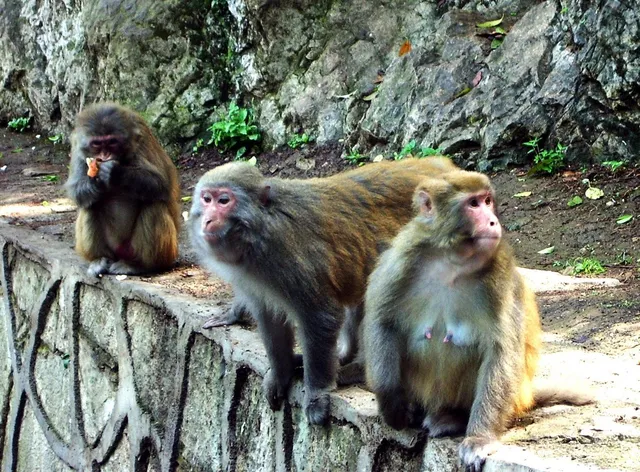
A 426-hectare karst forest pressed against the city's northwest edge, where paths climb through genuine woodland to Hongfu Temple, a working Zen monastery founded in 1672, past a lake, a cave, and a free zoo and panda house. The park's real celebrities are its several hundred wild rhesus macaques, who patrol the zigzag stone trail and inspect unattended bags with professional confidence. A cable car lifts the tired to the best city viewpoint.
Good to know · Entry has been free since 2024, but as of May 1, 2026 every visitor must reserve a timed slot in advance via the park's official WeChat account '黔灵山公园' or the Guikehui mini-program; unreserved visitors are not admitted — ask your hotel front desk to book if the system rejects your passport. Park hours run 7:00 a.m.–8:00 p.m. Metro Line 3 stops at the gate. Seal snacks before entering.
No. 4
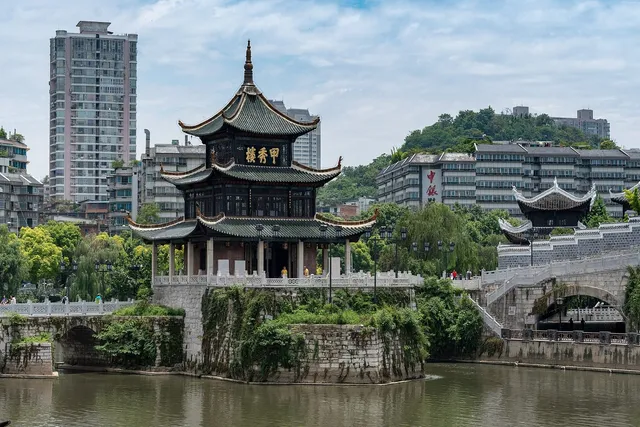
Jiaxiu Pavilion
Guiyang's symbol since 1598: a three-story pavilion balanced on a single boulder in the middle of the Nanming River, joined to both banks by the Fuyu Bridge. By day it is a graceful piece of Ming architecture amid the towers; after dark, when the riverside lights come on and the promenade fills, it becomes the city's living room. Pair it with the nearby Wenchang Pavilion quarter for one classic evening walk.
Good to know · Free entry as of September 2026, but timed reservation via the 'One Code Travel Guizhou' (一码游贵州) platform is required to climb; closed Mondays (except holidays), open roughly 9:00 a.m.–5:00 p.m. with the pavilion interior closing earlier. The illuminated exterior and riverside walk are always available and are the real draw — come after 8 p.m., then walk to the night markets.
No. 5
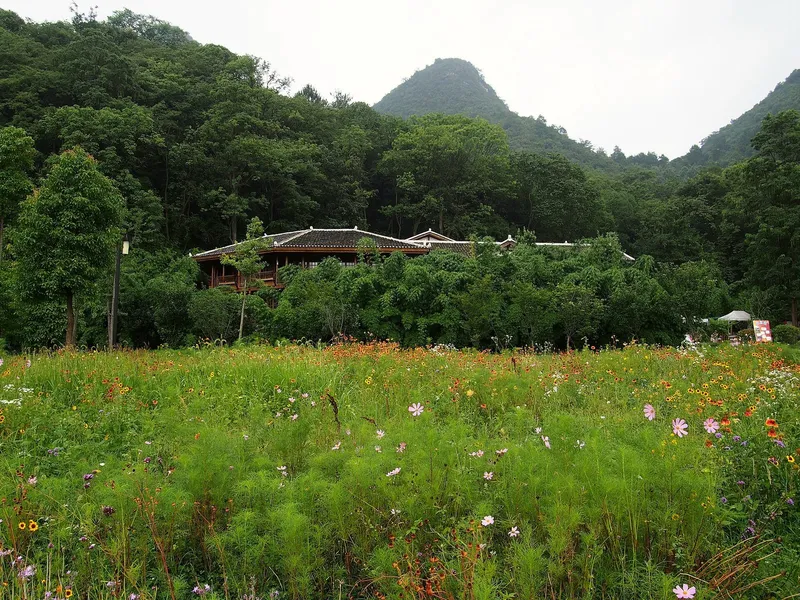
Huaxi Wetland Park
Ten li of riverbank between Guiyang and Qingyan where the Huaxi River braids through reed beds, flower fields, and willow groves — a national wetland park that doubles as the city's picnic ground. Boardwalks and cycle paths trace the water past flower gardens that peak in spring and a riverside 'golden avenue' of trees in autumn. Locals come to dangle feet in the shallows; visitors use it as the green corridor en route to Qingyan Ancient Town.
Good to know · The riverbank park is free to wander as of September 2026; bikes and sightseeing carts are paid extras. Reached on the same southbound route as Qingyan — metro Line 3 plus a short bus or DiDi, roughly 30–40 minutes from downtown. Best in the morning light or on a weekday afternoon; combine with Qingyan for a single well-paced day.
Guiyang is having a quiet moment. While China’s coastal megacities swelter through summer, this provincial capital sits at about 1,100 meters and keeps its June-to-August days in the low-to-mid twenties Celsius — hence the official slogan “Cool Guiyang” and the summer exodus of domestic travelers who come to breathe. The cool, wet climate is also what feeds its headline attraction: Huangguoshu Waterfall, one of Asia’s largest, an hour west by high-speed train, running at full thunder just as the rest of China looks for shade. The city itself is greener and slower than its size suggests — a monkey-filled karst mountain inside the city limits, a Ming-dynasty stone town on the southern bus route, a 1598 pavilion standing on a rock mid-river, and night markets devoted to Guizhou’s defining flavor: sour. Two well-planned days cover the essentials.
A Bit of History
Guiyang means “precious sun” — which the weather treats as irony: this is one of China’s cloudiest, dampest provincial capitals, and its history follows the mountains. The region sat at the edge of successive empires for centuries — loosely attached under the Tang and Song — until the Ming dynasty made Guizhou a province in 1413 and fortified it properly. Guiyang’s old city wall, its gates, and the garrison towns scattered across the province, Qingyan among them, date from that consolidation: Ming military families were settled here in the 1300s and 1400s, and many of their descendants still farm the same valleys.
The city’s emblem arrived in 1598, when a local official built a three-story tower on a boulder in the Nanming River, naming it Jiaxiu — “first under heaven” — to bless the river’s feng shui and the exam fortunes of local scholars. In 1886 a son of Qingyan, Zhao Yikui, became Guizhou’s first zhuangyuan — the empire’s top scorer — and his stone town house still stands.
The twentieth century treated Guiyang unevenly. Remoteness kept the province poor, then made it a rear area during the War of Resistance, when schools and factories moved inland; the Communist era built it into an industrial base of machine tools and tobacco. The 2010s brought the reversal nobody predicted: cool air, cheap hydropower, and stable geology turned Guizhou into China’s data-center province. Guian New Area, just south of the city, now holds one of the world’s densest clusters of large data centers — Apple’s Chinese iCloud partner, Huawei Cloud’s biggest facility, and Tencent all built there — and the city’s “Big Data Valley” billboard is less marketing than directory.
Culture & Daily Life
Guiyang moves at the tempo of a city that never expected the world’s attention: unhurried, green, and practiced at leisure. Teahouses and chess boards claim the park corners, badminton halls and milk tea claim the young, and the evening belongs to everyone. Guizhou is one of China’s most ethnically diverse provinces — Miao, Buyi, Dong, and Yi communities farm the hills beyond the basin, their festivals and silverwork drifting into the capital’s markets — and the city absorbs it all without ceremony; you will hear more dialects than textbook Mandarin on a single block. Foreign visitors are still uncommon enough to be a novelty, and the curiosity is friendly rather than salesy — expect a hello from schoolchildren, never a sales pitch.
The city’s rhythm follows its geography: a basin city where towers crowd between green karst hills, and the hills themselves became parks, so a morning walk to a temple doubles as a hike. The parks belong to retirees and their songbirds in the morning; the riverside promenade fills after dark; and the night markets — detailed under Food & Drink — are the city’s true social center, running late enough that 10 p.m. counts as an early dinner.
One practical caution rounds out the culture: the macaques of Qianling Mountain are wild animals with a municipal fan club — hold your bag zipped, keep your phone gripped, and do not open food anywhere near them.
Nature & Day Trips
The natural asset Guiyang built its brand on sits an hour west: Huangguoshu, a required full-day pilgrimage with its own shuttle system, covered in Top Sights below. The karst country offers backups — Tianhetan’s cave-and-river park southwest of downtown, and the labyrinth of Hongfeng Lake, a flooded karst valley dotted with islets, for a slow afternoon.
Inside the city, the greenery is better than most provincial capitals manage. Qianling Mountain packs a forested hill, caves, a lake, and a zoo behind the city’s northwest edge; the Nanming River promenade strings parks through downtown; and the Huaxi valley south of the city runs ten li of wetland boardwalks, flower fields, and cycling paths — the green corridor toward Qingyan. In spring the Huaxi flower beds and the rapeseed fields beyond Qingyan pull photographers; in autumn, a golden avenue of trees along the Huaxi River does the same.
The honest guidance for a two-day itinerary: give Huangguoshu one full day, Qingyan plus Huaxi a second half-day, and keep the city’s own sights for mornings and evenings. A third day opens up Guizhou’s bigger draws — the Miao village at Xijiang, the karst of Zhijin Cave — but those are overnight-scale commitments, not day trips.
Food & Drink
Guizhou food is one of China’s great unsung cuisines, and Guiyang is the easiest place to eat through it. The organizing principle is suan — sour, from fermentation rather than vinegar — layered under la, the chili; in a province where salt was once carried in on human backs across mountains, fermentation became the seasoning. Sour soup fish (suan tang yu) is the dish to organize a first evening around: a cauldron of tomatoes, rice-water ferment, and lemongrass, brought to the boil with a whole fish, dipped in chili-soy — a hotpot that has converted more skeptical travelers than any museum could. Order it at a dedicated restaurant, ask for the fish weighed in front of you before it hits the pot, and expect it to run roughly 80–150 yuan per person.
Mornings belong to changwang noodles, a pork-blood-and-intestine broth over noodles that sounds alarming and eats like a hug for 10–20 yuan. Graze beyond the headline pot: siwawa, dozens of rice-flour wrappers you fill yourself like tiny salads; lian’ai tofu, grilled over charcoal and split open for a spicy filling — the name, “love tofu,” jokes about courtship; fried potatoes tossed in fish-herb powder that locals treat as a food group; and Qingyan’s own contributions, braised pig trotters on skewers and rose candy pressed from sugar and petals. Mild by default is a real concept here: rice wraps, tofu, and soups come gentle, and wei la — a little spice — is all the instruction a stall needs.
The night markets are the dining rooms — Qingyun Market as the modernized flagship, the older Erqi Road strip louder, cheaper, and more local. Both reward grazing rather than ordering: walk the length first, then commit to three or four stalls. Budget 60–100 yuan for a serious crawl, and finish with the milk tea, sour-plum juice, or craft beer that the city’s young drinking scene turns out.
Top Sights
Huangguoshu Waterfall
One of Asia’s largest waterfalls, and the reason most travelers land in Guizhou at all. The main falls drop roughly 78 meters — the main plunge is 67 meters — into a churning pool up to 101 meters wide at peak flow; after rain the roar arrives before the view. The singular experience is Water Curtain Cave, a 134-meter passage threading through the cliff behind the falling water — a walk through a permanent storm of spray. But Huangguoshu is really three scenic areas along six kilometers of river, linked by shuttle: upstream, the broad 105-meter curtain of Doupotang, of 1986 Journey to the West fame; downstream, Tianxingqiao, a three-to-four-hour karst walk that many repeat visitors rate above the main falls.
Logistics decide whether this is a great day or a rushed one. Entry costs 160 yuan in peak season (March 1–November 30) as of September 2026, covering all three areas; the internal shuttle is a near-mandatory 50 yuan, a gorge escalator 50 return. Tickets are real-name: reserve one to 15 days ahead on the official Anluetong (安旅通) mini-program in WeChat or Alipay — the official site currently directs foreign-passport holders to buy in person. Water Curtain Cave needs a separate reservation inside and can close after heavy rain. From Guiyang North, trains reach Anshun West in about 30 minutes (around 47 yuan); shuttles run 40–50 minutes to the gate. Go at opening and run the loop Doupotang–Tianxingqiao–main falls ahead of the tour coaches.
Qingyan Ancient Town
Forty minutes south of downtown, the Ming dynasty built a stone garrison where the roads into the Guiyang basin climb — and the town is still standing in it. Granite-paved alleys climb between restored walls and city gates, past temples and memorial arches, a mosque, a Catholic church from the 1870s, and the hillside residence of Zhao Yikui, the province’s first imperial-exam champion. The architecture is half the visit; the other half is edible, and locals will tell you the food is the point: braised pig trotters sold by the skewer, tofu grilled over charcoal at the gates, rose candy from a family that has pressed it for a century,. Weekend days bring coach crowds from Guiyang; weekday mornings belong to grandmothers with baskets.
Wandering the lanes is free or nearly so; a combo ticket for the ticketed buildings (walls, temples, the zhuangyuan residence) has recently run around 60 yuan, with a cheaper base entry — check the posted rate at the gate as of September 2026. Interior sites generally close by early evening even when the town stays lively until 10. Pair it with the Huaxi wetlands on the same southbound route for the easiest good day trip in the portfolio.
Qianling Mountain Park
A piece of Guizhou karst forest preserved inside the city, 426 hectares of limestone hills where every path climbs toward either a temple or a monkey. Hongfu Temple, founded by a monk in 1672 near the summit, is a working monastery with a giant bronze bell and a jade Buddha; the zigzag stone trail from the south gate is the classic ascent and the heart of macaque country — several hundred wild rhesus monkeys live here, and they are accomplished, unafraid, and always watching for unzipped bags. Keep food sealed, never open a plastic bag in front of them, and hold your phone with intent; the vast majority of encounters are comedy rather than drama, but the park’s injury statistics are real. Beyond the monkeys: a lake with paddle boats, a free zoo and panda house, and a cable car rising 510 meters to the best city view.
The visit itself costs nothing — the park dropped its 5-yuan ticket in 2024 — but since May 1, 2026, every visitor must reserve a timed entry in advance through the park’s official WeChat account or the Guikehui mini-program; unreserved visitors are turned away, and the systems are built around Chinese ID numbers — try your passport number first, or ask your hotel desk to book. Hours run 7:00 a.m. to 8:00 p.m. as of September 2026, and Metro Line 3 now stops at the park gate. Go early: monkeys calm, paths empty, cool air at its best.
Jiaxiu Pavilion
The city’s postcard since 1598: a three-story wooden pavilion perched on a single boulder in the middle of the Nanming River, tied to both banks by the arched Fuyu Bridge. Built by a Ming official to bless the river’s feng shui and the exam fortunes of local scholars, it has been burned, rebuilt, and relit many times, and remains the physical center of the city’s self-image. By day it is a handsome antique under the towers; the version worth planning around comes after dark, when the lights come on and the pavilion glows gold above the water.
Climbing the pavilion itself requires a free timed reservation through the “One Code Travel Guizhou” platform; it closes Mondays (except holidays), running roughly 9:00 a.m.–5:00 p.m. as of September 2026 — but the exterior and the evening river walk are the real attraction. Pair it with Wenchang Pavilion, a late-Ming tower on a surviving stretch of the old city wall a short walk north, then continue to Qingyun Market for dinner — one classic Guiyang evening.
Huaxi Wetland Park
The city’s green corridor southward: ten li of riverbank where the Huaxi River braids through reed beds, lotus ponds, willow groves, and flower fields, protected as a national urban wetland park. Boardwalks, footbridges, and cycle paths thread the whole valley, and the background hum of the city fades within minutes. Locals use it as their park, picnic ground, and wedding-photo backdrop; travelers use it as the graceful way to spend a morning before continuing south to Qingyan Ancient Town on the same route. In spring the flower fields are the draw; in autumn, a riverside avenue of golden trees does the honors; in the summer haze, the wetland is a few degrees kinder than downtown, which in this city is saying something.
The riverbank park is free to wander as of September 2026, with paid extras like bike hire and sightseeing carts. Reach it by metro Line 3 plus a short bus or DiDi, roughly 30–40 minutes from downtown; buses to Qingyan pass the wetland edge. Go in the morning light and stop wherever the flower fields are in season — no reservations, no queues, and some of the best low-effort scenery in the city.
Getting There & Around
Guiyang Longdongbao Airport sits about 11 kilometers southeast of downtown, with dense domestic links and a growing international network; a metro ride or 30–40 yuan DiDi covers the trip. By rail, the city is a high-speed crossroads: Guiyang North and Guiyang East stations dispatch frequent trains toward Chengdu, Chongqing, Guangzhou, and Kunming; the hop to Anshun West for Huangguoshu takes about 30 minutes for around 47 yuan, with trains through the day. Book on the official 12306 app or Trip.com with your passport.
In town, the metro is modern, bilingual, and expanding — Lines 1, 2, and 3 cover the airport, both rail stations, Qianling Mountain, and the Huaxi direction — with rides at 2–6 yuan. DiDi is inexpensive and everywhere; downtown trips run 10–20 yuan. As of September 2026, metro gates, buses, and virtually every shop accept Alipay and WeChat Pay; keep cash only as a curiosity.
Where to Stay
Two areas cover most travelers. Yunyan district, around Wenchang Pavilion and Dashizi, is the classic first-visit base: walkable to the old center, two metro lines underneath, hotels from hostels up. The Nanming riverside near Jiaxiu Pavilion trades polish for position — you step out the door into the evening promenade and the night markets, which in this city is the correct priority. Guanshanhu, the new district to the northwest near the rail station, suits business travelers and early train catchers but costs you a ride back from everything worth doing at night. One alternative: a night inside Qingyan’s walls suits photographers who want the stone lanes at dawn, before the day-trippers arrive — guesthouses there are simple and cheap. Wherever you book, choose within a five-minute walk of a metro station, and reserve early for July and August — the cool-summer reputation fills the city with domestic escapees and doubles holiday-week prices. Golden Week in early October squeezes the whole province.
Sources & verification (12)
- https://www.hgscn.com/yd/
- https://travelwithkaede.com/blog/huangguoshu-waterfall-day-trip
- https://travelwithkaede.com/blog/things-to-do-in-guiyang
- https://travelwithkaede.com/blog/qianling-park-guiyang
- http://wlj.guiyang.gov.cn/jdhy/hygq/202604/t20260429_90055890.html
- https://gy.bendibao.com/tour/202056/49387.shtm
- https://gy.bendibao.com/jingdian/qingyanguzhen/price/
- https://www.dahepiao.com/lvyounews1/20250725522767.html
- https://gy.bendibao.com/tour/2023425/65705.shtm
- https://www.travelchinaguide.com/attraction/guizhou/guiyang/
- https://govt.chinadaily.com.cn/s/202309/04/WS64fae679498ed2d7b7e9a7e2/development-of-digital-economy-accelerating-as-data-cluster-grows.html
- http://dsjj.english.guiyang.gov.cn/2024-08/29/c_1017346.htm