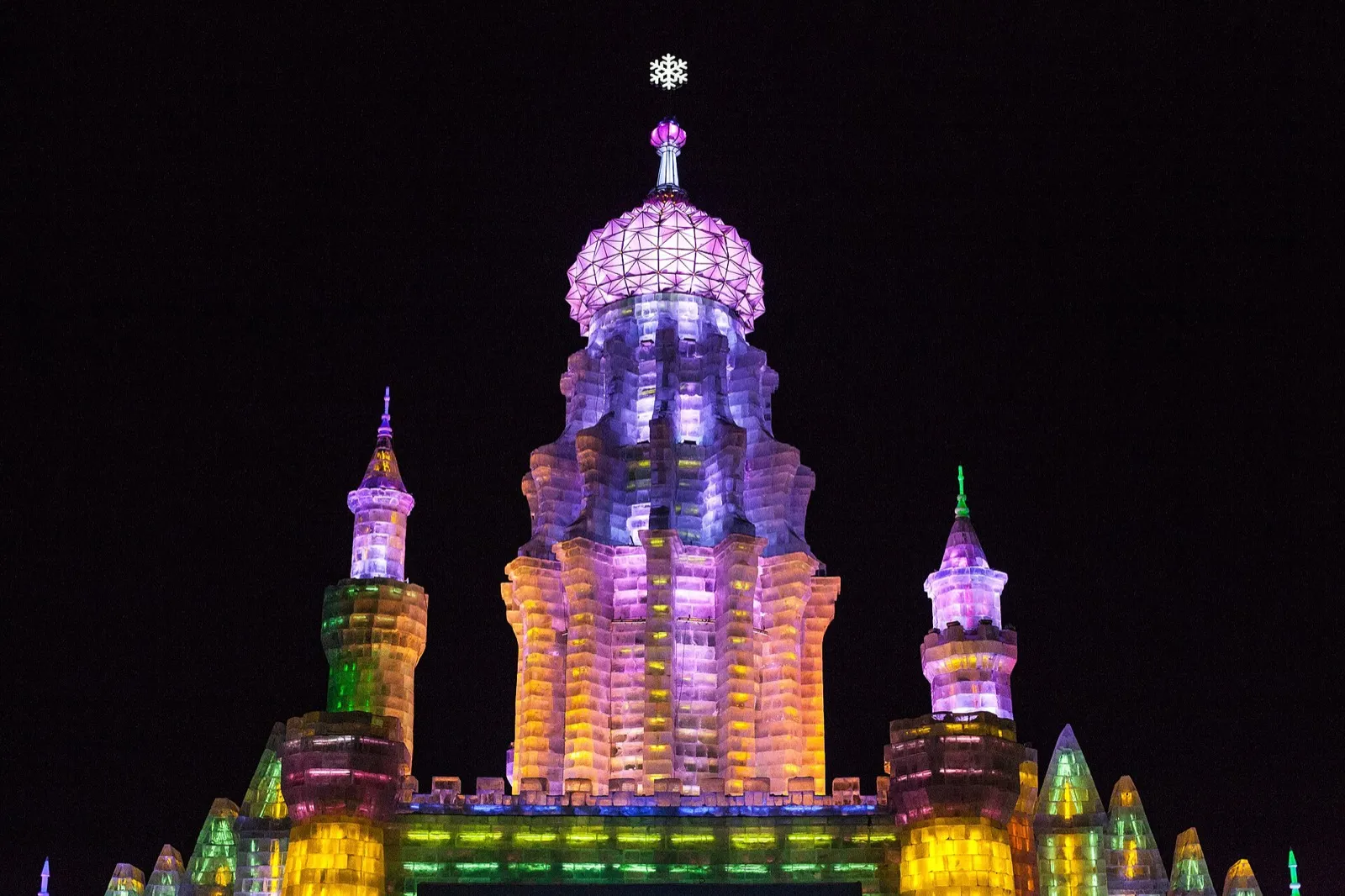
Harbin turns its brutal winters into its best selling point. Every year builders harvest ice from the frozen Songhua River and raise a full-size theme park of illuminated ice castles, slides and towers, while the city's Russian-built core — cobblestoned Central Street, the green-domed Saint Sophia Cathedral, a riverfront made for winter games — shows where the ice-lantern tradition began. This is deep northeastern China: temperatures run to minus 20 Celsius and below, coats matter, and the hospitality is as warm as the streets are cold. Summer is the insider's reversal, when Harbin cools the rest of sweltering China. Best for travelers who want China off the classic route, festival-scale spectacle, and a city whose history reads as a Russian chapter of Asia.
Top sights at a glance
No. 1
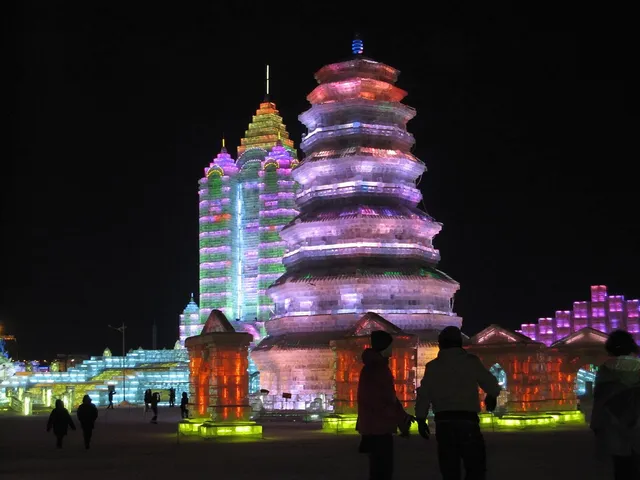
Harbin Ice and Snow World
Harbin's flagship festival park is built fresh every winter from blocks cut out of the frozen Songhua: a 1.2-million-square-meter city of ice castles, pagodas and towers, floodlit in saturated color from late afternoon. The giant ice slides are the draw — riders rocket down chutes on sleds — and the combination of playground energy and cathedral-scale architecture is unlike anything else in China.
Good to know · The 2025–26 season ran from mid-December, with standard admission at ¥328 and daily hours around 11 am to 10 pm; the 2026–27 opening is expected mid-to-late December. Buy via the official 'Harbin Ice and Snow World' WeChat account ahead of your visit, arrive around 3–4 pm to beat slide queues, and dress for minus 20.
No. 2
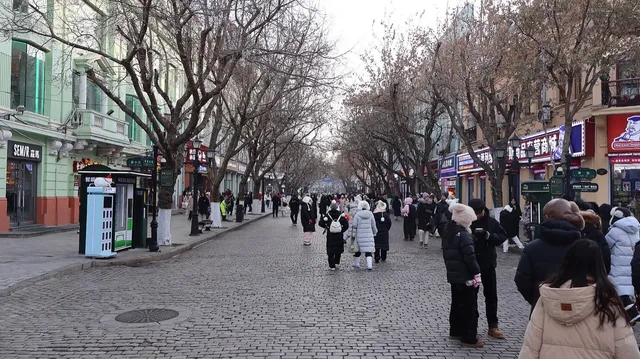
Central Street
Zhongyang Dajie is the promenade that earned Harbin its 'Moscow of the East' nickname: roughly a kilometer and a half of granite-cobbled pedestrian street laid out around 1900, lined with baroque, art nouveau and neoclassical facades raised by Russian railway architects. Today it runs from the stations and hotels to the Songhua riverfront, trailing shops, bakeries, red-sausage counters and ice-sculpture displays in winter.
Good to know · Free and open at all hours; evenings in winter, when the facades are floodlit and snow crunches underfoot, are the atmospheric peak. Try a red sausage snack and the local tradition of eating ice cream outdoors in deep winter. The street ends at Flood Control Memorial Tower and the frozen riverfront promenade.
No. 3
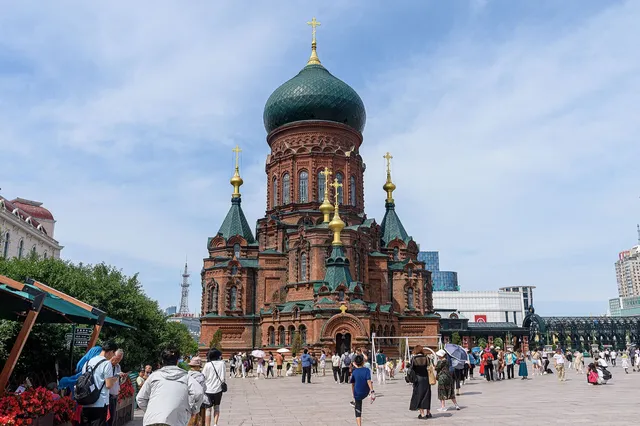
Saint Sophia Cathedral
A soaring Byzantine-style Orthodox church with a green onion dome and brick-red walls, Saint Sophia was built by the Russian community in 1907 and rebuilt on this scale in 1932. It no longer holds services; the interior houses the city's architectural art museum. The brick square around it, especially at night under floodlights with pigeons whirling, is Harbin's most photogenic corner.
Good to know · The square is free and open at all times; the small interior exhibition costs around ¥20. Reported opening hours vary by season and source (roughly 8:30 am onward, to late afternoon or evening) — check on the ground. Visit at dusk for the lit facade, then walk five minutes to Central Street.
No. 4
The Songhua River Front
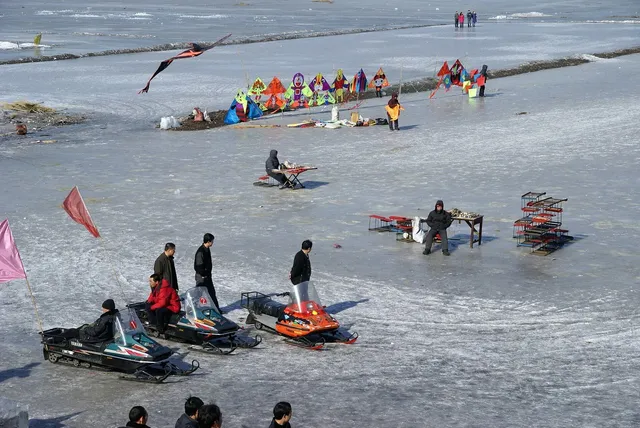
The Songhua River is Harbin's front yard, and the park that lines its southern bank — Stalin Park, running past the Flood Control Memorial Tower — turns into a carnival every winter. The river freezes more than half a meter thick, and Harbin walks, skates, slides and cycles across it. Come dusk, the ice road glitters against the Sun Island skyline and the cable car crosses overhead.
Good to know · Winter ice activities (ice slides, ice bikes, sleds) are rented and priced on the ice itself — a few tens of yuan per ride. The cableway to Sun Island runs year-round. In summer the same riverfront flips to strollers, swimmers and kayak crowds, which tells you how central this river is to the city.
No. 5
Siberian Tiger Park
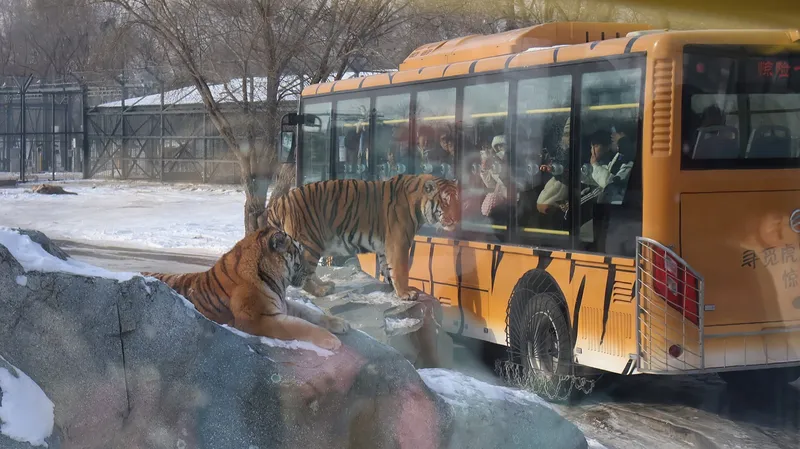
On the north bank near Sun Island, the Siberian Tiger Park is the world's largest breeding base for the endangered Siberian tiger, holding well over a thousand animals across wooded enclosures. Visitors ride fenced buses through the grounds, where tigers amble, spar and sprawl at remarkably close range. It is part conservation facility, part spectacle — a fascinating and ethically debatable hour that most winter visitors rate a highlight.
Good to know · Admission with the standard open safari bus runs about ¥110 (about ¥130 for the enclosed vehicle); hours run roughly 8 am to 4:30 or 5 pm depending on season, and winter light fades early. Go at opening, combine with Sun Island across the way, and treat the feeding-show elements as the spectacle they are.
See it in motion
Some places earn a moving picture
Stills can't show how this place moves — the drift, the light show, the crowd flow. We picked a recent, high-quality walkthrough rather than a promotional cut.
Inside Harbin Ice and Snow World 2026
TwoSweetTravel · YouTube · plays on click
Embedded via YouTube's official player (privacy-enhanced mode). Video: Inside Harbin Ice and Snow World 2026 by TwoSweetTravel. Not affiliated with China Travel Copilot; screened for quality and accuracy on 2026-09-28.
Harbin has the confidence of a city that has stopped apologizing for its weather. Winters here are genuinely severe — January averages sit near minus 15 Celsius, and nights run twenty below — and instead of hunkering down, the city doubled down: it harvests ice from its frozen river and builds a full-scale illuminated theme park out of it, spins winter games along the riverfront, and eats ice cream in the snow. Underneath the festival sits one of China’s most unusual cities. This was a Russian railway town built from scratch around 1900 on leased railway land, and the Moscow-style boulevards, onion domes and bread habits never left. For Western travelers, Harbin delivers something the classic Beijing–Xi’an–Shanghai triangle cannot: a province most visitors skip, festival-scale spectacle in winter, a legitimately cool escape in summer, and some of the cheapest, most generous eating in China.
A Bit of History
Harbin is a city with a birth certificate, and it is Russian. In 1898 the Russian Empire began building the Chinese Eastern Railway, a shortcut across Manchuria for the Trans-Siberian, and chose a fishing village on the Songhua River as its hub. Engineers, bankers, bakers and railway men poured in from the Russian Empire; within a decade a European city had risen on the floodplain, planned on Russian lines and named “Moscow of the East.” The 1917 revolution doubled it: tens of thousands of White Russian refugees fled east, and interwar Harbin became a polyglot city of Russians, Jews, Poles and others, with foreign consulates, Orthodox cathedrals, synagogues and its own café society.
The good times ended in the 1930s, when Japan seized Manchuria and ran it as the puppet state of Manchukuo until 1945; Soviet forces took the city in the war’s final days, and in 1952 the Soviets handed the railway back to China. Under the People’s Republic, Harbin became one of the northeast’s great industrial centers — machine tools, aircraft, motors — the proud, cold engine room of planned-economy China.
Its touristic identity arrived by accident and then by design. Ice lanterns — frozen lanterns grown around candles — were a folk craft of river fishermen; in 1963 the city staged an ice lantern exhibition in Zhaolin Park, and the winter festival grew from that seed, formalized in 1985 and expanded into the mega-parks of today, Ice and Snow World included, from 1999. The 2023–24 winter brought a second turning point, when a wave of viral social-media fame made Harbin China’s darling domestic destination almost overnight. The city that once built locomotives now builds ice palaces, and sells out.
Culture & Daily Life
Harbin is the capital of Dongbei — the northeast — a region with its own accent, its own humor and a reputation for directness that other Chinese regions find almost shocking. Expect to be drawn into conversation by strangers, over-served at dinner, and told bluntly when your coat is not good enough. Northeastern China was the industrial heartland of the planned economy, and the city retains that texture: broad socialist-era avenues, monumental stations, and an unhurried dignity even at minus 25.
The Russian century survives in daily habits, not just architecture. Red sausage — a smoked, garlicky cousin of Lithuanian sausage — is a household staple; round rye loaves the size of a steering wheel are called dalieba, from the Russian khleb, bread; and kvass is brewed commercially alongside China’s oldest beer. Harbin Beer was founded in 1900, predating the modern Chinese state by half a century, and in summer the riverside beer gardens pour it by the liter.
Winter is the organizing fact of local life. Daily routines bend around the cold — cars idle in courtyards, electric-bike riders wear quilted armor, and everyone transitions between brutal street and 25-degree interior with the efficiency of a system tested over decades. Harbiners swim in the river in winter (a hardy local scene cuts holes in the ice), and they eat frozen pears and ice cream outdoors as a matter of course. The infrastructure of warmth is excellent — buildings, buses, metro and restaurants are all aggressively heated — so a winter day is a rhythm of cold bursts between warm rooms. Travelers who adopt that rhythm love this city.
Nature & Day Trips
Harbin’s natural stage is the Songhua River, a vast slow waterway that freezes bank to bank every winter and becomes the city’s largest playground, then thaws each April into sailing and swimming season. Across the river, Sun Island is a park-and-residential district famous for its snow sculpture expo each winter, where teams carve colossal reliefs from packed snow — sculpture at architectural scale.
Wildlife has its own showcase at the Siberian Tiger Park on the north bank, the world’s largest breeding base for the endangered Siberian tiger (see Top Sights). Farther afield, the winter classics sit a few hours out: Yabuli, China’s oldest ski resort, roughly three hours away by rail and road, where the snow season runs reliably from late November into March; and China Snow Town, a photogenic logging village in the mountains east of the city where snow accumulates into knee-deep clouds on farmhouse roofs — very pretty, very popular, best midweek. Summer reverses the polarity entirely: while southern China swelters, Harbin cools — July afternoons in the mid-20s, green river islands, beer gardens — and the city markets itself, correctly, as China’s summer resort alternative. If your trip is flexible, winter is the headline act; summer is the connoisseur’s version.
Food & Drink
Dongbei food is the comfort food of China: big, hot, wheat-and-pork-forward, and portioned for Siberian winters. The signature dish is guobaorou, strips of pork in a crackling sweet-and-sour shell, a Harbin specialty born of Russian influence that every local kitchen guards its own recipe for. Dongbei hot pot and iron-pot stews — simmered over the table with pork ribs, corn, potatoes and glass noodles — are the winter rituals; dumplings come by the dozen. Restaurants here are cheap by national standards: a filling meal with beer routinely lands in the ¥40–80 per person range.
The Russian thread runs through the snacks. Red sausage (hong chang) is eaten cold from the paper wrapper, smoked over fruitwood; dalieba, the cannonball rye loaf, is a better souvenir than it is a picnic; kvass, the fermented rye drink, is sold in bottles everywhere. And there is the local spectacle you must join: eating ice cream in the street at minus 20. The century-old Madie’er (Modern) brand has made it a civic institution — locals insist ice cream tastes better in deep winter, and honestly, on the cobbles of Central Street, it does. Coffee culture is decent, tea is universal, and the riverside beer gardens in July are among the most pleasant drinking venues in China. Eat big here; the cold consumes calories, and the food is priced to prove it.
Top Sights
Harbin Ice and Snow World
The reason most travelers come, and worth the trip in full. Every winter the builders carve hundreds of thousands of cubic meters of ice out of the frozen Songhua River and assemble them — block by lit block — into a city of castles, towers, pagodas and ramps covering about 1.2 million square meters, the largest ice architecture on earth. By day it reads as a glacial ghost town; around 4:30–5 pm the floodlights come on and the whole city ignites in blue, gold and magenta, which is the image you came for.
The super ice slides are the main event: long chutes where riders on sleds hit genuinely high speeds, and the park’s demand exceeds its supply. Slots are grabbed on the in-park reservation system once you are inside, one activity per time slot, so enter early and book slides first. The 2025–26 season opened in mid-December 2025 with standard tickets at ¥328 and hours around 11 am to 10 pm; a February warm spell closed it early this year, a useful reminder that the season is weather, not calendar — for 2026–27, expect a mid-to-late December opening, announced on the official WeChat account, and buy tickets in advance. Budget four hours, arrive 3–4 pm to play before the lights, and dress properly: this is the coldest popular tourist experience in China, and underdressed visitors do not enjoy it (see the cold gear notes in Getting There & Around).
Central Street
Harbin’s parlor is Zhongyang Dajie, Central Street, laid out by Russian railway engineers around 1900 and paved with granite blocks worn to a polish by a century of boots. The strip runs about a kilometer and a half from the commercial core to the river, and the buildings along it — baroque facades, art nouveau flourishes, neoclassical banks — were the showpieces of the “Moscow of the East.” It is free, pedestrianized, and at its absolute best on a winter evening, when snow squeaks underfoot and the floodlights turn the stucco honey-colored.
This is also where Harbin snacks happen: red-sausage counters, warm bakeries, candied-fruit skewers frozen crunchy, and the Madie’er ice cream eaten defiantly outdoors. In winter, ice sculptures line the street; in summer, cafes spill onto it. Walk it end to end, detour into the side lanes for the Russian import shops and old confectioners, and finish at the Flood Control Memorial Tower on the riverfront, where Central Street delivers you directly into the Songhua River Front.
Saint Sophia Cathedral
Saint Sophia is the most photogenic building in Harbin: a Byzantine-revival Orthodox cathedral in brick red, crowned by a great green onion dome and ringed by smaller domes, built in 1907 for the Russian garrison and rebuilt at this scale in 1932. It has not held services in decades — the interior now houses the city’s architectural art museum, documenting Harbin’s Russian-built heritage — but the exterior is the point, and the brick plaza around it gives every visitor the same favorite photograph: pigeons up through the frame, red brick and green dome, winter light.
The square is free and open at all hours; the small interior exhibition costs around ¥20. Note that reported opening hours for the interior vary by season and source — from 8:30 am to late afternoon or even evening — so treat the square as the sure thing and the interior as a bonus checked on the ground. At night the facade is floodlit against the towers rising around it, which is Harbin’s history in one image: the 1900s and the 2020s stacked vertically. It sits five minutes’ walk from Central Street, so pair them in one dusk loop.
The Songhua River Front
Harbin faces its river the way European cities face a grand canal — across the south bank stretches Stalin Park, a broad promenade of sculptures, terraces and winter game stalls, anchored by the Flood Control Memorial Tower. When the Songhua freezes — every winter, lock-solid — the river itself becomes the venue. Locals and tourists share an informal ice carnival: chair-sleds and ice bikes for rent, snow slides, hovercraft rides, ice-skating patches, and a walked ice road to Sun Island. The temperature adds drama to everything, but that is Harbin’s bargain: spectacle in exchange for cold, well worth it at golden hour when the ice glows and the cable car to Sun Island crosses the pink sky.
In summer the same riverfront repurposes itself completely — strollers, swimmers off the steps, kayak clubs, and riverside beer gardens pouring the local 1900-brand lager. The river also feeds the festival: this is where the ice for Ice and Snow World is harvested each winter, blocks cut and hauled by machine in scenes worth watching for themselves. There is no ticket here; the riverfront is the city’s free room, and whatever the season, an hour on it explains Harbin better than any museum.
Siberian Tiger Park
The Siberian tiger — the largest cat on earth — barely survived the twentieth century, and the park on Harbin’s north bank is the flagship of the effort to breed them back: founded in 1996, it is the world’s largest Siberian tiger breeding base, with well over a thousand animals across its enclosures. The visit format is a safari in reverse: you board a fenced bus (a standard open-sided one for about ¥110, an enclosed vehicle for about ¥130, ticket included) and drive through the grounds while tigers — ambling, sparring, napping absurdly — come within meters. In snow, with the big cats against white ground, it is a photographer’s hour.
Be aware of what this place is: a breeding and research facility with a tourist business attached, including feeding spectacles that animal-welfare-minded travelers may find uncomfortable. The park’s conservation work is real — captive-bred animals from here have supported reintroduction efforts — but go with clear eyes and treat the shows as optional. Hours run roughly 8 am to 4:30–5 pm depending on the season, winter light dies early, and the park sits near Sun Island on the north bank, so it combines naturally with the snow sculptures or an afternoon crossing by cable car.
Getting There & Around
Harbin sits deep in the northeast, but getting there is straightforward. Harbin Taiping International Airport has dense domestic links — frequent flights from Beijing, Shanghai and the south — plus a handful of Asian international routes; Western travelers will almost always connect through a hub, an easy same-day add-on to a standard itinerary. From the airport, shuttles and taxis cover the roughly 40-minute ride into the center. The train is the better show: high-speed G trains run from Beijing (mainly Chaoyang station) to Harbin West in about four and a half to five and a half hours, second class around ¥600 with dynamic pricing, dozens of departures daily — and overnight sleepers offer a slower, cheaper, conversation-filled alternative. Book on 12306 or Trip.com, and in winter book early: festival dates sell out.
In town, the metro — including Line 2, which crosses the frozen river and has a dedicated Ice and Snow World station — covers the main sights for a few yuan a ride, taxis are metered and inexpensive, and DiDi works normally. The historic core (Central Street, Saint Sophia, the riverfront) is compact and walkable when the weather permits. Which brings us to the cold, the thing every Western visitor underestimates: in January you need a real expedition setup — a rated down parka, thermal base layers, insulated waterproof boots with grip (add strap-on ice cleats), mittens over liner gloves, a hat covering the ears and a scarf or buff for the face, plus disposable heat packs for pockets and phone. Batteries drain in minutes at minus 20; carry a power bank close to your body. Dress like that and winter Harbin is not hardship — it is the whole point.
Where to Stay
Choose from three zones. Central Street and the Daoli riverside district is the first choice for most visitors: you sleep inside the historic postcard, walk to Saint Sophia and the riverfront, and can be at the metro for Ice and Snow World in minutes; hotels range from Soviet-grand piles to boutique conversions. The north bank near Sun Island and the theme parks trades charm for logistics — closest to Ice and Snow World and the tiger park, quiet, and popular with families who want early park access, but colder, windier, and reliant on taxis. Around Harbin Station and the Nangang business district you find the best value: solid chain hotels, easy rail connections, a short ride from the old town. One timing note dominates everything: between late December and February, and brutally so around Chinese New Year, rooms sell out and prices surge — reserve as early as your flights. Whichever zone you pick, every building will be warm to a fault; the coat goes in the hallway, the ice cream goes outside.
Sources & verification (10)
- https://en.wikipedia.org/wiki/Harbin
- https://en.wikipedia.org/wiki/Harbin_Ice_and_Snow_World
- https://www.travelchinaguide.com/attraction/heilongjiang/harbin/ice-and-snow-world.htm
- https://post.smzdm.com/p/a7g5v89l/
- https://www.travelchinaguide.com/attraction/heilongjiang/harbin/st-sophia-church.htm
- https://www.travelchinaguide.com/attraction/heilongjiang/harbin/central-street.htm
- https://www.travelchinaguide.com/attraction/heilongjiang/harbin/siberian-tiger-park.htm
- https://us.trip.com/trains/china/beijing-to-harbin/
- https://en.wikipedia.org/wiki/Harbin_International_Ice_and_Snow_Sculpture_Festival
- https://en.wikipedia.org/wiki/Harbin_Brewery