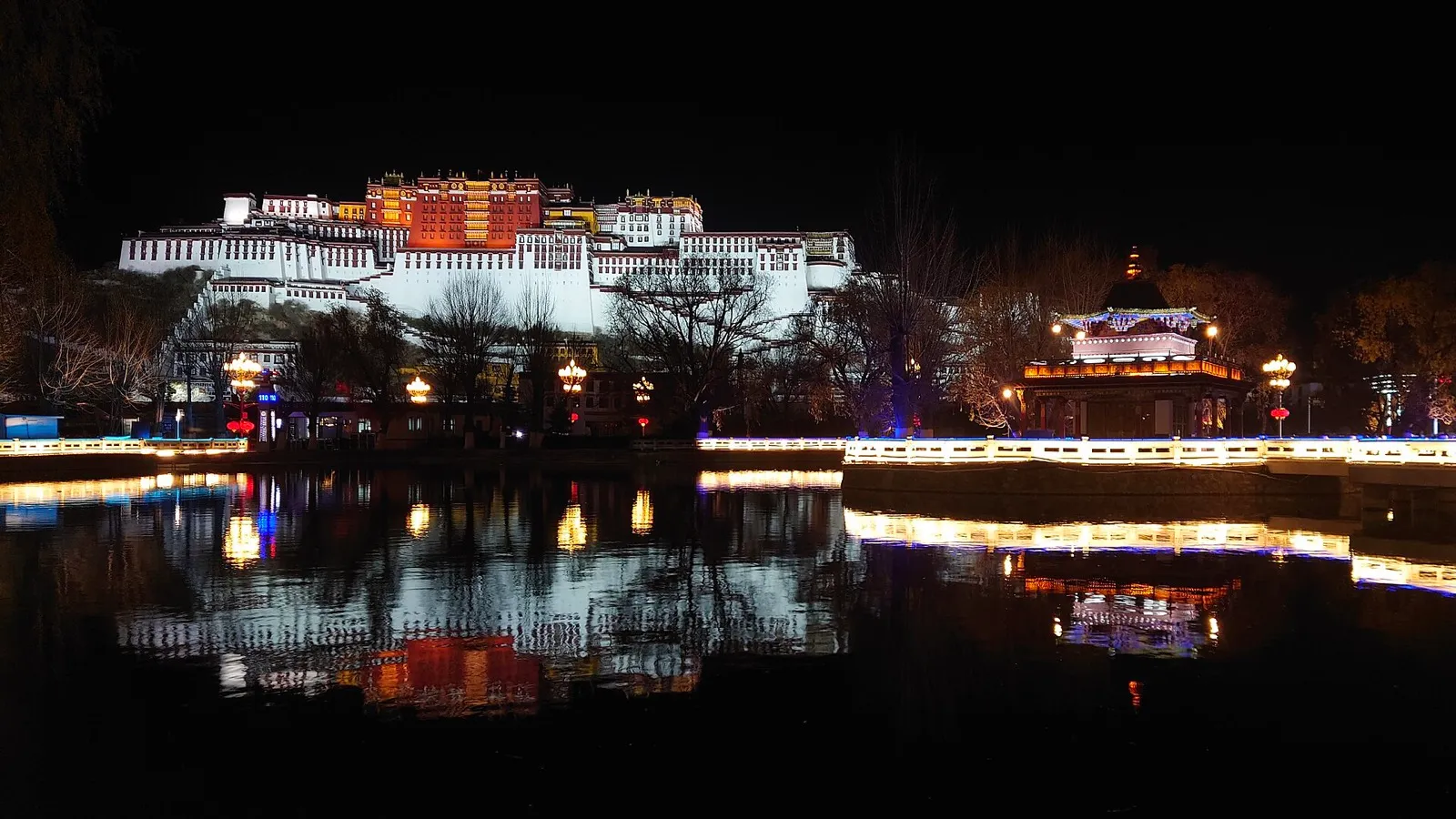
Lhasa is not just another stop on a China itinerary — it is the spiritual capital of Tibet, a city of pilgrims, monasteries, and incense at 3,650 meters, and it runs by different rules. Foreign visitors cannot simply book a train and go: entry requires a Tibet Travel Permit arranged through a licensed agency, and travel normally happens on a guided itinerary. Make that one adjustment and the rewards are enormous — the Potala Palace stacked thirteen storeys above the city, the Jokhang Temple at the heart of Tibetan Buddhism, the prayer-wheel hum of the Barkhor circuit, and standing-room monk debates at Sera Monastery. This page covers the 2026 permit reality, the reservation systems you will meet, how to pace your first days at altitude, and the train-versus-fly question. Come rested, go slow, and Lhasa repays patience like nowhere else in China.
Top sights at a glance
No. 1
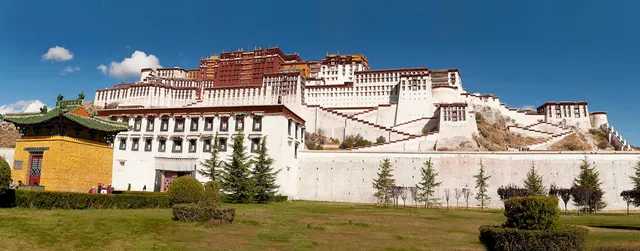
The Potala Palace
Begun in 1645 by the Fifth Dalai Lama on the foundations of a seventh-century royal palace, the Potala is the image of Tibet: thirteen storeys of white and red walls stacked up Marpo Ri hill, its golden roofs visible across the city. Inside, dim chapels hold gilded stupa tombs of successive Dalai Lamas, painted scripture halls, and centuries of treasure. A UNESCO World Heritage site since 1994, the visit is rationed accordingly — timed tickets, strict hourly flow, and about an hour on the stairways and roof terraces at the top of the world.
Good to know · Tickets are ¥200 in peak season (May–October) and ¥100 the rest of the year (as of September 2026). Admission is real-name and passport-tied, released through the palace's official reservation channels — your tour operator normally books it, and daily caps mean peak-season morning slots sell out first. Bring the passport you booked under; no photography inside, and expect roughly an hour on site.
No. 2
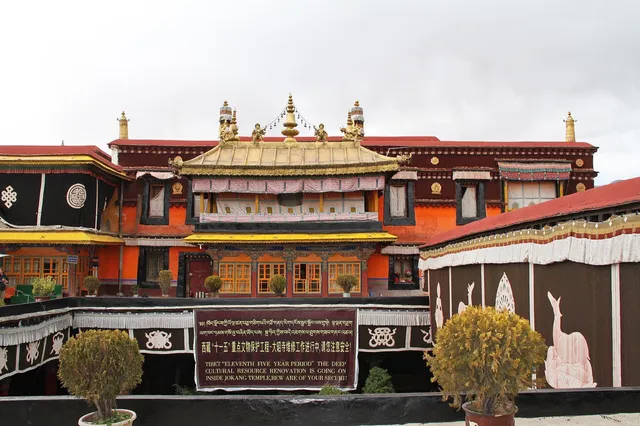
Jokhang Temple
The spiritual center of Tibetan Buddhism and, for many pilgrims, the entire point of Lhasa. Raised around 647 AD and encircled by the Barkhor pilgrimage circuit, the Jokhang enshrines the revered Jowo Shakyamuni statue — traditionally said to have been brought to Lhasa by the Chinese princess Wencheng — and draws a constant flow of worshippers who prostrate, refill butter lamps, and queue for a glimpse of the chapel's golden face. Climb to the second-floor roof stage for a gilded-roof panorama that looks straight across the city to the Potala.
Good to know · Admission is ¥85 in peak season and ¥35 off-season, with hours running roughly 9:00–18:00 (as of September 2026). Book a day ahead through the temple's official reservation channel, and note that late afternoon is often reserved for worshippers — go in the morning. Photography is forbidden inside the chapels; ask before photographing pilgrims.
No. 3
Barkhor Street
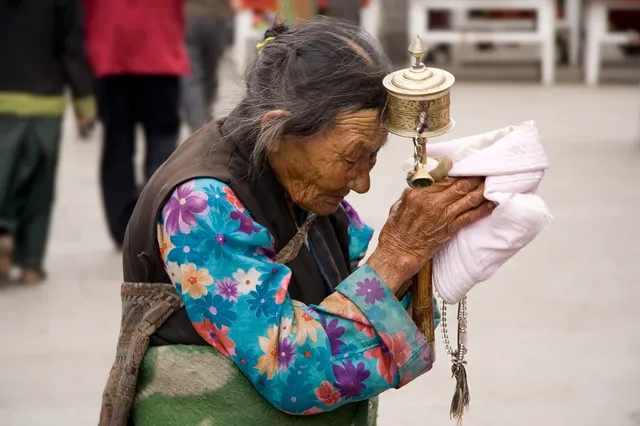
The circuit of faith and commerce that circles the Jokhang in the middle of the old town. All day, most movingly at dawn, pilgrims flow clockwise along it, spinning hand-held prayer wheels and prostrating the full length of the route; around them run souvenir stalls, incense shops, and centuries of whitewashed Tibetan houses with black-trimmed windows. A full lap takes about half an hour at walking pace, longer if you let the current carry you. It is the best free experience in Lhasa, and the city's pulse.
Good to know · Entry is free and the street never really closes; mornings belong to pilgrims, evenings to lantern-lit strolls. Always walk clockwise with the flow, never cut inside the pilgrimage lane, and treat the route as a working temple street rather than a shopping mall. Alipay and WeChat Pay work at nearly every stall.
No. 4
Sera Monastery
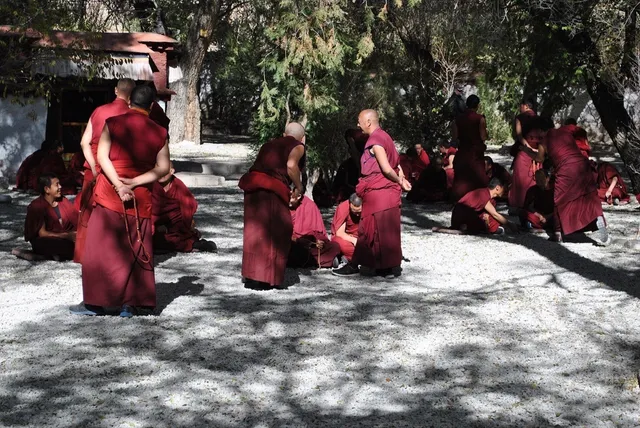
Founded in 1419, Sera is one of the great three Gelug monasteries of Tibet — along with Drepung and Ganden — in the wooded foothills a short drive northeast of the center. The headliner is the afternoon debating courtyard, where red-robed monks pair off in a ritualized philosophical contest: the questioner stamps, claps a dramatic palm-slap, and fires a challenge; the answerer must respond on the spot. It is loud, theatrical, and utterly genuine. Beyond the courtyard, whitewashed colleges and a vast 1710 assembly hall reward a slow loop uphill.
Good to know · Entry is ¥50, with grounds open roughly 7:00–17:00 (as of September 2026). The debates run 15:00–17:00 daily except Sundays and festival days — arrive 30 minutes early for a standing spot, keep quiet, and photography is generally tolerated at the courtyard. Tour the chapels first: some close by mid-afternoon.
No. 5
Norbulingka
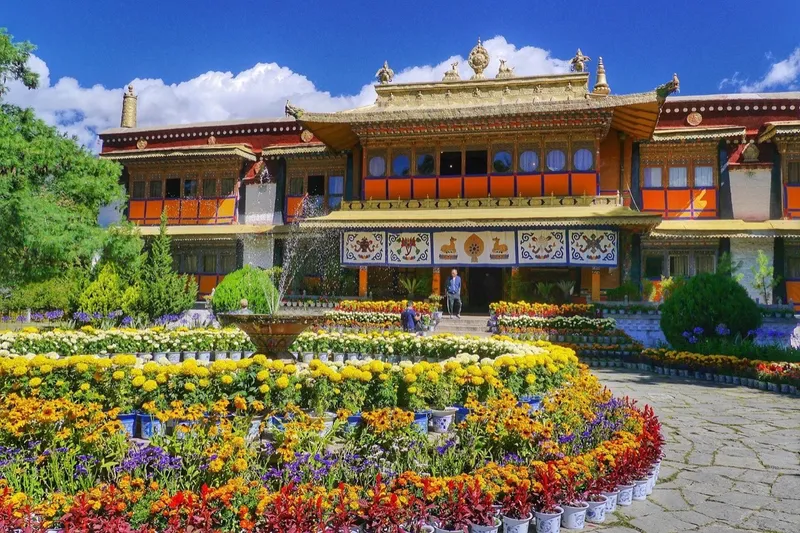
The Jewel Garden — the Dalai Lamas' summer palace, laid out from the 1750s on meadowland west of the Potala and added to the UNESCO World Heritage listing in 2001. Where the Potala is vertical and imposing, Norbulingka is horizontal and gentle: shaded gardens, and a sequence of palace compounds whose audience halls, bedrooms, and meditation chapels open a window onto daily court life. In late August, during the Shoton Festival, the lawns fill with Tibetan opera troupes and picnicking families — the park at its most alive.
Good to know · Tickets run around ¥60 in the high season and less in winter; figures vary by season, so confirm current prices with your agency. Hours run roughly 9:30–18:30 with last admission late afternoon (as of September 2026). Pair it with a Potala morning — the two palaces make a satisfying summer-versus-winter-residence comparison.
Lhasa feels less like a destination than a threshold. The air holds roughly two-thirds the oxygen of sea level, the light is hard and crystalline, and at dawn the streets around the Jokhang Temple fill with pilgrims who have walked — or prostrated — for months to reach its doors. This is the spiritual capital of Tibet, and the one corner of China where independent travel as most Westerners understand it simply does not apply: every foreign visitor needs a Tibet Travel Permit arranged by a licensed agency, and almost everyone moves through the region on a guided itinerary (as of September 2026). Accept that structure up front, plan a very slow first day, and the rewards stack up quickly — a thirteen-storey palace on a red-rock hill, the temple that anchors an entire faith, monk debates that pack a courtyard, and sweet tea in the sun at 3,650 meters.
A Bit of History
Faith put Lhasa on the map, and politics kept it there. The city began in the seventh century, when Songtsen Gampo united the Tibetan Plateau and based his rule in the Kyi Chu valley, building a palace on the red hill where the Potala now stands. Tradition credits his two brides — a Nepalese princess and the Chinese princess Wencheng — with bringing Buddhist images to Tibet, and the Jokhang Temple, raised around 647 to house them, became the city’s spiritual heart while Lhasa grew up around its doors.
The decisive rebuilding came much later. In 1645 the Fifth Dalai Lama began the Potala Palace over the old royal foundations: a White Palace for administration and living quarters, joined after his death by a Red Palace enshrining the gilded stupa tombs of successive Dalai Lamas. By the eighteenth century Lhasa was the undisputed religious and political capital of Tibet, its surrounding monasteries — Drepung, Sera, Ganden — among the largest institutions on the plateau. Pilgrims crossed the plateau year-round for the Jokhang’s chapels, and the city’s shape — fortress on the hill, golden roofs in the valley, prayer circuits threading between them — settled in that era and has barely changed since. Norbulingka, the summer palace, was laid out west of the city from the 1750s.
That layered legacy is exactly what visitors walk through today, and the wider world has taken notice: UNESCO inscribed the Potala Palace in 1994, extended the listing to the Jokhang Temple in 2000, and added Norbulingka in 2001 — a single ensemble protecting the capital’s golden age. In 1965 Lhasa became the capital of the Tibet Autonomous Region.
The modern connection that matters most to travelers arrived in 2006, when the Qinghai–Tibet railway crossed the permafrost and finished the highest rail line on Earth, linking Lhasa to the rest of China by steel. It turned what had been an expedition into a bookable journey — though one still governed by rules that require every foreign visitor to arrive with permits in hand and, in practice, a guide in the seat beside them.
Culture & Daily Life
Lhasa runs on pilgrim time. Two circuits frame the old town: the Barkhor, spinning tightly around the Jokhang, and the longer Lingkhor around the city’s sacred perimeter, and throughout the day both fill with Tibetans walking them clockwise — spinning hand-held prayer wheels, murmuring mantras, pausing for butter lamps or a spoonful of offering incense. Prostration, the full body-length bow repeated over years of accumulated rounds, is part of the street scenery; give practitioners room and never photograph them up close without asking.
Daily life here is visibly Tibetan. The old town is a quarter of whitewashed stone houses with black-trimmed trapezoid windows, where grandmothers shepherd kids home past shops selling incense and bolts of cloth, and where new construction follows old proportions rather than replacing them. Ridges bookend every view, and the afternoon sun off the whitewash is fierce — locals move deliberately, and you should too.
Etiquette that matters: dress modestly at religious sites, remove hats indoors, keep feet pointed away from altars, walk clockwise around every temple, and leave the drone at home. Conversation with strangers is warm but keep politics out of it — small talk about food, football, and where you are from beats interrogation about anything else. Payment is frictionless even this far up — Alipay and WeChat Pay work from museum counters to tea-house tins — and what there is least of is hurry. Shops close for dinner, the evening belongs to one last kora lap, and the city simply does not reward rushing.
Nature & Day Trips
Lhasa sits in a wide river valley at 3,650 meters, ringed by brown treeless ridges, and its best day trips follow the valley walls and the holy lakes beyond. The classic half-day is Drepung Monastery, once the largest monastery in the world, draped over the hills west of town, or Ganden Monastery on its high ridge to the northeast — both working monasteries with sweeping valley views, both arranged by your guide. The classic full-day is Yamdrok Lake, one of Tibet’s three great holy lakes, reached on a switchback road that climbs over a pass above 4,700 meters before the turquoise water appears in one unbroken sweep below.
Farther out, Namtso Lake sits at 4,700-plus meters behind a second pass, usually a long day trip or an overnight; and the multi-day route south to Shigatse and Everest Base Camp is the plateau’s flagship journey — note that the Everest region requires additional border paperwork beyond the standard permit, arranged by your agency, and that requirements there have been simplified in recent years, so confirm current rules before you commit. The iron rule: every one of these starts higher than Lhasa — spend two or three days acclimatizing in the city first, and tell your guide immediately if a headache turns ugly.
Food & Drink
Tibetan food is fuel first and pleasure second — at this altitude you will be grateful for both. The staple is tsampa, roasted barley flour worked with butter tea into a dough; most travelers meet it once out of duty and find it better than expected, especially with a spoonful of yak yogurt. Around it cluster the dishes you will order on repeat: momos, steamed or fried dumplings filled with yak meat or greens; thukpa, a hearty hand-pulled noodle soup; and in cooler months, stews of dense, sweet-ish highland yak beef.
The drink culture is the social glue. Butter tea — salty, warming, endlessly refilled — is hospitality itself, but the everyday obsession is sweet tea, milky and sugary, drunk in dedicated tea houses where a thermos on a shared table costs single-digit yuan and an hour vanishes among regulars. Tibetan barley beer and Lhasa-brewed lager round out evenings. Sichuan food, ubiquitous across western China, backs up every menu when you want fire. For the widest choice, eat where the neighborhood eats: family-run Tibetan kitchens around the old town ladle out thukpa and momos all day, Sichuan noodle shops cover the fast-and-cheap end, and hotel dining rooms serve tour groups at a markup. Breakfast is the quiet pleasure — a tea-house stool, a bowl of noodles, sweet tea by the thermos, and the morning kora filing past the window. If you have dietary limits, flag them when booking your tour: outside Lhasa, options thin out quickly to noodles, eggs, and fried rice.
Prices run a notch above inland China for equivalent quality thanks to freight costs — figure ¥30–60 for a solid meal, tea-house breakfasts for pocket change. Two altitude-specific notes: alcohol hits noticeably harder at 3,650 meters, so slow down for the first few days, and hydration is a dish, not a drink — keep the tea coming.
Top Sights
Lhasa’s sights divide neatly into two altitude-friendly clusters — the palace hill and the old town — plus one unmissable afternoon ritual. Plan mornings for the big ticketed sites, late afternoons for debates and kora laps.
The Potala Palace
You will see the Potala from everywhere in Lhasa — the discipline is saving it for your slotted morning. The visit climbs from the base of Marpo Ri through the White Palace’s stepped courtyards into the Red Palace’s sequence of chapels: butter-lamp dark, gold everywhere, the stupa tombs of Dalai Lamas sheathed in tons of gilded metal, and wall after wall of painting dense enough to reward a full hour of looking. From the roof terraces, the whole valley arranges itself below — low white houses, the Jokhang’s golden roofs, the ridgelines beyond.
Respect the machinery that makes a visit possible at all. Tickets are ¥200 in peak season, ¥100 off-season (as of September 2026); they are real-name, passport-tied, and sold in timed batches through the palace’s official reservation channels — daily caps mean peak-season slots sell out, and your tour operator will normally secure the booking. The palace allows roughly an hour inside, forbids photography and hats in the chapels, and involves real stairwork at an altitude where stairs cost double.
Jokhang Temple
If the Potala is Tibet’s postcard, the Jokhang is its beating heart — the temple pilgrims cross the plateau to reach. Inside the dim, butter-smoke thick chapels, the line files past the Jowo Shakyamuni, a statue of the Buddha as a young man brought to Lhasa, tradition says, by Princess Wencheng in the seventh century; worshippers top up butter lamps by the crate on their way through. The second-floor roof stage is the payoff for foreign visitors: a gilded-roof terrace with the Potala dead ahead across the rooftops and pilgrim crowds swirling in the square below.
Practicalities are simple. Admission is ¥85 in peak season, ¥35 off-season, hours roughly 9:00–18:00, with same-day-or-earlier booking through the temple’s official reservation channel (as of September 2026) — your guide will handle the mechanics. Late afternoons are often reserved for worshippers, so come in the morning, circle the roof first, and save the chapels for last when the queue thins. No photography inside; outside, ask before photographing prostrating pilgrims.
Barkhor Street
Between ticketed sites, Lhasa’s real museum is the street around the Jokhang. The Barkhor is the pilgrim circuit — a broad stone loop of prayer-wheel spinners, prostrators, and families herding small children around the route’s full clockwise kilometer — doubled by a market of incense, rosaries, dangly hats, and every souvenir the plateau sells. The trick of the Barkhor is timing: come at dawn, when the pilgrim current is strongest and the light hits the Jokhang’s golden roof, and come again after dark, when lanterns warm the whitewash and the day’s last devotees hurry their final laps.
Two rules make you a good guest here. First, move clockwise — the flow of the circuit is the whole point, and drifting against it reads as disrespect, not wandering. Second, treat the inner lane as worship space and the outer arc as commerce; bargain cheerfully in the shops, and step out of the flow to photograph. Entry is free, and the street is the richest free hour in Lhasa — take it every day you are in town.
Sera Monastery
Time your visit to Sera for one hour: 15:00, when the debating courtyard erupts. Monks pair off across the flagstones — questioner standing, challenger seated — and the ritual is physical theater: a stamp, a thunderclap of palms with each challenge, roars of laughter when doctrine stumbles. It is the final exam of a living monastic university, performed with evident relish, and it draws a packed, mostly local crowd; foreigners stand along the edges with everyone else.
Come early — debates run 15:00–17:00, daily except Sundays and festival days (as of September 2026) — and spend the time before them on the monastery itself: the great assembly hall of 1710 with its forest of pillars, the whitewashed colleges climbing the hillside, and the views back over the valley. Entry is ¥50; some chapels close by mid-afternoon, so tour first, debate second. Photography is generally fine in the courtyard — be discreet and quiet — and the whole site sits 6 kilometers northeast of the center, an easy drive your guide will fold into a Potala-free afternoon.
Norbulingka
Save Norbulingka for the day your body has finally accepted the altitude — it is Lhasa at its gentlest. The summer palace compounds sit in a big park of lawns and willows west of the Potala, begun in the 1750s and expanded by successive Dalai Lamas until it became the warm-weather seat of government; the palaces open into audience halls, private apartments, and a remarkably intact 1950s-era set of rooms. Added to the UNESCO World Heritage listing in 2001, the ensemble is best read as the Potala’s answer to itself: winter fortress, summer garden.
Admission runs around ¥60 in the high season and less in winter — seasonal figures vary, so confirm with your agency — and hours run roughly 9:30–18:30 with last entry in the late afternoon (as of September 2026). If your trip lands in late August, prioritize it: during the Shoton Festival, the lawns fill with Tibetan opera stages, picnics, and the whole city in holiday mode. Otherwise, go on a Potala morning’s afternoon, find the shade, and let the park explain why the palace’s residents kept two addresses.
Getting There & Around
Most travelers fly in. Lhasa Gonggar Airport sits across the river about 60 kilometers southwest of downtown — roughly an hour by airport shuttle or taxi — with direct flights from Chengdu, Chongqing, Beijing, Xi’an, and other cities; flying saves days but delivers the altitude shock at full strength, so book your first day as a rest day. The alternative is the Qinghai–Tibet railway: about 41 hours from Beijing aboard train Z21, or roughly a day and a night from Xining, whose daytime run across the Tanggula highlands is the trip’s great scenery. Carriages are oxygen-enriched over the highest sections. Foreigners need their Tibet Travel Permit to buy tickets and board, must use staffed ticket gates with passports, and their agency typically handles the booking.
In town you will barely need transport: the Potala, the old town, and the Jokhang all sit within a walk of each other, taxis are cheap and metered, DiDi works, and your guide’s vehicle covers the rest. Leave the rental-car idea at home: foreign self-driving in Tibet is not on the table.
Where to Stay
Two bases cover Lhasa. The atmospheric choice is the old town near the Barkhor: restored Tibetan courtyard houses turned guesthouses, steps from the kora, with rooftop views and butter tea on tap — romantic, though stairs argue for a ground-floor room. The comfort choice is the modern Chengguan district east of the Potala: full-service hotels, several with oxygen-enriched rooms worth the upgrade on your first night.
One structural note shapes everything: because your Tibet Travel Permit is tied to a booked itinerary, your agency will usually arrange lodging as part of the package — so choose a company that will put you where you want to be, and tell them explicitly if you want the old town or the modern side. Plateau nights run cold most of the year, so confirm heating before you commit. Whenever you sleep, book well ahead for May–October, when permits, Potala slots, and hotel rooms all tighten together.
Sources & verification (10)
- https://www.tibettravel.org/tibet-travel-permit/tibet-permits.html
- https://www.tibettour.travel/blog/2026/08/19/tibet-travel-permit-guide-2027
- https://www.thelandofsnows.com/tibet-travel-regulations
- https://www.chinadiscovery.com/tibet/lhasa/potala-palace.html
- https://www.chinadiscovery.com/tibet/lhasa/jokhang-temple.html
- https://www.chinadiscovery.com/tibet/lhasa/sera-monastery.html
- https://whc.unesco.org/en/list/707
- https://www.tibettravel.org/tibet-train/ticket-reservation.html
- https://www.tibettravel.org/tibet-travel-advice/high-altitude-sickness-faqs.html
- https://www.yowangdu.com/tibet-travel/avoiding-altitude-sickness