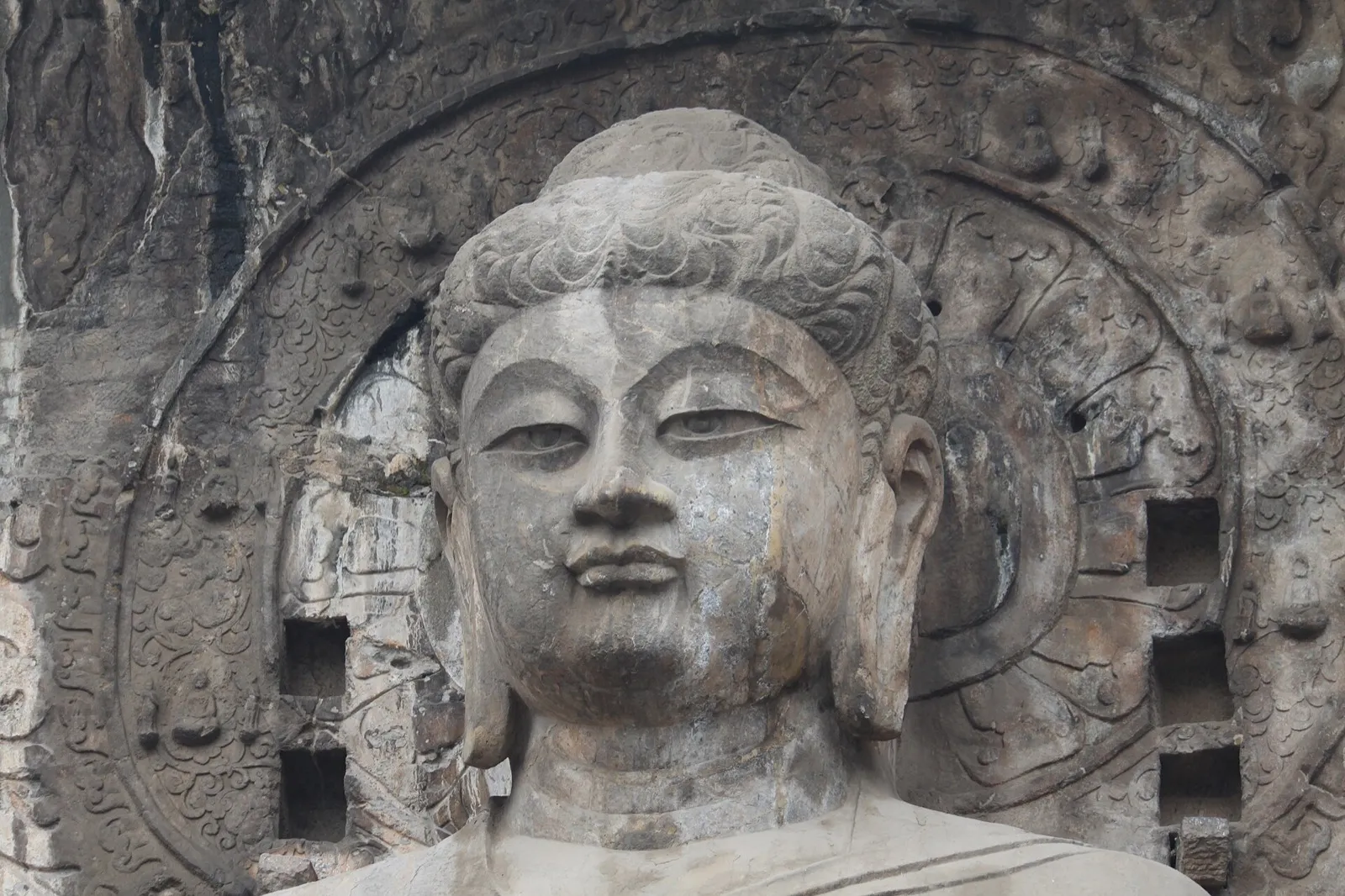
Luoyang, in western Henan, served as capital to thirteen dynasties across some 1,500 years — longer, residents will tell you, than anywhere else in China. What survives is extraordinary: the Longmen Grottoes, where tens of thousands of Buddhas fill limestone cliffs above the Yi River; White Horse Temple, the country's first Buddhist foundation; and the reconstructed halls where Empress Wu Zetian ruled her only-ever female dynasty. Add a museum full of Tang treasures, a lantern-lit old town, and an April peony festival that has made the city famous for flowers, and Luoyang rewards two unhurried days. Sitting conveniently between Xi'an and Zhengzhou on the high-speed line, it is the smartest branch-stop a first-time visitor can add to the classic route.
Top sights at a glance
No. 1
Longmen Grottoes
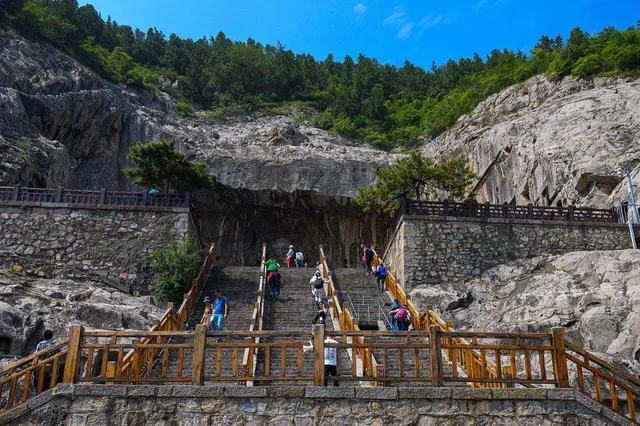
For four centuries starting in 493 AD, dynasties and donors chiseled some 100,000 Buddhist figures into the limestone cliffs on both banks of the Yi River south of Luoyang. The climax is the Fengxian Temple's Vairocana Buddha, seventeen meters tall, serene above the waterline since 675. A UNESCO World Heritage site since 2000, the grottoes are best at day's edge — and, from April to October, again at night under lights.
Good to know · Entry is 90 yuan, sold as timed real-name tickets via the official Longmen WeChat account, released seven days ahead at 00:10 (as of September 2026). Hours run about 8:00 AM–6:00 PM from March to October; a separate night session lights the West Hill cliff. Metro Line 2 to Longmen station, then a taxi or bus to the gates.
No. 2
White Horse Temple
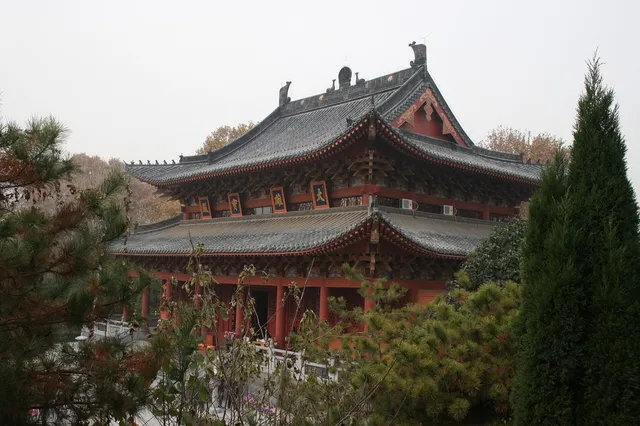
Founded in AD 68 after the emperor dreamed of a golden figure from the West, White Horse Temple is where Buddhism formally entered China — the 'ancestral court' every Chinese monastery traces back to. Incense-heavy Ming-era halls and an ancient pagoda sit beside a newer wonder: complete Thai, Indian, and Myanma temple compounds built with those governments' help, a diplomatic village of world Buddhism in one walled precinct.
Good to know · Entry is 35 yuan, open roughly 7:40 AM–6:30 PM with admission ending around 6:00 PM (as of September 2026). It lies about 12 kilometers east of downtown; city buses 56 and 58 run there, or take a 30-minute DiDi. Mornings are calmest, and three hours covers the Chinese halls and the international quarter.
No. 3
Luoyang Museum
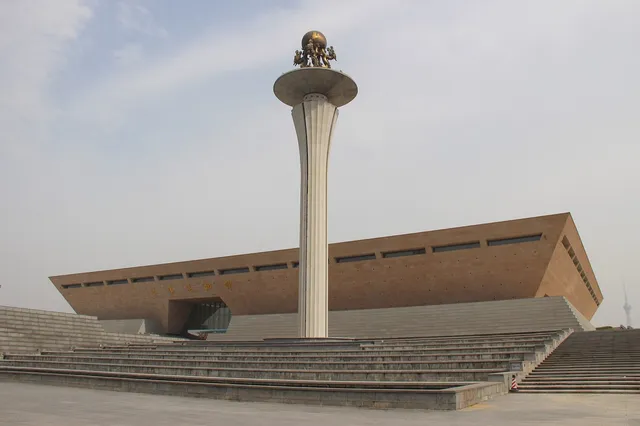
A capital for thirteen dynasties leaves a deep basement, and this free museum puts the best of it on display: Shang and Zhou bronzes, Han dynasty stone carvings, gold and jade, and room after room of Tang sancai — the three-color glazed camels and court ladies for which the region is famous. The giant Eastern Han stone bixie beast out front sets the tone: mythic scale, excavated locally.
Good to know · Admission is free with real-name reservation through the museum's official WeChat account; open about 9:00 AM–5:00 PM and closed Mondays except public holidays (as of September 2026). Book with your passport a few days ahead — slots tighten during the April festival. It sits in Luolong district, near the Sui-Tang heritage sites.
No. 4
The Old Town & Lijing Gate
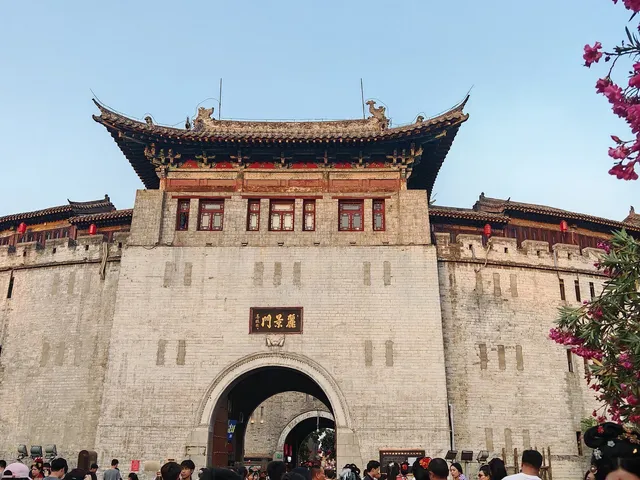
Luoyang's walled old town survives as a lived-in grid of low gray houses, temple courtyards, and food streets anchored by Lijing Gate, the rebuilt western gate whose tower crowns the district. The locals' saying — if you haven't been to Lijing Gate, you haven't been to Luoyang — is tourism boilerplate, but the scene it guards is real: at dusk Shizi Street's night market lights up, and the lanes fill with soup steam and lantern glow.
Good to know · The streets and gate passage are free; climbing the gate tower costs a small fee, around 45 yuan, and is worthwhile for the rooftop view over the old town (as of September 2026). It sits in the Old City district, a short taxi or metro-and-walk trip from the center. Come at dusk, hungry, and walk Shizi Street end to end.
No. 5
Mingtang & Tiantang
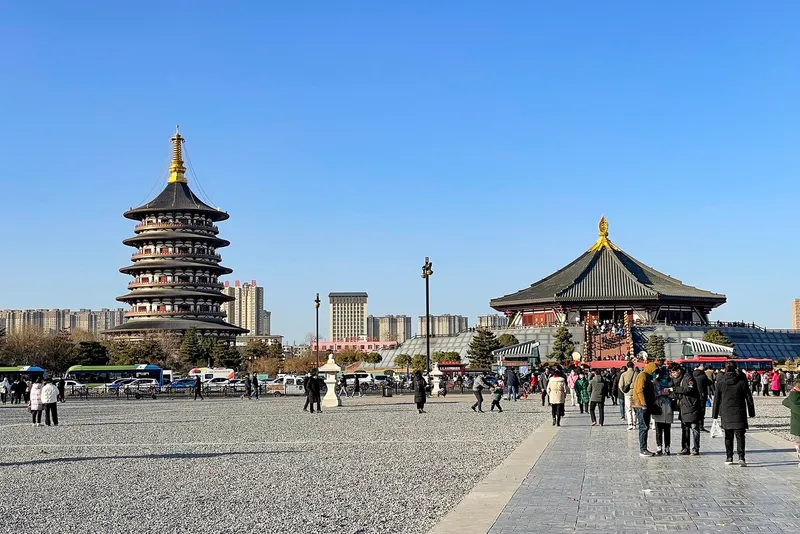
When Empress Wu Zetian ruled China from Luoyang — her 'Divine Capital' — the Mingtang was her ceremonial audience hall and the Tiantang her towering Buddhist sanctuary, both among the largest buildings on seventh-century earth. Both burned within years. Today full-scale reconstructions rise over the excavated foundations inside the Sui-Tang Luoyang City National Heritage Park: modern inside, imperial outside, and dramatically lit after dark.
Good to know · Tickets run roughly 90 to 120 yuan depending on the sites and packages chosen, bookable via official WeChat channels or platforms like Trip.com with your passport (as of September 2026); evening visits catch the light shows, and nearby Yingtianmen gate hosts its own night display. Metro Line 1 or 2 gets you close. Allow two hours inside.
Luoyang is the capital China forgot on purpose — and that is exactly why to go. Thirteen dynasties ruled from here across some 1,500 years, from the semi-legendary Xia through the glory days of the Eastern Han and the Tang, when Empress Wu Zetian made this “Divine Capital” the center of the known world. Politics moved on, the court left, and the city kept its treasures in the ground: cliffs carved with a hundred thousand Buddhas, the courtyard where Buddhism first stood on Chinese soil, palace foundations still waiting under the suburbs. Today Luoyang is an affordable, unhurried Henan city with one of the greatest sight-five in the country, a food culture built on soup, and — each April — a peony festival that fills the parks with the national flower. Two days here, slotted between Xi’an and Zhengzhou on the high-speed line, is the easiest upgrade to any classic China route.
A Bit of History
Chinese history begins, in part, here. The Erlitou archaeological site just east of the modern city is the leading candidate for the capital of the Xia, the semi-legendary first dynasty, and Luoyang’s dynastic résumé runs unbroken from there: thirteen courts held the throne here across roughly 1,500 years. The Eastern Zhou kings buried their chariot fleets in the city center — you can see the excavated pit today. The Eastern Han made Luoyang its capital at the start of the first millennium, and in AD 68 a visiting Buddhist mission founded White Horse Temple, the first state-sponsored Buddhist establishment in China.
The northern dynasties kept the city central: in 493 the Northern Wei moved its court to Luoyang and began cutting Buddhist shrines into the cliffs at Longmen, work that the Sui and Tang dynasties continued and expanded. Under the Tang, Luoyang served as the eastern capital of an empire that ran the Grand Canal’s western terminus, and in 690 the empress Wu Zetian — China’s only female sovereign — formally declared her own Zhou dynasty here, ruling from a palace complex whose main hall, the Mingtang, ranked among the largest buildings on earth. Both her great halls burned within years; the empire’s center of gravity shifted to Chang’an and then away from the interior for good.
What followed was a long afternoon. Later dynasties moved the capital east and eventually north, and Luoyang settled into provincial life, its imperial past surviving in earthworks, museum basements, and cliff-side Buddhas. The twentieth century made it a railway and heavy-industry town; the twenty-first has made it a heritage city, mining its own ground for a living. The result for travelers is rare: a major sightseeing city where the attractions sit close together, tickets are cheap, and the crowds — outside April — are manageable.
Culture & Daily Life
Luoyang wears its Tang nostalgia openly. The city brands itself the Divine Capital, hosts nightly light shows over Wu Zetian’s palace grounds, and has become China’s unlikeliest fashion capital: renting a Tang-style hanfu dress with full hair and makeup, then parading the old town and grottoes for photographs, is now the default Luoyang experience for domestic tourists of every age — and costume shops around the old town will happily outfit foreigners too, buying you a warmer reception than standing aside.
The daily ritual you will actually notice is soup. Luoyang eats soup at every meal, but breakfast belongs to it: beef broth, mutton broth, tofu broth, ladled over noodles with chili and vinegar at counter shops that open before dawn, for a few yuan a bowl — and locals treat the choice of soup shop as a matter of family identity. The city’s rhythm is older and slower than the coastal megacities — shops close early, evenings concentrate on the night market, and the pace of queuing is forgiving.
Practical culture is standard-issue urban China: Alipay and WeChat Pay work everywhere (see /guides/payments/), and every sight in this guide reserves by real-name ticket through official WeChat mini-programs using your passport number — set up before you arrive, and book Longmen days ahead. English signage is solid at the major sites and thin elsewhere; a translation app covers the rest. Prices run below Xi’an’s, and vendors are more curious than pushy. Henan opera, loud and beloved, drifts from park pavilions in the mornings alongside taiji groups and the eternal clack of mahjong tiles.
Nature & Day Trips
The basin between the Luo and Yi rivers hides better hiking than most visitors expect. The showpiece is Laojun Mountain, two hours south by bus: a 2,200-meter Taoist holy mountain where temples, cliffs, and a golden summit hall float above a sea of clouds, best treated as an overnight or a very early start. Closer to town, the Longtan Grand Canyon layers waterfalls and red-sandstone gorges into a solid half-day, and the Yellow River’s Xiaolangdi dam reservoir makes a scenic drive when water is released.
Inside the city, the Sui-Tang heritage park’s grounds and the peony gardens do the green work — the National Peony Garden is as much park as museum, pleasant even out of bloom, and the Yi River banks below the Longmen cliffs make an easy evening stroll.
Realistically, most visitors spend their nature budget in one of two ways: an April morning among the peonies, or a full day at Laojun Mountain. The grottoes, temple, museum, and old town are urban pleasures, and Luoyang’s compactness means none of the above requires more than an hour or two of transit.
Food & Drink
Henan cooking is wheat, vinegar, and soup, and Luoyang’s table is the most distinctive version of it. The ceremony dish is the water banquet (shuixi), a fixed sequence of more than twenty courses that arrive and clear like flowing water — mostly broths, braises, and mock meats, opening with the famous “peony swallow dish,” a carrot construction shaped and served to resemble a bird’s nest crowned with a peony. Restaurants across town serve the banquet in sizes from two-person versions to full theatrical spreads; expect to spend 80 to 150 yuan a head and pace yourself.
The daily staples are cheaper and just as local. Breakfast is the soup counter: beef or mutton broth over noodles, garnished yourself with chili, vinegar, and scallion, a few yuan the bowl. Luoyang’s night specialty is bufang tang, a peppery vegetarian soup layered over paper-thin “unturned” pancakes, sold at old-town stalls into the small hours. Street snacks run to peony cakes — flaky pastries stuffed with sweetened peony petals, sold everywhere in spring — sesame flatbreads, and cold jelly noodles dressed with vinegar.
The place to graze is Shizi Street in the old town, the night market that anchors the district after dark: skewers, soups, fried dough, candied fruit, and diners balancing all four. Prices are among the gentlest you will meet in China — a full night-market circuit costs under 50 yuan, restaurant meals rarely break 60 a head, and the only real strategy required is an empty stomach and patience for queues that move quickly.
Top Sights
Luoyang’s headline sights divide neatly into two days: the Longmen Grottoes and White Horse Temple out of the center, the museum, old town, and Tang heritage park in it. Reserve every ticket through official WeChat mini-programs with your passport, paying with Alipay or WeChat Pay — in April, book everything several days ahead.
Longmen Grottoes
The reason to come. Along a kilometer of limestone cliffs on both sides of the Yi River, more than 2,300 caves and niches hold some 100,000 Buddhist figures carved between 493 and the Tang era — a work of dynastic devotion so vast it reads today as a stone archive of Chinese art. The sequence builds to the Fengxian Temple’s Vairocana Buddha, seventeen meters tall and finished in 675, said to have been modeled on Empress Wu Zetian, who funded the project; the famous, calmly smiling face above the waterline is one of the great images of world art, UNESCO-listed since 2000.
Cross the bridge to the east bank for Xiangshan Temple and the garden tomb of the poet Bai Juyi, then look back: the full carved cliff over the river is the photograph everyone comes for, and the terrace opposite frames it perfectly. Entry is 90 yuan as a timed real-name ticket through the official Longmen WeChat account, released seven days ahead at 00:10 — set an alarm (as of September 2026). Hours run about 8:00 AM–6:00 PM from March to October; from April to October a separate night session relights the West Hill cliff, sold under the same 90-yuan ticket but with its own entry window, and subject to occasional suspension — confirm on the official account that day. Metro Line 2 reaches Longmen station; transfer to a short taxi or bus.
White Horse Temple
Buddhism’s Chinese birthday. In AD 68, the Han emperor — prompted by a dream of a golden figure flying over his palace — sent envoys west; they returned with two Indian monks and scriptures carried on a white horse, and the temple built to receive them became the first state-sponsored Buddhist foundation in China, the “ancestral court” from which every later monastery claims descent. The surviving halls are a rewarding blend: incense-thick courtyards, Ming-era statuary, and the Qiyun Pagoda rising in the garden where the two monks are buried.
The surprise is next door. Within the same precinct stand complete international compounds — a Thai temple in gilded royal style, an Indian shrine in Sanchi stupa form, a Myanma copy of the Shwedagon — built with support from those countries’ governments over recent decades. Walking from Tang-style incense halls to a slice of Bangkok to a slice of Yangon within five minutes is the strangest, most enjoyable architectural stroll in Henan. Entry is 35 yuan, open roughly 7:40 AM–6:30 PM (as of September 2026); the temple lies about 12 kilometers east of downtown — city buses 56 and 58 run there, or a 30-minute DiDi. Give it a calm three hours, mornings ideally.
Luoyang Museum
A thirteen-dynasty capital bequeaths a serious basement, and this free, well-designed museum shows it off without the crush of bigger-city rivals. The galleries walk Henan’s deep chronology: Shang and Zhou ritual bronzes, Han dynasty stone reliefs and the celebrated winged stone bixie beast, gold, jade, and ceramics — and then the Tang rooms, full of sancai, the lead-glazed three-color figures of camels, grooms, and court ladies that were produced here for the empire’s burials and now define the era’s image worldwide. Labels translate well enough, and the building sits conveniently near the Sui-Tang heritage sites.
Admission is free with real-name reservation through the museum’s official WeChat account, booked with your passport a few days ahead; it opens about 9:00 AM–5:00 PM and closes on Mondays except public holidays (as of September 2026). During April’s festival, slots tighten — reserve early. Two unhurried hours cover the core galleries; combine with a Mingtang-and-Tiantang evening and you have Luoyang’s perfect second day.
The Old Town & Lijing Gate
Luoyang’s oldest surviving neighborhood is modest by imperial standards and all the better for it: low gray-brick lanes, small temples, the Wenfeng Pagoda, and a food street that has fed the district for generations. Lijing Gate, the rebuilt western gate of the old Qing-era town, anchors it — pass through the free tunnel under the gate and the district opens up; climb the tower for a small fee, around 45 yuan, to look across rooftops to the modern city (as of September 2026). The gate’s marketing slogan — “if you haven’t been to Lijing Gate, you haven’t been to Luoyang” — oversells a reconstructed gatehouse, but as a frame for an evening it works.
Time your visit for dusk. Shizi Street, the crossroads night market at the old town’s heart, lights up after sunset: soup steam, lantern strings, sizzling skewers, and the crowd thickening by the minute. It is free, lively into late evening, and safely walkable. The rebuilt Luoyi Ancient City quarter, just south, adds more lanterns and the heaviest concentration of costumed hanfu photographers in town; treat both as one long, atmospheric evening, easily reached by taxi or metro plus a short walk.
Mingtang & Tiantang
The oddest and most enjoyable reconstruction in China. On the excavated foundations of Wu Zetian’s palace complex, the Sui-Tang Luoyang City National Heritage Park has raised full-scale modern reconstructions of her two great buildings: the Mingtang, her ceremonial hall of state, and the Tiantang, her Buddhist tower, once among the tallest structures on earth before both burned in the 690s. Inside they are museums — glass floors over excavation pits, exhibits on the only female emperor’s reign — wrapped in imperial exteriors that glow spectacularly after dark.
Purists will mutter that it is theme-park history, and they are not wrong; but the scale communicates what text alone cannot, and the excavated foundations beneath are genuine. Tickets run roughly 90 to 120 yuan depending on sites and packages, booked via official channels or Trip.com with your passport (as of September 2026); the nearby Yingtianmen gate adds its own floodlit evenings and costumed performances, often bundled in combination tickets. Metro Lines 1 and 2 serve the area. Visit at night rather than noon, allow two hours, and finish on the plaza when the light show starts — Wu Zetian would have approved of the spectacle, if not the electricity bill.
Getting There & Around
Luoyang sits mid-way on the Zhengzhou–Xi’an high-speed corridor, and that is its strategic charm. Luoyang Longmen station, on metro Line 2, dispatches trains to Zhengzhou East in about 30 to 40 minutes and to Xi’an North in around one and a quarter to one and a half hours (as of September 2026) — both legs bookable on the 12306 app up to about 15 days ahead with your passport. Beijing runs roughly four hours; Shanghai around five and a half. Coming from Xi’an, budget half a day for the grottoes plus an old-town evening; coming from Zhengzhou, Luoyang is barely a commuter hop.
The city’s small airport handles mostly domestic connections; most international visitors arrive by rail. The metro — two intersecting lines — covers the station, the Tang heritage park, and the Longmen area, and is signed in English. DiDi rides across town typically cost 10 to 30 yuan, and taxis are metered. Buses reach White Horse Temple directly (routes 56 and 58). Distances are short by Chinese standards: with a base near the old town or the city center, nothing in this guide requires more than half an hour of transit.
Where to Stay
Two bases make sense. The Old Town district around Lijing Gate and Shizi Street is the atmosphere pick: lantern-lit lanes out the front door, night-market suppers, sunrise walks before the crowds, and the heaviest cluster of hanfu rental shops — best for travelers chasing the Tang-evening experience. The modern center along the metro interchange near Wangcheng Square and the museum district is the logistics pick: bigger hotels, easier metro access to Longmen and the station, quieter nights — best for families and short stopovers.
In April, book early and re-book nothing: the peony festival triples demand and prices, rooms sell out days ahead, and even budget chains join the surge — a rare Luoyang inconvenience that planning defeats easily. Two nights are the right measure for the city: grottoes and temple on one, museum, old town, and Tang lights on the other. Anything extra belongs to the peony gardens or Laojun Mountain, and both justify a third night without argument.
Sources & verification (12)
- https://whc.unesco.org/en/list/1003/
- https://en.wikipedia.org/wiki/Longmen_Grottoes
- https://www.sina.cn/news/article/comos_nitfhum9841729.html
- https://www.travelchinaguide.com/attraction/henan/luoyang/longmen.htm
- https://www.chinahighlights.com/luoyang/attraction/longmen-grottoes.htm
- https://en.wikipedia.org/wiki/White_Horse_Temple
- https://www.travelchinaguide.com/attraction/henan/luoyang/baimasi.htm
- https://en.wikipedia.org/wiki/Luoyang_Museum
- https://www.travelchinaguide.com/attraction/henan/luoyang/luoyang-museum.htm
- https://en.wikipedia.org/wiki/Luoyang
- https://www.trip.com/trains/china/route/xian-to-luoyang/
- https://www.trip.com/trains/china/route/zhengzhou-to-luoyang/