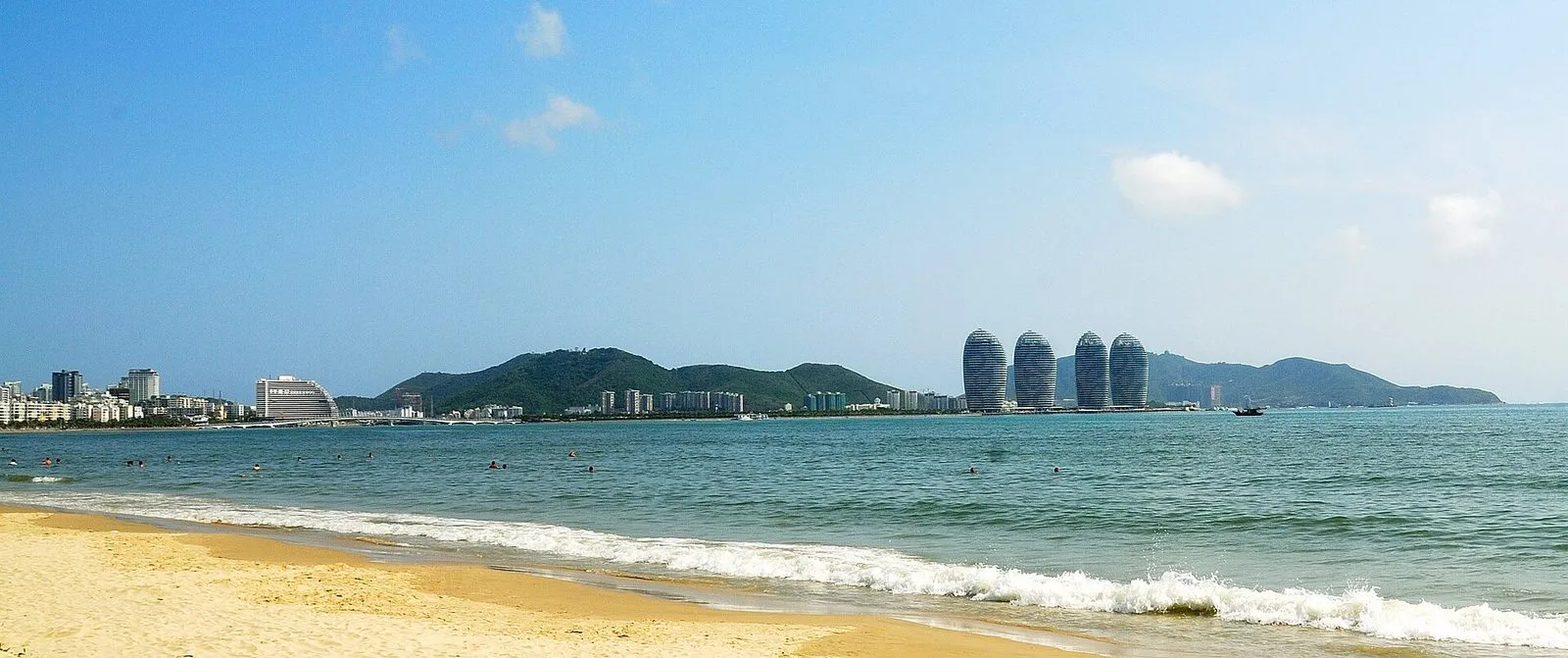
Sanya, on the southern tip of Hainan Island, is China's answer to Hawaii: a tropical city of palm-fringed bays, 25-degree winter days, and the busiest beach resorts in the country. Its bays each have a distinct personality — developed Dadonghai, convenient Sanya Bay, polished Yalong Bay, and resort-heavy Haitang Bay with one of the world's largest duty-free shopping complexes — and picking the right bay is the whole game, since the city has no walkable center. Add coral-diving islands offshore, a 108-meter sea Guanyin at Nanshan, the famously scenic seafood markets, and a steady tide of northern-Chinese and Russian winter escapees, and you get China's only genuine beach holiday. This guide explains how the bays differ, what tickets and boats cost, how the offshore duty-free allowance works, and how to spend three or four easy days. Facts verified as of September 2026.
Top sights at a glance
No. 1
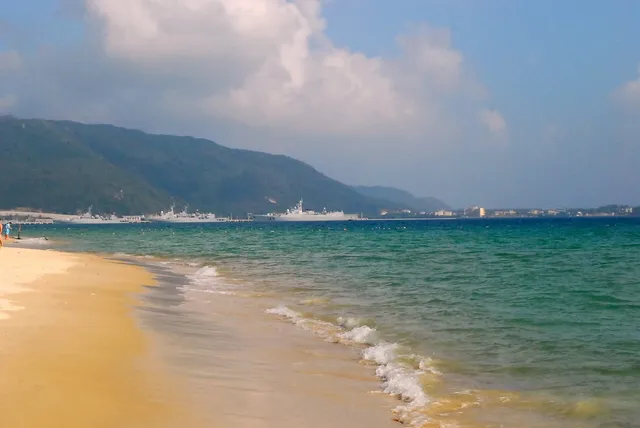
Yalong Bay
The postcard: a 7.5-kilometer crescent of pale sand about 25 kilometers east of downtown, with the clearest swimming water in Sanya and a calm, deep-blue gradient that has earned it the reputation of the most beautiful bay on the island. Five-star resorts line the back of the beach behind mature gardens, while the shoreline itself stays public and swimmable. Central Square's totem pole marks the bay's midpoint, and the water clarity — often ten meters from the surface — makes even a casual swim feel like snorkeling.
Good to know · The beach is free and open all day; hotels provide loungers for guests, so bring a towel if you are day-tripping. Buses 15, 24, 25, and 27 connect the bay with downtown and the railway station, roughly 40–60 minutes; a taxi from the city runs around 70 yuan. Go early morning or after 4 p.m. — midday sun is brutal even by Hainan standards.
No. 2
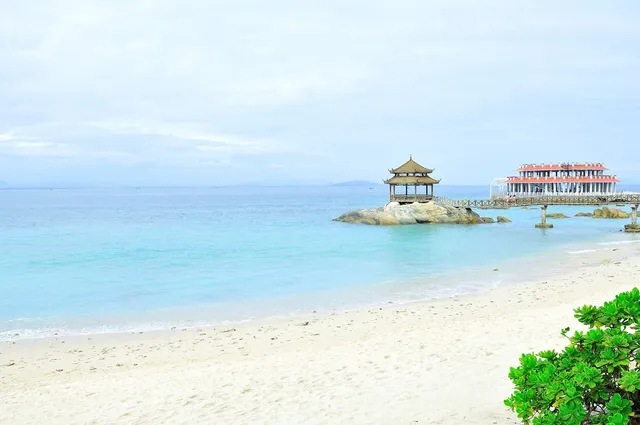
Wuzhizhou Island
The island offshore from Haitang Bay is Sanya's water-sports capital: a protected coral islet where scuba diving, snorkeling, and glass-bottomed boats run over reefs of tropical fish, and motorized toys — jet skis, parasailing, banana boats — fill the calmer coves. Wooded paths link Lover's Bridge, a small Matsu temple, and viewpoints over improbably turquoise water. It is the priciest ticket in town and the most rewarding full-day trip, with queues to match on weekends.
Good to know · Tickets cost 136–144 yuan including the round-trip boat as of September 2026 (seasonal pricing); boats leave every 20 minutes from 8 a.m. to 4 p.m., with the last return at 5:30 p.m., so time your exit. Book online with your passport via Trip.com or the official channel to skip the ticket-window line, and take bus 28 or Haitang line 1 from downtown to the wharf. Bring reef-safe habits — the coral is why you came.
No. 3
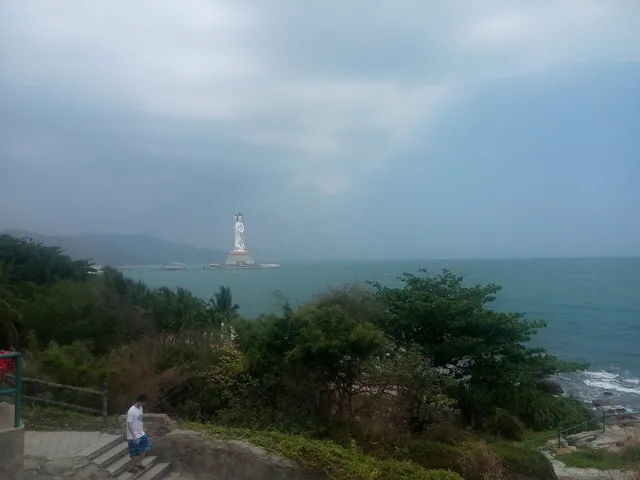
Nanshan & the Sea Guanyin
Sanya's cultural heavyweight is a vast Buddhist park on the coast west of the city, anchored by the Guanyin of the South Sea — a 108-meter stainless-steel-and-gold bodhisattva standing on an artificial island, taller than the Statue of Liberty and visible for miles. The grounds hold the considerable Nanshan Temple, gardens, and vegetarian restaurants famous across the island. It is commercial, enormous, and genuinely moving at golden hour, when the statue's face catches the last light over the sea.
Good to know · Admission runs 108–129 yuan by season as of September 2026; the park is big, so use the internal sightseeing bus (around 30 yuan) rather than walking everything in the heat. Buses 16, 25, and 55 serve the gate from downtown, about an hour. Go in the late afternoon for the light, and book online with your passport during Chinese holidays when entry is capped.
No. 4
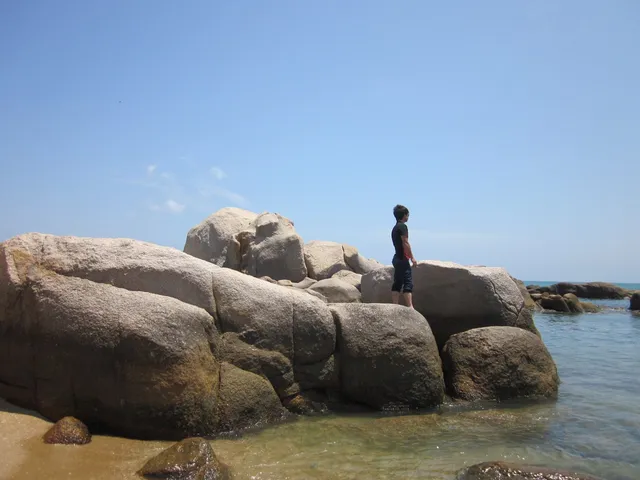
Tianya Haijiao
'Edge of the sky, corner of the sea' — for centuries the end of the habitable world for exiled officials, now Sanya's most famously scenic shoreline. Giant inscribed boulders (the characters for Tianya and Haijiao) lean over a beach of coconut palms and fishing boats, and the name has made the site the country's romantic landmark for couples and wedding parties. It is less a swimming beach than a coastline walk with serious cultural resonance and the best sunset rocks in the area.
Good to know · Entry costs 68–81 yuan by season as of September 2026; buses 16, 25, and 26 run from downtown in about 40 minutes. It pairs naturally with Nanshan, just ten minutes further west — do Nanshan first, then Tianya for sunset. Weekday late afternoons are calmest; weekends bring wedding-photo convoys to the big rocks.
No. 5
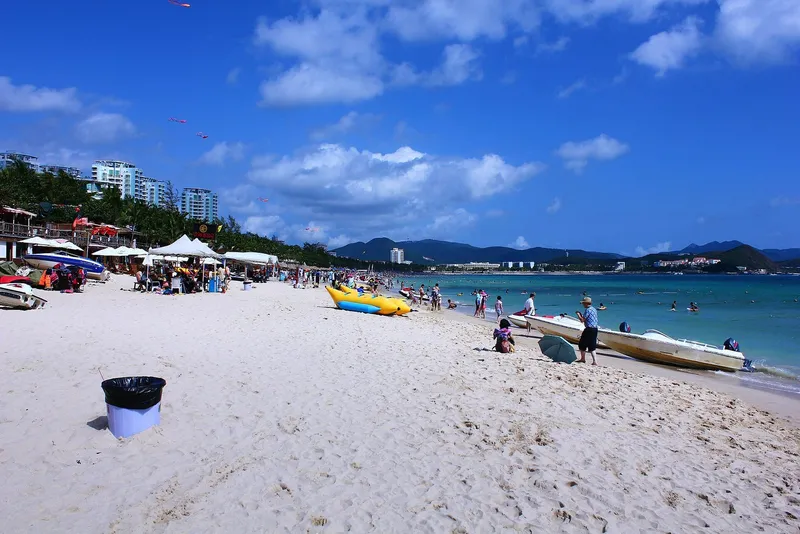
Dadonghai
The bay closest to downtown — about four kilometers southeast — and the city's original resort beach: a wide arc of sand backed by palm promenades, mid-range hotels, and cafes, with warm, shallow water that suits casual swimmers and beginner surfers. Dadonghai has long been the favored base of Russian winter visitors, whose beach life gives the strip its international flavor. Free to enter, easy to reach, lively at night, and the most convenient base for travelers without a car.
Good to know · The beach is free around the clock; buses 2, 4, 8, 17, 24, 25, and 55 stop at Dadonghai Square, about 15 minutes from downtown. Water is calmest in the mornings; watch flags and lifeguards in winter when swells run. The seafood strip behind the beach is convenient but tourist-priced — see our food notes below before you order.
Sanya does one thing and does it with total commitment: the beach holiday. At the southern tip of Hainan Island — China’s southernmost major tourist city — this city of bays has spent four decades turning its coastline into the country’s winter capital: the place northeast Chinese retirees winter, Russian package tourists land, and everyone else discovers that China has a tropics. What surprises first-time visitors is the structure: this is not a backpacker beach town but a resort metropolis spread across separate bays, each with its own character and price bracket, and picking the right one is the whole game. Choose your bay, time your tickets, eat seafood with your wits about you, and Sanya delivers genuinely excellent water, sand, and winter sun — with duty-free malls and a 108-meter goddess standing in the sea for the non-beach hours.
A Bit of History
For most of Chinese history, Sanya was not a destination but a sentence. The far south of Hainan was the empire’s place of exile — the literal end of the road, as the name Tianya Haijiao, “edge of the sky, corner of the sea,” commemorates — where Song-dynasty officials were sent to contemplate their careers from a shore of jungle and fishing villages. The Li people, Hainan’s indigenous minority, held the island’s interior long before imperial maps reached here; their brocade remains one of its signature crafts.
Everything you see now is younger than your grandparents. Sanya only became a modern city when Hainan was made a province in 1988 and pointed at tourism; the same year, Tianya Haijiao opened as an official scenic area and the first resort zones were sketched along the coast. The bay-by-bay build-out followed — Dadonghai first, then Yalong Bay’s hotel wall, then Haitang Bay’s mega-resorts — and the “Oriental Hawaii” tag stuck early.
Two recent chapters define today’s Sanya. The first is duty-free: turbocharged on July 1, 2020, when the offshore duty-free allowance jumped to 100,000 yuan per person per year, Hainan was turned into a shopping free port, and the giant mall in Haitang Bay became one of its principal destinations — the province’s duty-free shops booked over 60 billion yuan of sales in 2021. The second is the free trade port: Hainan’s island-wide independent customs operation, launched in December 2025, is the country’s boldest opening experiment, layering visa-free entry, simplified customs, and tariff breaks onto the beach economy.
Culture & Daily Life
Sanya’s culture is a stack of migrations. The oldest layer is Li and Miao village life in the hills — brocade weaving, mountain rice wine, the island’s original flavors — mostly visited today as organized cultural parks. Above it sits the Hainanese fishing culture: dawn fish landings at the ports, coconut everything, the Wenchang-chicken-and-rice cuisine that Hainan people actually eat for dinner. And on top of both, the migrants: northeastern Chinese who winter here so thoroughly that locals joke Hainan is China’s fourth northeast province, and — since the visa and charter era — the Russians, whose beach routines at Dadonghai and Yalong have been a fixture for decades.
Daily life here is shaped by season more than by clock. Winter (October to April) is high season: the water stays swimmable, the humidity drops, and the seafront promenades fill with sunburnt northerners dancing to speakers at dusk. Summer is hot, humid, quieter, and typhoon-prone — August 2025 brought Typhoon Kajiki, the strongest storm on record for the city, felling trees and knocking out power before a fast recovery; check forecasts if you travel June to October. Through it all, Sanya keeps a resort-town tempo: things start early, hibernate at midday, and resume at sunset when the night markets open.
Practical notes for foreigners: Mandarin is universal and English is patchy outside big hotels, so keep a translation app loaded. Everything from boat tickets to barbecue runs on Alipay or WeChat Pay; cash is nearly extinct. Swimwear belongs on the sand; the promenades are evening-wear territory. The city is safe by any standard, and the single cultural skill worth learning is bargaining with a smile at the seafood market.
Nature & Day Trips
Sanya’s natural offer is the sea itself, and it ranges from urban swims to genuine reef. The bays run clean and swimmable from about October to May, warmest and calmest in the morning; Yalong Bay holds the clearest water in the city, with visibility that can reach ten meters on quiet days. Offshore, Wuzhizhou Island protects the region’s signature coral reefs — the island’s marine ranch is a national demonstration zone for coral restoration — with snorkeling and diving over gardens of tropical fish. This is one of the few places in China where an ordinary traveler can reef-dive without a boat expedition, though pressure on the coral is real: dive with the licensed operators and keep fins off the coral.
Rainforest covers Hainan’s interior, and two parks put it within day-trip range: Yanoda Rainforest, an hour northeast, with guided valley walks and waterfall swims, and Betel Nut Valley (Binglanggu), which pairs rainforest with living Li and Miao heritage demonstrations. West of the city, the coast turns quiet and rocky toward Nanshan, with fishing villages and the coconut corridor along Sanya Bay for slow cycling. The classic days pair naturally: Nanshan plus Tianya Haijiao on one western day; Wuzhizhou Island as a full eastern day; a rainforest day when the beach needs a break. The round-island high-speed railway also makes Haikou, the provincial capital, feasible as a two-day extension — the fastest Haikou–Sanya trains take about an hour and a quarter.
Food & Drink
Sanya eats from the sea, and the honest food strategy is seafood done your own way. The city’s signature experience is the market-and-processing model: you buy live seafood by weight at a market — shrimp, mantis shrimp, grouper, oysters, mud crabs, spiny lobster — then hand it to a nearby kitchen stall that steams, grills, or wok-fries it for a per-kilo processing fee, eating at plastic tables under fans. It is fresh, fun, and the cheapest great meal in town when done right. It is also where tourists get burned: the classic scams are inflated weights, “market staff” steering you to partner stalls, vague processing charges, and live-swapped catches. The defenses are simple — insist the scale is digital and in view, photograph the catch before it leaves your sight, agree the processing fee in advance, and pay with Alipay or WeChat Pay so every gram is on the record.
Beyond the markets, Hainan’s own kitchen deserves equal time. Wenchang chicken — the island’s famous free-range bird poached gently and served with rice cooked in its fat and a ginger-scallion dip — is the national dish of Hainan and a perfect non-seafood dinner. Hele crab, steamed and paired with ginger-vinegar, is the local crab of record; Jiaji boiled duck from Qionghai completes the island’s celebrated trio. Coconut features everywhere — coconut rice, coconut chicken hotpot (a Sanya specialty worth planning an evening around), fresh coconut water for a dollar a nut. Tropical fruit is absurdly good and cheap: mangoes, mangosteens, dragon fruit, and the tiny sweet bananas.
Where to eat: the night markets behind Dadonghai and downtown do street food and grilled skewers at local prices; the seafood strips at Chunyuan and the downtown First Market area are the processing-fee heartlands; hotel-beach restaurants charge double for the sound of waves. Budget 60–120 yuan per person for market seafood done properly, less for noodles and chicken rice. And the coffee — Hainan grows its own — is surprisingly serious.
Top Sights
Sanya’s sights are spread along the coast, so think in days: one western day (Nanshan, Tianya Haijiao), one island day (Wuzhizhou), and beach time slotted between. Book the island and holiday-period tickets online in advance.
Yalong Bay
If you swim once in Sanya, swim here. The bay curves seven and a half kilometers between forested headlands, and its water is the city’s clearest and calmest — a swimmable, gradually deepening bay with real blue offshore, backed by the densest wall of five-star resorts in China. The beach itself is public, free, and open all day; resorts keep their loungers on their own frontage, so day-trippers head for the Central Square section, where the famous totem pole rises and the sand widens. Yalong’s trade-offs are distance (25 kilometers east of downtown, 40–60 minutes by bus or taxi) and a quiet, curated feel: this is a base for people who want the sand and the pool to be the whole trip. Come early or late for the light and the temperature; the midday tropical sun forgives nobody.
Wuzhizhou Island
The full-day excursion that justifies Sanya for divers. Wuzhizhou sits in the open sea off Haitang Bay, a wooded islet whose leeward coves protect coral gardens, and the operation here is slick: a 15-minute boat every 20 minutes from 8 a.m. to 4 p.m. (last return 5:30 p.m.), a ticket that bundles the crossing with island entry, and a menu of water sports from glass-bottomed boat rides to scuba over the reefs, parasailing, and motorized everything. The island itself has walking paths to Lover’s Bridge, a tiny temple, and headland viewpoints where the water runs through three shades of blue. Go on the earliest boat — by 10:30 the coves are themed-park busy, and the best snorkeling light is morning anyway. Tickets run 136–144 yuan with the boat as of September 2026; book ahead with your passport via Trip.com or the official mini-program, and note that diving has separate charges with medical declarations — answer honestly. Non-swimmers get a fine day from the paths and viewpoints alone.
Nanshan & the Sea Guanyin
Sanya’s one essential non-beach sight is a statue: the Guanyin of the South Sea, 108 meters of steel and gold rising from an artificial island just offshore, three faces looking three directions over the water. Whatever your view of monumental Buddhism, the effect — especially in the low gold light of late afternoon — lands. The statue stands within the Nanshan Cultural Tourism Zone, a vast, landscaped park of temple halls, gardens, and walkways that could swallow a full day; most visitors give it half. Nanshan Temple itself is a working monastery complex built in Tang style, and the zone’s vegetarian restaurants are famous in their own right. Entry runs 108–129 yuan by season as of September 2026; the internal sightseeing bus (around 30 yuan) is worth it, since the park stretches for kilometers along the coast. Buses 16, 25, and 55 connect from downtown in about an hour, or combine with Tianya Haijiao ten minutes west for one efficient cultural afternoon. Dress respectfully, and expect holiday-period caps on entry — another reason to book online ahead.
Tianya Haijiao
The name means “edge of the sky, corner of the sea,” and for two thousand years this coastline was exactly that — the last stop of exile, the end of China. The scenic area turns the idea into a shoreline walk: a coconut-fringed bay strewn with giant granite boulders, two of them carved with the characters Tianya and Haijiao, the Chinese shorthand for love that survives any distance. That romance makes it the country’s wedding-photo pilgrimage site, which is half the spectacle — bridal parties queue at the famous rocks like pilgrims at a shrine. Opened as a scenic area in 1988, it is less about swimming than about the walk, the fishing boats dragging ashore, and the particular Sanya light on dark stone. Entry is 68–81 yuan by season as of September 2026; buses 16, 25, and 26 run from downtown. Come in the last two hours of daylight for the sunset, then let it roll straight into a seafood dinner back in town.
Dadonghai
The convenient bay, and the right base for most first-time visitors. Dadonghai curves between two headlands four kilometers from downtown, a broad arc of sand with warm, shallow, family-friendly water, a palm promenade built for evening strolls, and the fullest budget-to-midrange hotel selection in the city — which is precisely why it became the beach of the Russian package-holiday trade decades ago and stayed one. Free, open, and fifteen minutes from everything, Dadonghai is where Sanya feels most like a lived-in beach town rather than a resort enclave: morning tai chi on the sand, market breakfasts off the square, night stalls grilling squid after dark. Use buses 2, 4, 8, or 25 from downtown. For many itineraries Dadonghai is not a sight but a home — sleep here, swim here, and ride out to Yalong, Wuzhizhou, and Nanshan from this base.
Getting There & Around
Sanya Phoenix International Airport sits about 11 kilometers northwest of downtown, tight against Sanya Bay — most Chinese hubs fly here direct in three to four hours, and an airport taxi to Dadonghai or downtown runs roughly 30–60 yuan. The island’s round-island high-speed railway is the traveler’s friend: Sanya station is the southern terminus, with the fastest Haikou–Sanya services taking about an hour and a quarter across some 212 kilometers and frequent departures all day. From Sanya station, buses and short taxi rides reach every bay; the same railway stops at Yalong Bay station for the eastern resorts.
Around the city, distances make transport a real decision. There is no metro; buses cover the coast cheaply (roughly 2–10 yuan) but slowly, taxis and DiDi are plentiful, and day-hire cars with drivers cost a few hundred yuan — worthwhile for the Nanshan-plus-Tianya circuit or rainforest days. Between the main bays, allow 20–40 minutes by car. As of September 2026, all transport takes Alipay or WeChat Pay, and taxis at the airport and night markets will offer flat rates — use the meter or your app. One seasonal caution: typhoon season runs roughly June to October; flights and trains pause for a day when storms cross the island, so build slack into late-summer plans.
A word on the shopping scheme everyone asks about. Sanya’s duty-free malls (the giant complex in Haitang Bay above all) sell under Hainan’s offshore duty-free policy: visitors aged 16 and up can buy up to 100,000 yuan of goods per person per calendar year, pay duty-free prices in store, and collect the goods at your departure port when leaving the island — keep your departure ticket handy at purchase, and expect passport checks. Note this is separate from the nationwide departure tax refunds for goods bought at “Tax Free” stores.
Where to Stay
Sanya has no center, so choosing your bay is choosing your trip. Dadonghai is the default: midrange hotels, walkable restaurants and night stalls, a genuine beach-town feel, the cheapest base, and 15 minutes from downtown — best for first-timers and anyone without a car. Sanya Bay, west of downtown along the airport road, trades swimming quality for convenience and sunset views over Phoenix Island; its strip of apartment-hotels suits long-stay winter escapers and value hunters. Yalong Bay is the resort bubble — the best beach and water, a wall of five-star properties, and almost nothing outside the hotels; come here when the resort is the destination, knowing every meal happens on property. Haitang Bay, furthest east, is the new-luxury zone of mega-resorts (Atlantis among them) and the duty-free mall at its heart; it suits families and shoppers with a driver’s patience.
Whichever bay you pick, two booking notes. In Chinese holiday weeks — early October above all — room rates double or triple and the good beaches are standing-room; if your dates flex, come in November–December or March–April. And hotels are used to foreign passports, but smaller guesthouses will still need yours scanned at check-in — carry it. For most three-to-four-day plans: base at Dadonghai, one resort splurge night at Yalong, and a sunset from the Sanya Bay promenade before you fly.
Sources & verification (15)
- https://www.chinadaily.com.cn/a/202101/04/WS5ff31d3aa31024ad0baa0609.html
- https://www.chinadaily.com.cn/a/202201/24/WS61ee4e96a310cdd39bc82df9.html
- https://www.chinadaily.com.cn/a/202507/23/WS688013ffa310ad07b5d9158d.html
- https://www.chinadaily.com.cn/a/202604/27/WS69eeb800a310d6866eb45a6c.html
- https://www.travelchinaguide.com/attraction/hainan/sanya/wuzhizhou-island.htm
- https://www.travelchinaguide.com/attraction/hainan/sanya/nanshan-cultural-tourism-zone/
- https://www.travelchinaguide.com/attraction/hainan/sanya/tianya.htm
- https://www.travelchinaguide.com/attraction/hainan/sanya/yalongwan.htm
- https://www.travelchinaguide.com/attraction/hainan/sanya/dadonghai.htm
- https://www.chinadaily.com.cn/a/201301/18/WS5a2a2550a3101a51ddf8ef92.html
- https://www.chinadaily.com.cn/a/202310/09/WS6523c5aea31090682a5e7890.html
- https://www.chinadaily.com.cn/a/202508/26/WS68adabe1a3108622abc9d44f.html
- https://www.chinahighlights.com/sanya/
- https://www.trip.com/trains/china/route/haikou-to-sanya/
- https://www.travelchinaguide.com/cityguides/hainan/sanya/dining.htm