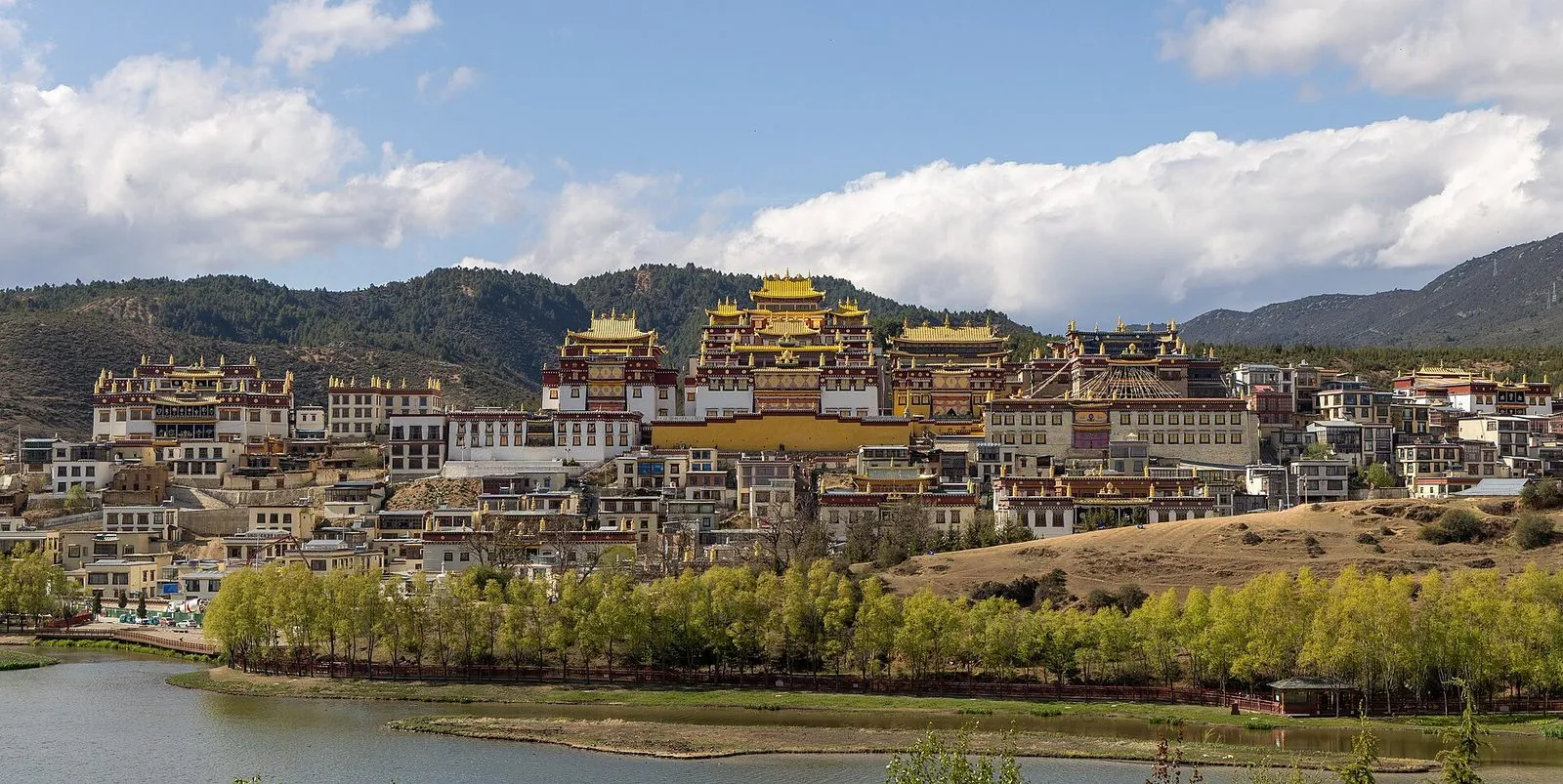
Shangri-La, a small city on the eastern edge of the Tibetan Plateau in far northwestern Yunnan, has worn a famous name since 2001, when the government rebranded the old town of Zhongdian after the paradise in James Hilton's 1933 novel Lost Horizon. The marketing gambit worked, but the place earns the myth: a 300-year-old monastery known as the Little Potala catches the sunrise over a holy lake, an old Tibetan quarter spins its giant prayer wheel above the rooftops, and the grasslands of Napa Hai run to snow peaks. At roughly 3,300 meters, it is high enough that altitude management is part of the itinerary, and winter is genuinely cold — yet the same clear skies that chill you make the light extraordinary. Shangri-La suits travelers who want Tibetan culture without a Tibet permit and big landscapes — including the two-day Tiger Leaping Gorge high trail — to go with it.
Top sights at a glance
No. 1
Songzanlin Monastery
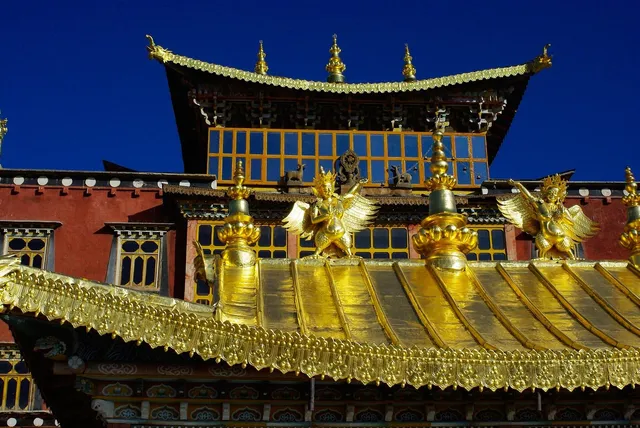
Founded in 1679 under the Fifth Dalai Lama and modeled on Lhasa's Potala Palace, Songzanlin is the largest Tibetan Buddhist monastery in Yunnan and the spiritual heart of the region. Its gold-roofed assembly halls climb a hillside above the holy lake of Lamuyangcuo, reached by a flight of 146 steps that will remind your lungs exactly where you are. Around 700 monks live here today; pilgrims from across Kham prostrate their way around the circuit. For many visitors this is the single best half-day in town.
Good to know · Entry runs ¥115 including the shuttle bus from the visitor center, open roughly 8:00 AM–5:30 PM (as of September 2026). Photography is forbidden inside the halls, remove hats and sunglasses, and walk clockwise. Local bus 3 reaches the gate cheaply from Dukezong; a taxi takes about 15 minutes.
No. 2
Pudacuo National Park
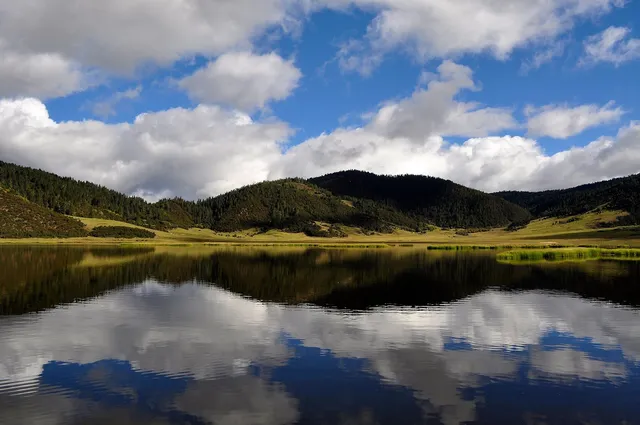
China's first national park, set up in 2006–2007 around two glacial lakes in the Three Parallel Rivers landscape, protects some 600 square kilometers of forest, meadow, and wetland an hour's drive from town. The visit nowadays concentrates on Shudu Lake at 3,705 meters, where boardwalks circle a mirror of water under fir forest — with azaleas in May and June and gilded larches in October. Higher pastures at Militang and Bita Hai have been closed on ecological rotation since 2017, which trims the classic route but concentrates the beauty.
Good to know · Ticketing has been restructured repeatedly as management shifted to conservation-first rules: recent published prices run from ¥190 up to a ¥258 package (¥138 entry plus ¥120 park bus), and hours run about 8:00 AM–4:00 PM for last entry in winter (as of September 2026). Confirm what is open and current pricing on the official WeChat mini-program before you go, and book with your passport.
No. 3
Dukezong Old Town
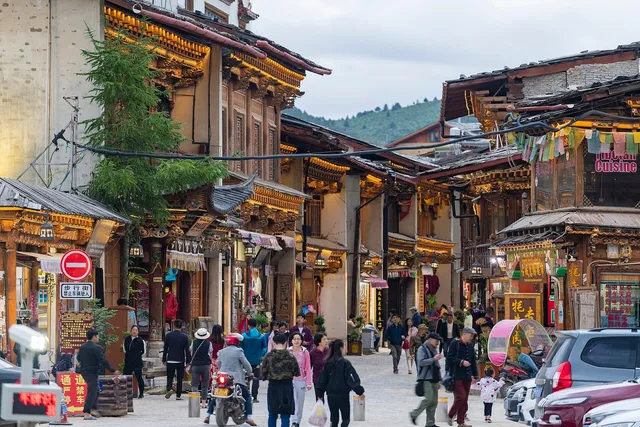
Dukezong — 'Moonlight City' in Tibetan — has stood on this plain for some 1,300 years as a caravan stop on the Tea Horse Road. In January 2014 a fire destroyed about half of the wooden old town, displacing 2,600 residents; the rebuild is faithful if a bit fresh-faced, and the headline sight survived untouched. Climb Guishan Hill's turning alley to the giant prayer wheel that pilgrims spin from a platform above the rooftops, then join the open-to-everyone circle dancing in Moonlight Square at night.
Good to know · Entry is free, day and night (as of September 2026); the prayer wheel takes several people pulling together to turn a full revolution. The prefecture museum near Moonlight Square is free and gives useful context on Kham Tibetan culture. Evenings are cold at this altitude year-round — bring a real jacket for the square.
No. 4
Napa Hai
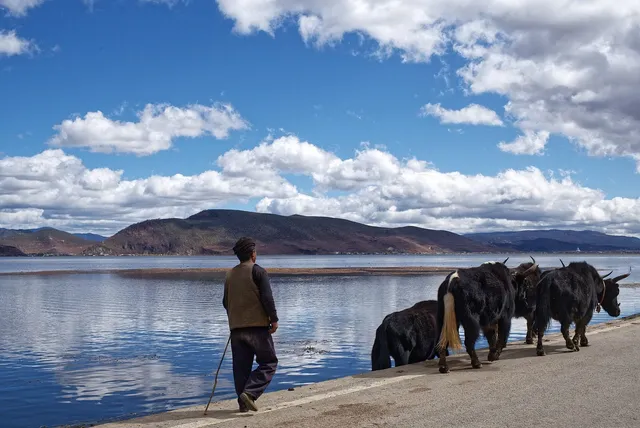
A few kilometers northwest of town, the Napa Hai is a plateau wetland that behaves like two landscapes in one year: from summer rains a shallow lake dotted with ducks, and by late autumn a golden grassland where yaks, horses, and Tibetan herders work beneath a wall of mountains. Endangered black-necked cranes — less than 10,000 left worldwide — winter here between roughly September and March. It is the easiest big scenery in Shangri-La, and on clear evenings the light turns the whole basin to amber.
Good to know · The ring road is freely rideable by bike or taxi, but checkpoints on the grassland side charge around ¥60 for the scenic area, and horse-ride offers run negotiable by the hour (as of September 2026). Locals may press firmly for the fee; pay at official booths only. Go late afternoon for photos, and in wet season expect mosquitoes at the lake edge; carry windproof layers, because the grassland generates its own weather.
No. 5
Tiger Leaping Gorge
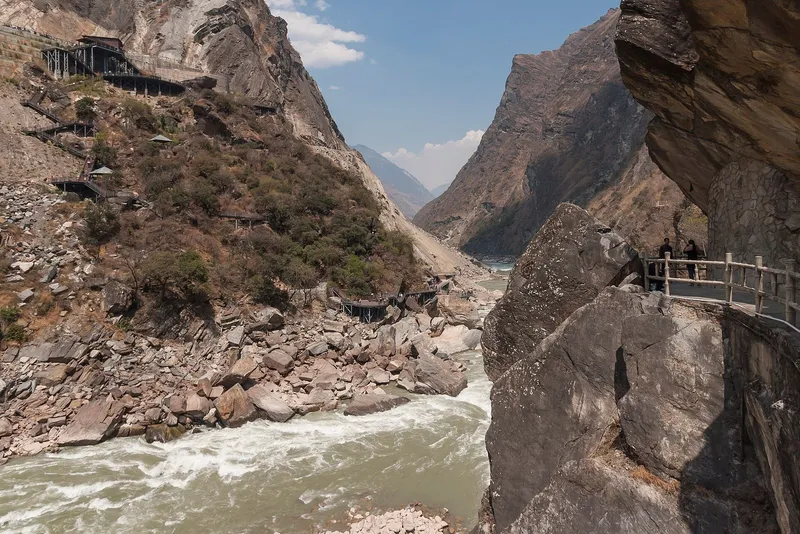
The Jinsha River, upper Yangtze, squeezes between the 5,596-meter Jade Dragon and 5,396-meter Haba snow mountains through one of the world's deepest gorges — nearly 3,800 meters from rim to rapids. From the Shangri-La side you get the upper-gorge walkways and the roar of the narrows within an hour and a half of town. But the gorge's real legend is the two-day high trail from Qiaotou over the 28 Bends to Halfway guesthouse — one of the finest walks in China, and worth planning a whole trip around.
Good to know · Entry is ¥45 on the Shangri-La side, open about 8:30 AM–5:30 PM (as of September 2026). The high trail is best in April–May and September–October; middle-gorge ladders and side paths charge small extra fees. Buses and shared tours run from town through the morning — or ride the Lijiang train and start from Qiaotou for the classic direction.
Shangri-La is the rare destination whose name is a marketing story and whose reality outperforms it. In 2001 the government renamed a small Tibetan market town — Zhongdian to mapmakers, Gyalthang to Tibetans — after the fictional paradise of James Hilton’s 1933 novel, and tourists have been testing the claim ever since. Mostly, the place wins. This is the Tibetan Plateau at its most approachable: a 300-year-old monastery known as the Little Potala glowing above a holy lake, a 1,300-year-old old town turning the world’s biggest prayer wheel, grasslands of yaks and black-necked cranes an easy bike ride from your guesthouse. It sits at roughly 3,300 meters, which reshapes everything: walk slowly on day one, pack a down jacket even in summer. Come here for Tibetan culture without needing a Tibet permit, for the gorge country on its doorstep, and for the cleanest high-altitude light you will ever photograph.
A Bit of History
For most of its history this place answered to geography, not to novelists. The town — Gyalthang, “royal plains” — sat on the Tea Horse Road, the caravan network that carried Pu’er tea north into Tibet and brought horses and salt back down, and its population of Khampa Tibetans traded with Naxi, Han, and Bai merchants moving through the valley. The Fifth Dalai Lama founded Songzanlin Monastery in 1679, choosing the site by divination, and under his successors the monastery grew into the region’s political-religious anchor — at its height housing around 2,000 monks. In April 1936 the Red Army’s He Long passed through on the Long March, an episode remembered in a small old-town museum.
The name change is the story everyone asks about. James Hilton never visited China, but his lamasery-with-a-view drew on National Geographic articles by Joseph Rock, an explorer-botanist working out of Lijiang — which gave the region a plausible paper trail to the myth. In December 2001 the central government awarded the name to Zhongdian county, making it the first place on Earth to legally become Shangri-La; several Chinese localities campaigned, and this one won. The county became a county-level city in 2014. Skeptics called it a publicity stunt, and it was — but it was also an acknowledgment that the very landscapes Hilton borrowed were here.
The 20th century was harder than the myth. Songzanlin was badly damaged in the Cultural Revolution and rebuilt from 1982 onward, and today holds around 700 monks. On 11 January 2014, fire tore through Dukezong’s wooden lanes, destroying some 242 homes — roughly half the old town — and displacing 2,600 people; the giant prayer wheel and hilltop temples survived, and rebuilding began within the year. Walk the lanes now and you will notice the seams: charred memories on one street, fresh-cut timber on the next, and a community that simply kept living here.
Culture & Daily Life
Shangri-La is a Tibetan city with a broad borderland cast. The old town and the surrounding countryside are predominantly Khampa Tibetan — the wide-walked, red-tasseled-braid branch of Tibetan culture — alongside Han, Naxi, Bai, Yi, and Lisu neighbors. Prayer flags run from every rooftop, prayer wheels line the pilgrimage circuit around the monastery, and on market mornings you will see herders in trapper hats selling cheese and butter next to farmers selling mushrooms.
Tibetan Buddhism structures the day. Pilgrims circle Songzanlin’s chorten clockwise, spinning every wheel; and in the old town’s squares the evening gathering — grandmothers to teenagers, visitors openly welcomed — dances in a great rotating circle well past dark. Joining in is the easiest cultural exchange you will have in China: someone wordlessly demonstrates the steps.
The town’s altitude — about 3,300 meters, with winter means below freezing and summer highs that rarely feel hot — keeps life deliberate. Locals drink butter tea for calories, eat tsampa and yak everything, and move through the bright, thin sunlight at a pace first-timers would do well to copy. Sunscreen is not optional at this elevation; the UV is fierce even when the air is cold.
Two honest notes on the tourist culture scene. The “Tibetan family visit” evenings — butter tea, tsampa-making, songs, and dancing with a local household — range from genuinely warm to amateur dinner theater depending on the operator; treat them as entertainment, not anthropology, and ask your guesthouse which families actually host. And the old town’s shop streets have their trinket commerce; the culture here is not behind the shopfronts but above them — on the hill, on the lake circuit, in the squares after dark.
Nature & Day Trips
The setting is the sales pitch. Shangri-La sits on a plateau dissected by upper Yangtze tributaries, ringed by peaks that stay white much of the year, and the light at this altitude makes even a bus window photogenic. The near landscape is the Napa Hai wetland and the grasslands beyond it — a half-day by bike — and Shika Snow Mountain lifts a cableway onto its 4,500-meter ridge directly south of town if you want the high country without a hike.
The serious landscape outing is Pudacuo National Park, an hour east, where boardwalks circle Shudu Lake under old-growth fir — full details below. May and June paint the hillsides with rhododendrons; the park’s azalea season is locally famous, and by October the larches go gold. Farther afield, the road toward Deqin climbs toward the Meili Snow Mountains, whose 6,740-meter Kawagarbo peak draws pilgrims on the multi-day Yubeng trek.
And then there is Tiger Leaping Gorge, beginning an hour and a half south. Even the upper-gorge platforms are a genuine encounter with big water; the two-day high trail is one of the great walks of Asia, and Shangri-La is the natural place to stage and recover from it. Whatever you choose, keep a flexible day: mountain weather turns fast, and a rained-out pass is best met with a second pot of butter tea.
Food & Drink
Highland Tibetan cooking anchors the table, and at 3,300 meters it is cuisine with a job to do. Yak butter tea — salty, rich, more soup than beverage — is the constant; drink it and your body will thank you. Tsampa, the roasted-barley staple you knead with tea and cheese into dough, is the regional bread, and tsampa-making features in most family-visit evenings. Yak meat shows up as stewed chunks, dumplings (momo), jerky, and — in winter — a hotpot built for the cold. Noodle houses and Sichuan-flavored kitchens fill the gaps, and good ones at that.
Seasonality matters here more than almost anywhere in China: from June to November the forests send matsutake and other wild mushrooms to market, cooked into restaurant hotpots at festival prices. Fresh yak yogurt with a dusting of sugar makes the standard dessert; barley beer and stronger highland spirits lubricate the evening dancing.
Where to eat: the lanes around Dukezong’s Moonlight Square hold the tourist-facing grills and hotpot halls, while the streets north toward the bus station keep the local canteens — follow the smell of butter tea. Prices run a notch below Lijiang for local food, and everything runs on Alipay or WeChat Pay; cash is rarely needed. A filling noodle lunch costs pocket money, a yak hotpot for a group divides kindly, and plain hot water or tea is the safe default drink — tap water stays off the menu, as everywhere in China.
Top Sights
Two mornings and two afternoons cover the essentials comfortably. Carry your passport for every ticketed sight; bookings run on official WeChat mini-programs and pay with Alipay or WeChat Pay.
Songzanlin Monastery
Give Songzanlin your clearest morning. The monastery — properly Ganden Sumtseling, founded 1679 by the Fifth Dalai Lama — spreads its white walls and golden roofs up a mountainside five kilometers north of town, deliberately modeled on Lhasa’s Potala Palace and nicknamed accordingly. From the visitor center a shuttle delivers you to the base of 146 steps; climb slowly, because the halls sit around 3,380 meters and the altitude tax is real. Inside, the assembly halls hold a gilded eight-meter Buddha, centuries of murals, and walls of scripture; around 700 monks study here now. Etiquette is strict and simple: no photography inside any hall, hats and sunglasses off, no pointing at statues, and always move clockwise. After the halls, walk the pilgrimage circuit around Lamuyangcuo lake below — roughly two kilometers, 40 minutes to an hour — where the whole monastery doubles itself in still water on calm mornings; the classic photo angle sits near Conggulong village. Entry runs ¥115 including the shuttle, open about 8:00 AM–5:30 PM (as of September 2026); local bus 3 makes the trip from Dukezong for pocket change, or a taxi takes about 15 minutes.
Pudacuo National Park
Pudacuo — the name is a Sanskrit rendering of “Bita,” ferry lake — became China’s first national park when it opened in 2006–2007, protecting glacial lakes, old-growth conifer forest, and meadow at 3,200 to 4,159 meters, an hour’s drive east of town. The visit has changed shape in recent years: after a 2017 environmental inspection, the boats, restaurants, and lakeside services at Bita Hai were removed, and both Bita Hai and the Militang pastures have been closed on ecological rotation since — the park you walk today centers on Shudu Lake. It is no demotion. A boardwalk runs along the lake shore at 3,705 meters through fir forest alive with squirrels and, if you are lucky, the flash of a black-necked crane in season; May–June adds rhododendrons, October gilds the larches. Be aware ticketing has been reworked repeatedly as management tightens conservation rules — recent published prices run ¥190 to a ¥258 package (entry plus mandatory park bus), with last entry around 4:00 PM in the cold months (as of September 2026). Reserve on the official WeChat mini-program or Trip.com with your passport, verify what is open before you drive out, and dress warmly: even in summer this is the coldest afternoon of your trip.
Dukezong Old Town
The old town rewards both directions of the clock. By day, wander the rebuilt timber lanes — 1,300 years of Tea Horse Road history, half of them refashioned after the 2014 fire — ducking into the free prefecture museum off Moonlight Square and the Long March museum, both good and both free. The climb that matters is Guishan Hill, up a turning alley of prayer wheels to the hilltop platform where the giant prayer wheel sits; it takes several people hauling together to complete a revolution, which is precisely the point. Entry to the old town is free around the clock (as of September 2026). By night, the square belongs to everyone: from about 7:00 PM the circle dance forms, locals and visitors rotating to Tibetan pop and traditional steps until well after dark. Skip the souvenir streets’ tiger pelts, buy gloves for tomorrow’s lake walk instead, and note the evening chill — the fun lasts longer if you dressed for it.
Napa Hai
The easiest landscape in Shangri-La is also its most seasonal, so time it deliberately. In summer the Napa Hai fills with monsoon water — a shallow lake graveled with ducks, the grass a deep green — and by late autumn it drains through its sinkholes, leaving a vast golden pasture where yaks and horses graze under the Shika range. From September to March the endangered black-necked crane overwinters here, one of the birding spectacles of the Himalayan region. The town side of the wetland is freely viewable from the ring road — rent a bike and ride out over the hill northwest of Dukezong — while checkpoints on the grassland side charge around ¥60 for the scenic area, and horse outfits work the shoreline at negotiable hourly rates (as of September 2026). Honest advice: the roadside and village-edge views give away most of the scenery for free, so pay the fee only if you want the specific grassland tracks or a ride. Go for the last two hours of daylight, when the basin turns amber and the mountains catch alpenglow; carry windproof layers — the grassland generates its own weather.
Tiger Leaping Gorge
The gorge deserves its reputation and then some: where the Jinsha River narrows between Jade Dragon Snow Mountain and Haba Snow Mountain, the water compresses into a churning chute just tens of meters wide — a tiger, legend insists, cleared it in one leap — and the walls tower nearly 3,800 meters above the rapids, among the deepest gorge profiles on Earth. From Shangri-La it is about 100 kilometers and an hour and a half by road to the upper-gorge section, where walkways drop to platforms beside the roaring narrows; entry on this side is ¥45, open about 8:30 AM–5:30 PM (as of September 2026). But the honest headline is the high trail: the two-day route from Qiaotou over the switchbacking 28 Bends to the legendary Halfway guesthouse — its toilet with the cliff-cut view — then down to Tina’s and the middle-gorge ladders, is one of the finest walks in China, and hikers who give it those two days tend to call it their trip’s highlight. Side paths and ladders charge small fees; April–May and September–October are the walking windows, and summer rain makes the trail slick and rockfall-prone. Buses and shared transfers run from Shangri-La through the morning; book the guesthouses ahead in season.
Getting There & Around
The railway changed this town. The Lijiang–Shangri-La line opened in November 2023: around eight departures a day make the run from Lijiang in about 1 hour 10 minutes to 1 hour 40 minutes for CNY 56–70, with through carriages putting Kunming within roughly five hours (as of September 2026). Book on the official 12306 app or Trip.com with your passport. The station sits on the west side of town, 15 minutes by taxi from the old town. Buses still cover the Lijiang route in about two and a half hours on the expressway if the train times misalign, and no flights fly it. Diqing Shangri-La Airport, ten minutes southeast, keeps several daily hops to Kunming (about an hour) plus Chengdu and Lhasa services — domestic only, so international visitors connect through Kunming.
In town, bus 3 is the pilgrim’s route to Songzanlin for a couple of yuan, taxis are cheap and everywhere, and bikes and e-bikes cover the Napa Hai ring pleasantly. For the gorge and Pudacuo, shared tours and chartered cars save logistics — the park gates sit an hour out, and bus service is thin. Altitude is the real transport planning: keep your arrival afternoon light.
Where to Stay
Two bases, clearly divided. Dukezong’s old town is the atmospheric pick — courtyard guesthouses rebuilt in Tibetan timber style, rooftop breakfasts under prayer flags, and the square dancing outside your window until it ends. It is the right choice for most first-timers — pick a lane a few minutes off Moonlight Square for quieter sleep. The modern town around the bus station and Changzheng Road is plainer and cheaper, with the practical advantage of early departures for the gorge and better late-arrival options from the train station.
Whichever you choose, book ahead for Chinese public holidays and the July–August swell, when prices climb with the crowds. Two nights is the workable minimum — one for Songzanlin and Dukezong, one for Pudacuo or Napa Hai — and a third unlocks the Tiger Leaping Gorge high trail, which is the trip within the trip.
Sources & verification (15)
- https://en.wikipedia.org/wiki/Shangri-La_City
- https://en.wikipedia.org/wiki/Ganden_Sumtseling_Monastery
- https://en.wikipedia.org/wiki/Potatson_National_Park
- https://en.wikipedia.org/wiki/Dukezong
- https://en.wikipedia.org/wiki/Lijiang%E2%80%93Shangri-La_railway
- https://en.wikivoyage.org/wiki/Zhongdian
- https://www.chinadiscovery.com/yunnan/shangri-la/ganden-sumtseling-monastery.html
- https://www.chinadiscovery.com/yunnan/shangri-la/pudacuo-national-park.html
- https://www.chinadiscovery.com/yunnan/lijiang/tiger-leaping-gorge.html
- https://www.chinahighlights.com/shangri-la/attraction/songzanlin-lamasery.htm
- https://www.chinahighlights.com/shangri-la/attraction/lake-napa.htm
- https://www.chinahighlights.com/shangri-la/plan-a-trip.htm
- https://www.chinahighlights.com/lijiang/attraction/tiger-leaping-gorge.htm
- https://www.travelchinaguide.com/attraction/yunnan/lijiang/tiger.htm
- https://www.trip.com/trains/china/route/lijiang-to-shangri-la/