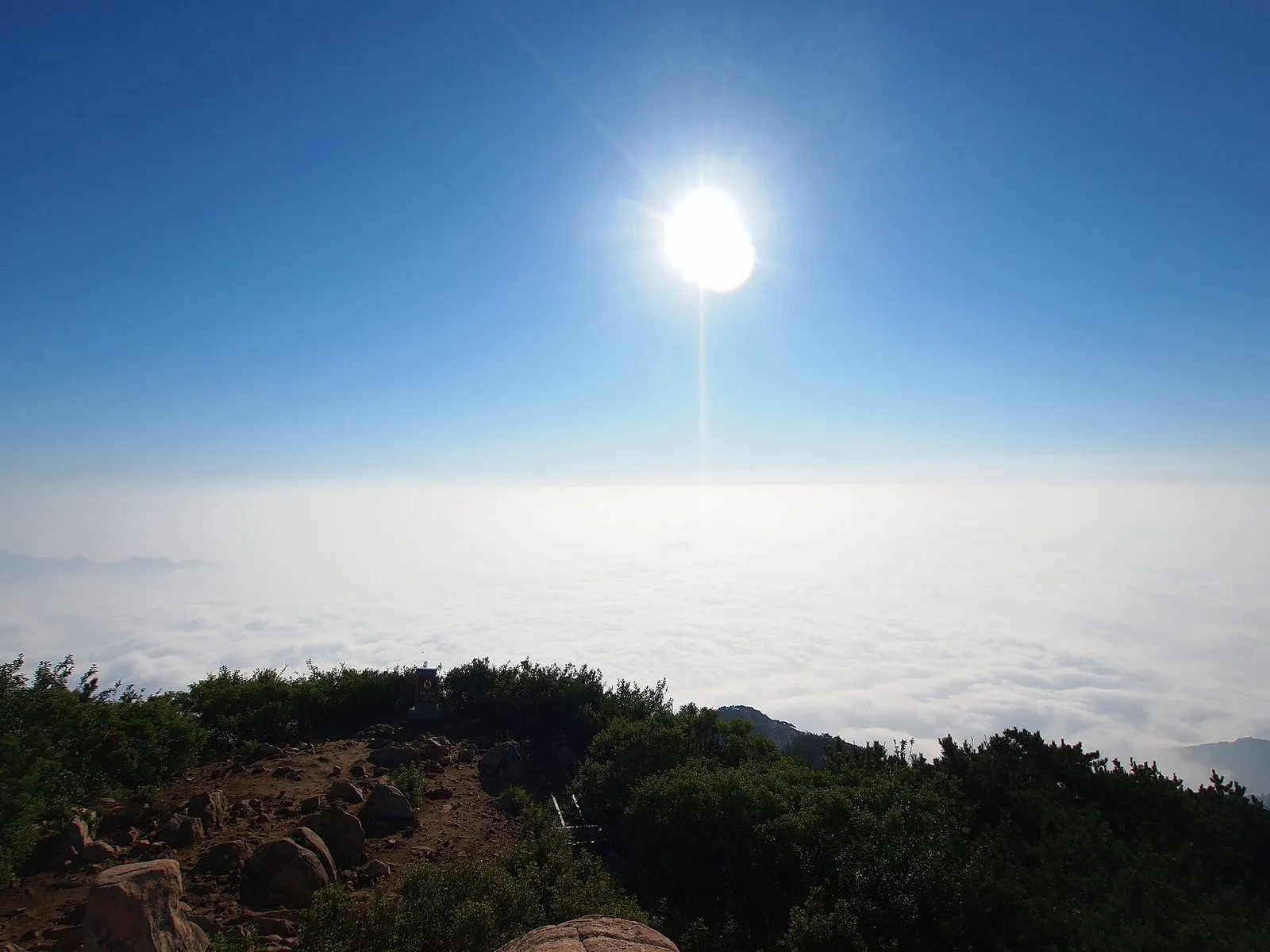
Tai'an is China's pilgrimage city — a prefecture that exists to put you on top of Mount Tai, the most ceremonially loaded mountain in the country. Emperors came here to sacrifice to heaven and earth; today the ritual belongs to everyone, and the classic form is the night climb: enter at the Red Gate in the dark, grind up 7,000-odd stone steps, and watch dawn break from the 1,545-meter summit above a sea of clouds. Cable cars spare modern knees, Dai Temple anchors the old city at the mountain's foot, and grill smoke and pancake stalls keep pilgrims fed. Mount Tai is a World Heritage site honored for both culture and nature, and pairs naturally with Qufu, Confucius's hometown, one stop south by high-speed rail. This page covers the night-route logistics, the reservation system, and when to ride instead of climb. Two days is plenty; one works if you are sharp.
Top sights at a glance
No. 1
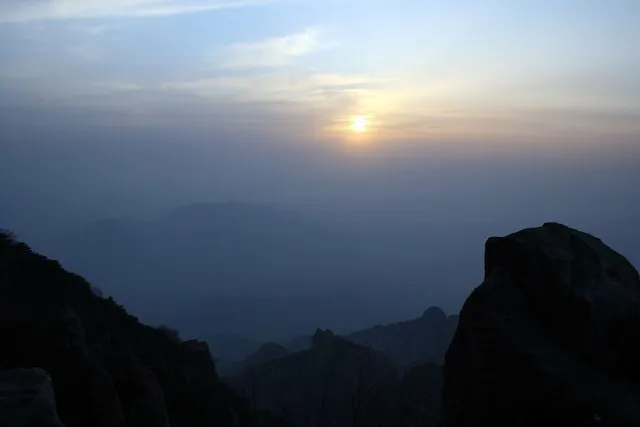
Sunrise on Mount Tai
The whole point of the mountain, and one of the great shared rituals of Chinese travel. The classic form is the night climb: enter at the Red Gate after dinner, walk roughly four hours up 7,000-odd stone steps through sleeping temples, and arrive at the Jade Emperor summit as the eastern horizon starts to burn. Sunrises here made Mount Tai the clock of Chinese cosmology — and on a clear morning the effect explains everything: light flooding a sea of cloud while hundreds of strangers go quiet at once.
Good to know · Entry requires a real-name reservation made up to seven days ahead on the official Taishan WeChat account or Trip.com; foreign passports get verified at a staffed window before the gate. Check the posted sunrise time and start so you summit 40 minutes early; summit restaurants rent thick padded coats, and temperatures run 10 degrees colder than the city. If clouds win, the mountain is still worth the stairs — but pick your second night rather than paying summit-hotel prices twice.
No. 2
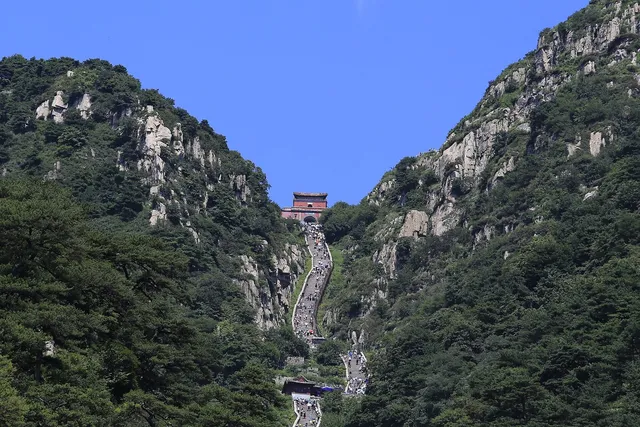
The Eighteen Bends
The mountain's final exam. Below the South Gate of Heaven the pilgrim path rears into three flights of near-uniform stairs called the Eighteen Bends — the steepest, most photographed section of the 7,000-step route, switchbacking up an open granite rampart with the valley falling away behind you. Pilgrims have climbed this ramp for two thousand years; today's climbers share it with student night-hikers, elderly pole-carriers, and porters hauling crates of bottled water on shoulder poles, which tends to recalibrate your complaints.
Good to know · The Bends sit in the last third of the Red Gate route, so pace your night climb for them — slow, small steps, headlamp on your forehead not your pack. In icy months the stone glazes over; microspikes sold at trailside stalls are worth every yuan. If you ride the mid-mountain cable car up instead, you can still descend the Bends on foot for the full experience without the quadricep bill.
No. 3
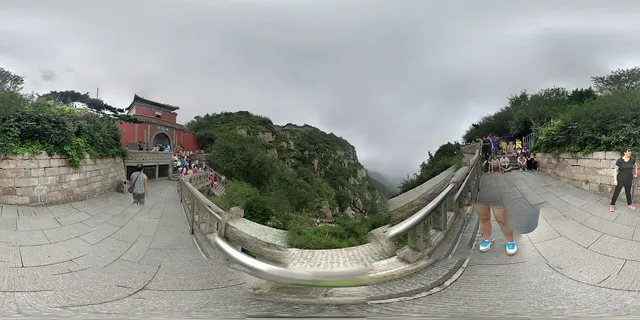
South Gate of Heaven
The red gatehouse pinned to the ridge at the top of the Eighteen Bends, and the threshold every Chinese climber knows by name: crossing it means leaving the human world for the sky. Beyond it the route levels onto Heavenly Street, a stone-paved row of temples, tea stalls, and guesthouses strung along the summit ridge like a village that floated up from the Ming dynasty. The gate is the mountain's best photo — part fortress, part mirage, lit by climbers' headlamps all night long.
Good to know · The gate marks the junction of the walking route and the mid-mountain cable car, which deposits riders a short walk below it — the standard plan for anyone skipping the stairs. Above the gate, everything is priced for its altitude, so top up water below. Sunrise crowds flow through here in the dark; grab a railing spot toward the eastern cliffs before heading for the Jade Emperor summit stone.
No. 4
Dai Temple
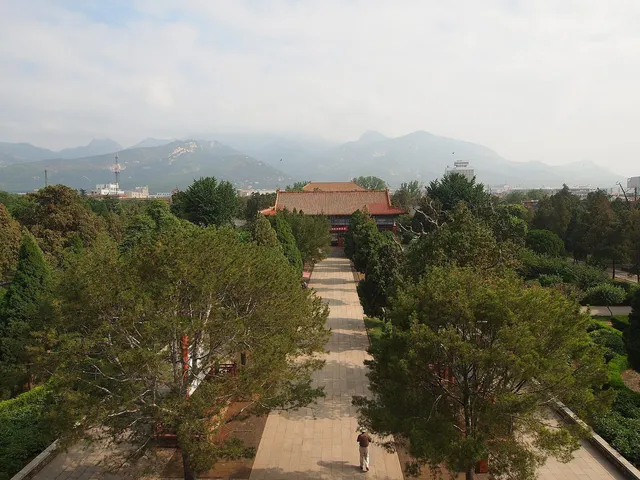
The mountain's gatehouse to the human world: a vast Han-dynasty-founded temple city at the southern foot of Mount Tai, where emperors honored the god of the mountain before ascending to heaven. Modeled on an imperial palace, it ranks with the Forbidden City and Confucius's Qufu temples among China's great historic building complexes — cypress-shaded courtyards, a forest of 150-plus ancient stelae including a 2,000-year-old specimen cut by Li Si. The centerpiece Tiankuang Hall shelters a 62-meter Song-dynasty mural of the mountain god's procession, over 600 figures long.
Good to know · The temple sits at the end of Tai'an's central axis, an easy walk or short taxi ride from the old town; allow 90 minutes and go in the morning light when the mural hall is quiet. Pair it with the start of the classic route — emperors began here before climbing — then continue to the Red Gate trailhead by city bus. Buy entry on site or with your mountain booking; the mural hall keeps its own hours inside the complex.
No. 5
Azure Clouds Temple
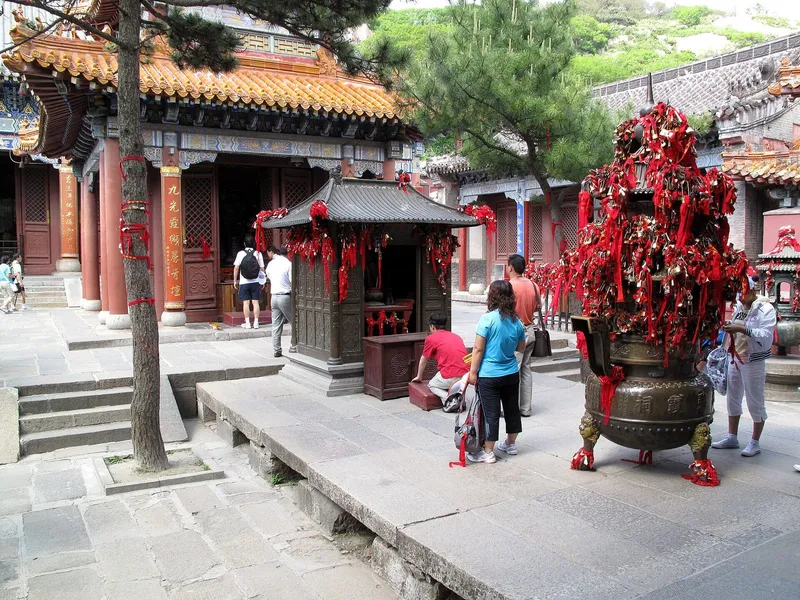
The summit's spiritual heart: a compact bronze-roofed Taoist complex on the south slope, founded in 1008 and renamed under the Qing, dedicated to Bixia Yuanjun — the Lady of Azure Clouds, Mount Tai's own goddess who grants safety and favors to the pilgrims who still stream up Heavenly Street clutching incense. Its iron and bronze cladding has survived lightning and centuries of mountain winters; from above, the temple's courtyards fold into the peaks. It is the most atmospheric building on the summit.
Good to know · The temple sits just off Heavenly Street below the Jade Emperor summit — ten minutes' walk from the cable-car top station, though the approach steps are steep. It is an active place of worship, so give incense-carrying pilgrims the inside line and photograph discreetly. Bronzes drip with padlocks and offerings; bring nothing you would mind leaving, and mind the ice on its stone apron in winter.
Every country has one mountain that means more than its height, and this is China’s. Mount Tai is not the tallest, wildest, or prettiest of the country’s peaks — Chinese tradition says so plainly — but it is the most ceremonially important, the “First of the Five Great Mountains,” where emperors came to report their legitimacy to heaven and where every schoolchild can recite Confucius’s verdict that climbing it makes the world look small. Tai’an, the city at its foot, has one organized purpose: moving pilgrims up and down. That sounds like a knock. It is the opposite — a landscape of stairways, temples, grill smoke, and rented coats tuned over centuries to one experience, sunrise from the top, that reliably reduces its climbers to silence. The smart visit runs one or two days: climb at night for the dawn, descend through the temples, finish in Dai Temple’s shaded courts. Fitness is optional — cable cars do the heavy lifting — but at least one long flight of the old stairs is what makes the summit mean something.
A Bit of History
Mount Tai’s resume starts where Chinese written history starts. Seventy-two rulers are said to have performed the great sacrifices here in antiquity; the Han dynasty’s Emperor Wu climbed eight times, and the temple complex at its foot grew into Dai Temple, founded in the Han era and expanded by every dynasty that wanted a claim on heaven. Confucius, who grew up one river plain away in Qufu, climbed it and pronounced the world small; poets kept adding verses. The stone steps and cliff faces became a public ledger of Chinese statecraft — some 2,000 inscribed relics remain, including a fragment cut under China’s first emperor’s chief minister, Li Si.
What made the mountain politically essential was the fengshan sacrifice: the rite a successful emperor performed here to report — and formally ratify — his mandate to rule. Rising abruptly from flat plains, Mount Tai was read as the pillar where heaven and earth met, and temples stitched the route into a single allegory — from Dai Temple at the city axis, up 7,000-odd steps through the Eighteen Bends, through the South Gate of Heaven, to the Jade Emperor summit at 1,545 meters: a ten-kilometer ascent from the underworld to the sky.
Modern history institutionalized the climb. Mount Tai entered the first UNESCO World Heritage list in 1987 as both a cultural and natural site — among the first mixed listings anywhere — and the city built a tourism calendar on it: the International Mountaineering Festival, raced every September since 1987, held its 40th edition in 2026. The working culture persists: Taishan porters still carry supplies up thousands of steps on shoulder poles as national symbols of grit, while “Stone Dares” talismans chiseled from Taishan rock still guard doorways across China.
Culture & Daily Life
Tai’an is a company town whose industry is transcendence. The city’s rhythm follows the mountain’s: dawn buses fill at Tianwai Village for the cable-car queue, dusk brings night-climbers to the Red Gate trailhead with headlamps and rented gloves, and the small hours belong to the stairway — students, families with thermoses, retired hikers in matching windbreakers, all at the same patient trudge toward a horizon none of them will see until 5 AM. The night climb, once an austerity hack for budget students, has become the mountain’s signature social ritual, half fitness culture, half pilgrimage.
Religion runs gently under the logistics. Mount Tai is Taoism’s eastern sacred peak and the seat of Bixia Yuanjun, the Lady of Azure Clouds, whose summit temple draws steady streams of incense-carrying pilgrims — grandmothers in matching jackets, parents carrying toddlers up the last steps for a blessing. You will hear the idiom “steady as Mount Tai” used for anything reliable and see Taishan stone slabs sold as door guardian talismans. Participation is welcome; no one will police your posture.
Daily life is Shandong at street level: heaping plates of dumplings and pancake rolls, night markets loud by 7 PM, and a pace that treats a five-hour stair climb as ordinary weekend behavior. English is thin — a translation app earns its keep — but Alipay and WeChat Pay work nearly everywhere, including at the gate; keep a little cash for the trailside coat-rental stalls.
Nature & Day Trips
Geologically, Mount Tai is an antique: a bulge of some of the oldest rock in China, shoved up in the Archeozoic and still growing at a bragged-about half-millimeter a year. Its power is relative height — it rises sheer off the North China plain, so it reads far bigger than its 1,545 meters, with nearly 1,400 meters of relief in under nine kilometers of walking. That abruptness makes its weather: the famous four wonders are sunrise, the sea of clouds, “Buddha’s light” glories, and winter rime icing the pines, and cool, clear mornings after rain favor all four.
Practical nature time is mostly the climb itself. The Red Gate route strings waterfalls, inscribed boulders, and pine shade up the green eastern flank; the western bus-and-cableway route trades forest for speed. Summit weather runs ten degrees colder than the city and wind is routine, so pack summer clothes plus a real layer whatever the forecast. Spring and autumn deliver the steadiest skies; midsummer brings thunderstorms and the biggest crowds; winter delivers ice and the year’s best rime shots for those who dress for it.
Day trips stack up cleanly. Qufu, Confucius’s hometown with its temple, mansion, and cemetery, sits one high-speed stop south and fits an afternoon. Jinan, the city of springs, is 18 minutes north by high-speed rail. And the mountain repays a slower second look: the lower trail temples and a sunset beer under the city wall with headlamp traffic still climbing above the town.
Food & Drink
Tai’an eats like Shandong — big, honest plates built to fuel labor — with the mountain supplying its own ingredients. The local brag is the Tai’an “three whites”: mountain cabbage, tofu, and spring water, worked into a formal Tofu Feast that turns the humblest ingredient into a dozen courses; herb feasts do the same with wild greens. The street staple is the Shandong millet pancake — a crackly crepe rolled around scallions and sauce — alongside dumplings, which the town eats with conversion-camp enthusiasm. The mountain’s signature protein is the chillin (rock) carp native to Taishan’s high streams, flash-fried whole until crisp enough to eat bones and all; order it once in town.
After dark the city eats barbecue: the streets around Dai Temple anchor a serious grill scene of lamb skewers, leeks in foil, and tower-height beer rounds that run late, joined by sprawling night markets feeding the post-climb crowd. On the mountain, adjust expectations and carry snacks — summit food is instant noodles and corn at altitude pricing, eaten for calories with a view, and there is genuine dignity in a steaming noodle bowl at 5 AM in the wind. Water costs climb with elevation; buy bottles at the Red Gate or Heavenly Street level. The one summit luxury worth the markup is a pre-dawn breakfast bag from your guesthouse — ask the night before.
Top Sights
Order matters on this mountain more than on most. The classic single-day plan: Dai Temple at the axis, night climb from the Red Gate, sunrise at the summit, temples on the descent.
Sunrise on Mount Tai
The night climb is the mountain’s essential experience, and it is easier than it sounds. From the Red Gate trailhead, the stone-pilgrim route — 7,000-odd steps past temples, springs, and inscribed boulders, through the mid-mountain town and up the great final flights — takes most walkers around four hours to the summit, timed so the eastern horizon is still black when you arrive. You will not be alone: holiday nights bring thousands, headlamps rippling up the switchbacks like a river of embers, and even on weeknights a steady trickle of students and pensioners keeps the stone warm. The posted sunrise time changes through the year; your hotel will know it.
Practicalities decide whether dawn is magic or misery. Entry is real-name and timed: reserve up to seven days ahead on the official Taishan WeChat account (or Trip.com with your passport) for your chosen gate and window — the Red Gate walking entrance keeps limited overnight hours, and foreign passport holders verify at a staffed window before entering. Bring a headlamp, a real warm layer, and cash for the trailside stalls that rent thick padded coats for the summit wait. When the sky clears, claim a spot on the eastern cliffs ten minutes before the posted time; when it does not, the thermos tea and shared jokes are their own consolation.
The Eighteen Bends
Every pilgrim route needs its crucible, and the Eighteen Bends are it: three steep, staircased flights stacked directly up an open granite rampart below the South Gate of Heaven, the final ascent of the classic route. The stairs are uniform, the rock closes in, the wind sharpens, and the crowds slow to a shared crawl — most people climb the last stretch in a hush broken only by counted breaths and the tap of walking poles. It sounds like a hardship; in practice it is the most communal stretch of the mountain, where strangers hand each other up the rails and arrive at the gate as temporary comrades.
Two tactics. On a night climb, save a reserve: the Bends come in the last hour when legs are spent, so shorten your stride, use both handrails, and rest at the landings rather than in the stair lanes. In ice season the stone glazes — traction cleats sold at the stalls below are the difference between climbing and skating. If you rode the mid-mountain cable car up, descend the Bends on foot instead: the view down the stairway to the plains is the mountain’s most iconic angle, and gravity makes it free.
South Gate of Heaven
The South Gate of Heaven is where the mountain changes states. The red gatehouse sits astride the ridge crest at the top of the Eighteen Bends, framed by cloud or blackout depending on the hour, and passing under it is the moment the climb stops being exercise and becomes arrival. Beyond, the trail levels into Heavenly Street — a stone lane of Taoist temples, noodle counters, guesthouses, and padlock stalls strung along the summit ridge, a working village that happens to float at 1,400-plus meters. It is the most atmospheric half-kilometer of walkway in eastern China, especially at night when headlamps replace lanterns.
The gate is also the junction for those who skip the stairs: the mid-mountain cable car tops out a short walk below it, and its queue is the summit’s main choke point — on holiday mornings the line can eat an hour, and when winds spike the cars simply stop, so build slack into any summit plan. Above the gate, continue ten minutes past Azure Clouds Temple to the Jade Emperor summit and its 1,545-meter marker stone. Everything up here costs more and carries less; the exception is the view, which over-delivers.
Dai Temple
Begin where the emperors began. Dai Temple anchors Tai’an’s central axis at the mountain’s foot — a Han-founded, palace-scaled complex of walled courtyards, ancient cypresses, and more than 150 inscribed stelae that function as the mountain’s national archive. The showpiece is Tiankuang Hall, raised in 1009, whose interior walls carry one of China’s great murals: sixty-two meters of Song-dynasty procession showing the mountain god’s hunting return, over 600 figures deep. Among Chinese historic buildings the temple shares a short list with the Forbidden City and Confucius’s Qufu complex, and standing in its main court, you get why.
Give it ninety unhurried minutes, ideally early before the tour buses. Do not miss the stele garden — the Li Si fragment, cut for China’s first emperor, is the oldest of its kind — or the faintly surreal sight of locals practicing calligraphy with water brushes on the courtyard stones. Entry is ticketed separately from the mountain; the central-axis walk toward the Red Gate trailhead is the classic orientation.
Azure Clouds Temple
Halfway between Heavenly Street and the summit, tucked into the south slope’s shoulder, stands the mountain’s spiritual landlady’s house: Azure Clouds Temple, founded in 1008 and dedicated to Bixia Yuanjun, the Lady of Azure Clouds. Her cult is the living religion of Mount Tai — mothers climbing with children on their backs, grandmothers with incense bundles, teenagers renting robes for photos — and the temple’s courtyards, roofed in iron and bronze against the mountain’s moods, stay busy in every season the cable car runs. Renamed in the Qing, it has survived lightning, fire, and revolution; the metal roofs you see are the engineering answer to a thousand winters.
Visit between the summit stones: it sits a staircase off Heavenly Street, ten minutes below the Jade Emperor peak, and the approach steps are slick in shade and ice. This is the summit’s active-worship space more than its museum — incense smoke, donation boxes, a queue to touch the altar rail — so move with the pilgrims, keep voices low inside the halls, and photograph the bronzes rather than the worshippers. On a cloud day, the temple dissolving into white, bells sounding from nowhere, is the summit’s best consolation prize.
Getting There & Around
Rail is the way in, on the Beijing–Shanghai high-speed corridor: frequent direct G-trains from Beijing, Shanghai, Jinan, and Qufu stop at Tai’an’s high-speed station, a short taxi hop from the old town and Red Gate. From Jinan, the provincial capital, trains run constantly and cover the distance in 18 minutes — most long-haul visitors transfer there. A smaller number of conventional trains use the older central station closer to the mountain’s base; check which station your ticket names, and book on 12306 or Trip.com with your passport.
On the ground, Tai’an is compact and mountain-logical. City buses and cheap taxis link the high-speed station, Dai Temple, the Red Gate trailhead, and the Tianwai Village bus-and-cableway plaza; the mountain shuttle connects Tianwai Village to the mid-mountain cable car. The overnight climber’s checklist: enter via your reserved gate and time slot (foreign passports verify in person), keep your ticket — it stays valid for three days after first check-in — and budget for the descent, when legs and judgment are both worse. As of September 2026, all mountain entry runs on real-name reservation via the official Taishan WeChat account or Trip.com, paid with Alipay or WeChat Pay.
Where to Stay
Pick your base by your climbing plan. For the night climb, stay near the Red Gate: the lanes around the trailhead are packed with small hotels and guesthouses tuned to 3 AM departures — luggage storage while you climb, hot showers after, and a breakfast counter that never really closes. It is the standard play and the cheapest good one.
For comfort, the belt between Dai Temple and Tianwai Village puts you at the city’s center axis: ten minutes’ walk to the temple, short taxi to either entrance, and the night market and barbecue streets at your door. It suits riders and one-night visitors who want the food without a midnight alarm.
The third option is the summit itself, and it is a trade: one night at the top buys you sunrise without the night climb and the strangest dawn of your life above the cloud line, at summit-hotel prices for rooms that are basic and book out weeks ahead around holidays — reserve early, split a room, or bring earplugs for the dorm beds. Rented padded coats are part of the ritual either way. Most first-timers should climb at night and sleep below.
Sources & verification (10)
- http://www.chinanews.com.cn/sh/2024/04-25/10205585.shtml
- http://www.chinanews.com.cn/sh/2024/04-30/10209087.shtml
- https://www.chinahighlights.com/mount-tai/
- https://www.chinadaily.com.cn/a/202305/13/WS645ec5eba310b6054fad2b90.html
- https://www.chinahighlights.com/china-trains/taian-jinan-train.htm
- https://www.chinanews.com.cn/sh/2021/06-14/9499543.shtml
- https://www.chinanews.com.cn/sh/2019/06-02/8853984.shtml
- https://www.taian.gov.cn/art/2026/8/27/art_368483_8301.html
- https://www.taian.gov.cn/art/2026/9/29/art_46739_10370126.html
- https://www.chinadaily.com.cn/a/202608/04/WS6a718d24a310986e2b468eaa.html