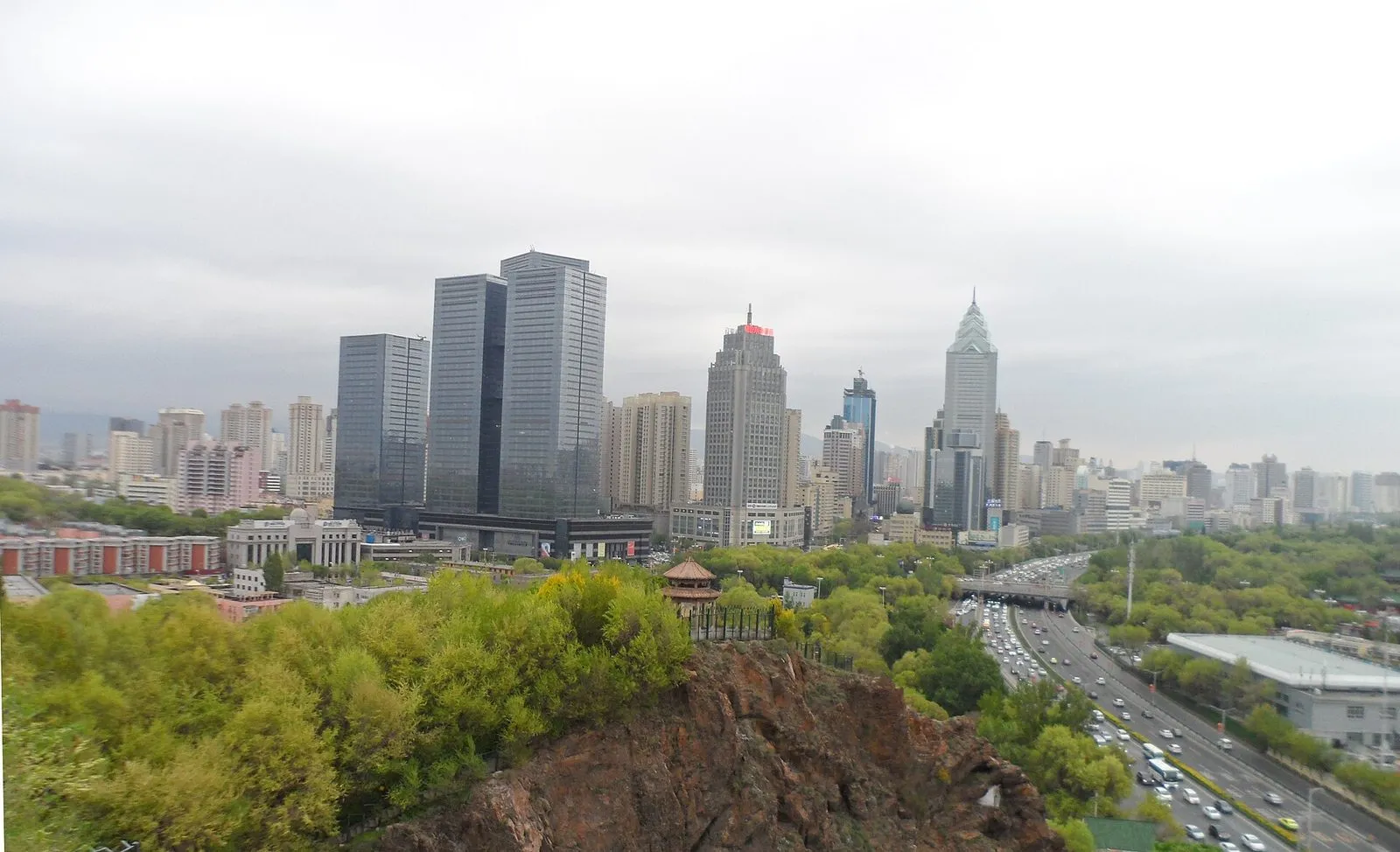
Urumqi sits closer to the geographical center of Asia than to any coastline — roughly 2,500 kilometers from the nearest sea — and everything about it feels accordingly far-flung. This is the gateway to Xinjiang and northern Silk Road country: a fast-growing metropolis of glass towers and grill smoke where Uyghur, Han, Kazakh and Hui communities share dumpling-and-naan streets. Travelers come for the International Grand Bazaar, the snow-rimmed Heavenly Lake of Tianshan under 5,000-meter peaks, the mummies of the Xinjiang Regional Museum, and horseback pastures an hour south of downtown. The city also runs on its own clock — China uses one time zone, but the sun here sets near 10 pm in summer, pushing dinners and bazaar nights late. Best for travelers continuing into northern Xinjiang, and for anyone who wants China at its most unexpectedly Central Asian.
Top sights at a glance
No. 1
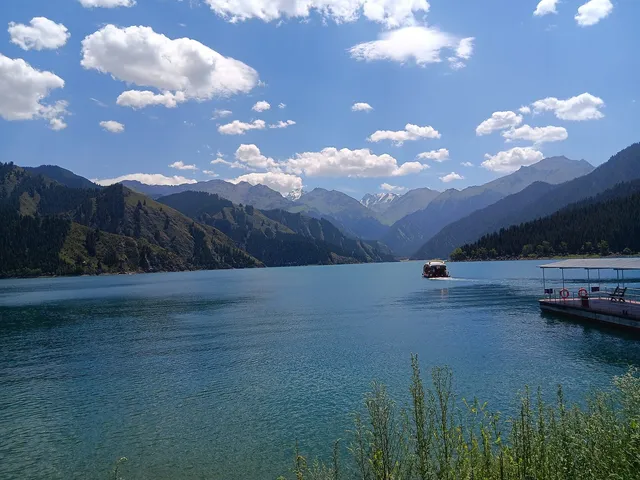
Heavenly Lake of Tianshan
About 100 kilometers east of the city, a crescent of meltwater — legend says the bathing pool of the Goddess Queen Mother of the West — lies cupped beneath the sawtooth snow peaks of Bogda Feng at around 1,900 meters altitude. Glacier-fed and improbably turquoise, the lake takes pleasure boats against a backdrop of spruce forest and Kazakh grazing meadows, and the mountain drive up is half the fun. In 2013 the greater Tianshan landscape was inscribed as UNESCO World Heritage, and the lake is its postcard.
Good to know · As of September 2026, expect a peak-season entry ticket of ¥95 (April–October) plus a mandatory park shuttle of ¥90; the site opens roughly 9:00–19:30 in high season. It is about a 90-minute drive each way — most visitors take a day tour, chartered car, or tourist bus. Go early for calm water and clear peaks, and book through official channels, paying with Alipay or WeChat Pay.
No. 2
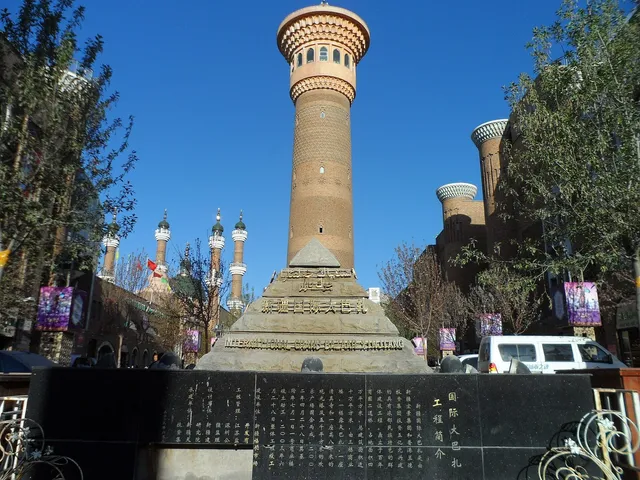
The International Grand Bazaar
Marketed as the largest bazaar on earth, this Islamic-styled market quarter of nearly 40,000 square meters packs in more than 3,000 stalls of dried fruit, carpets, jade, musical instruments and spices, with a food court grilling whole sheep and pulling noodles in plain view. Climb the sightseeing tower for a panorama over the old Erdaoqiao district, then stay for dusk, when tightrope walkers and street musicians work the square. It is touristy by design — and still enormous fun.
Good to know · Entry to the bazaar is free; the Silk Road Sightseeing Tower costs ¥50 (open roughly 10:00–20:00, with shops 9:30–20:00, as of September 2026). Bargain warmly from about half the opening price for carpets and dried fruit, and pay with Alipay or WeChat Pay. For a less staged version, wander the side streets of Erdaoqiao around it.
No. 3
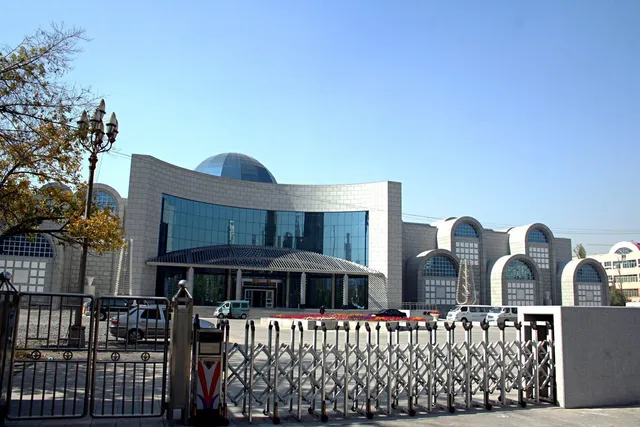
Xinjiang Regional Museum
Xinjiang's flagship museum does two things superbly: it tells two thousand years of Silk Road history — documents, textiles, Tang-dynasty biscuits — and it displays the ancient desiccated mummies the region's dry burials preserved, including the famous 4,000-year-old 'Loulan Beauty' with her eyelashes intact. Galleries on ethnic costumes and musical instruments double as a primer for everything you will see in the bazaar and beyond. Free, modern, and genuinely world-class.
Good to know · Admission is free with your passport. Closed Mondays; hours run 10:00–18:00 from mid-April to mid-October and 10:30–18:00 the rest of the year, with last entry around an hour before closing (as of September 2026). Daily numbers are capped with timed admission batches — arrive early or reserve ahead on the official WeChat account.
No. 4
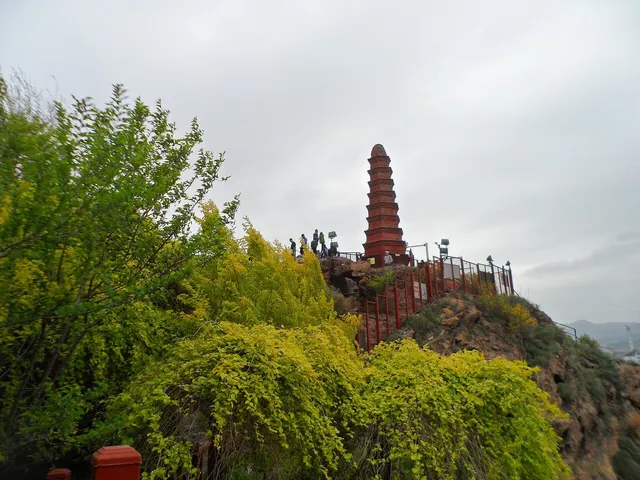
Red Hill Park
The craggy, iron-red outcrop at the city's heart is Urumqi's symbol, crowned since 1788 by the ten-meter Zhenlong Pagoda, a gray-brick Qing-dynasty tower built, as the story goes, to pin down a dragon that was flooding the town. A network of paths and pavilions climbs through the park to viewpoints over the downtown towers, with the snow cone of Bogda Feng visible on clear days. Sunset is the locals' hour, and the pagoda floodlights beautifully after dark.
Good to know · The park is free and opens roughly 10:00–21:00; the small tower-pavilion (Yuantiao Tower) charges ¥5 (as of September 2026). It sits minutes from the People's Square area, so pair it with an evening meal nearby. Bring your passport details to mind — security checks at park entrances are routine in Xinjiang.
No. 5
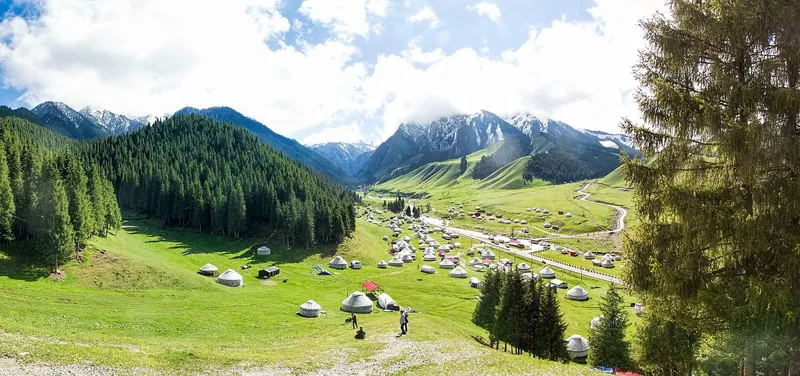
The Southern Pastures
An hour's drive south of downtown, the grassy folds of the Tianshan foothills — the 'Southern Pastures,' with West White Poplar Gully at their core — turn alpine every summer: spruce forest, wildflower meadows, snowmelt waterfalls and white yurts pitched by Kazakh herders. Accept the inevitable invitation for milk tea and cheese inside a felt tent, ride horses across the slopes, and you will understand why the name Urumqi is often glossed as 'beautiful pasture' in Mongolian.
Good to know · Admission to West White Poplar Gully runs about ¥30, open all day (as of September 2026); buses and day tours run from the city in roughly an hour. June to September is the green season — nights are cold even in July, so pack a layer. Agree on horse-ride prices before setting out, and carry small change for yurt tea stops.
Urumqi is the big city you did not expect this far from any ocean. The capital of Xinjiang sits almost exactly at the center of the Eurasian landmass — around 2,500 kilometers from the nearest coastline, farther from the sea than any other major city on earth — and it has grown into a fast, glassy metropolis that still smells of roasting lamb and cumin. For travelers it plays two roles: staging point for northern Xinjiang’s headline landscapes, and a destination in its own right — a bazaar city of Uyghur, Han, Kazakh and Hui communities, where the evening light lasts until nearly eleven and dinner starts when the rest of China is going to sleep. Give it two days and let it reset your clock.
A Bit of History
The name is old and the city is, by Chinese standards, young. Urumqi derives from a Mongolian phrase usually rendered “beautiful pasture,” a reminder that this valley was seasonal grazing land long before it was a capital. Herders, then Silk Road caravans, passed below the Bogda peaks for two thousand years; the town that emerged here was a garrison and grain depot, formally walled as Dihua by the Qing dynasty in the 1760s after their conquest of the Dzungar regime. When Xinjiang was made a province in 1884, Dihua — renamed Urumqi in 1954 — became its administrative head.
The twentieth century kept the city on edge and moving fast. Warlords, then Soviet influence, then the waves of migration and state farms of the 1950s turned a dusty oasis town into a planned industrial center of railway workshops, steel and cotton. When the main line from Lanzhou finally reached Urumqi in 1962, the city became the western terminus of China’s rail arteries and the hub of the Xinjiang Production and Construction Corps economy. It grew enormous and ethnically layered: a Han-majority city with large Uyghur, Kazakh, Hui and other communities, each with its own neighborhoods, mosques and restaurants.
Recent decades brought both prosperity and pain. Oil and trade money — Urumqi is the pivot of China’s Central Asian commerce — rebuilt the center in glass and concrete, while ethnic tensions erupted in serious unrest in the 1990s and most violently in July 2009, after which security became a visible, permanent feature of urban life. Today the city functions calmly under pervasive policing: checkpoints, ID checks and bag scans are simply part of the daily routine, for locals and visitors alike. Travelers who accept that reality find a welcoming, workaday city — one whose history is best read not in monuments, few of which survive, but in its people, its food, and the bazaar’s continuous reinvention of Silk Road commerce. For all its newness, it is a capital by decree with the memories of a caravan town: look past the glass and the pastures are still there, in the name, the food, and the mountains on the horizon.
Culture & Daily Life
The first thing to internalize in Urumqi is the clock. All of China runs on Beijing time, but the sun here keeps Central Asian hours: solar noon lands around two hours after the clock’s, so in June the sun rises near 6:30 and sets close to 9:45–10:00 pm, and in January it does not rise until nearly ten. Local life bends accordingly. Offices follow Beijing time, but restaurants stay busy past 10 pm, bazaars peak in the late evening, and asking for breakfast at 7 am can mean an empty kitchen. Plan your days about two hours later than you would elsewhere in China, and jet lag becomes a feature, not a bug.
The population mix shapes everything you see and eat. Uyghur and other Muslim communities anchor the food culture — expect halal defaults and lamb everywhere — while Han migrants from across China run much of the retail and service economy. Signage is bilingual in Chinese and Uyghur, though English is rare; a translation app and your destination’s name in Chinese characters will smooth most transactions. Kazakh herders still come down from the mountains with dairy to sell.
Daily life is North Chinese in texture and Western in setting. Winters are genuinely cold — a continental climate with long, dry freezes — and summers are hot by day, pleasant by night, with long golden hours. The city is modern and car-heavy, with a working metro, vast shopping malls, and an old bazaar district that functions as its communal living room. Security checks at malls, stations and attractions are routine and quick; carry your passport and build in a few extra minutes. What surprises most visitors is how relaxed the evenings feel: whole families out at 10 pm, skewer smoke over the crowds. That long dusk is the city’s signature experience.
Nature & Day Trips
Nature is the reason most travelers pass through, and Urumqi delivers it in two directions. South of the city, the Tianshan foothills fold into the Southern Pastures — Kazakh grazing country with yurts, horse trails and a dripping snowmelt waterfall about an hour from downtown (see Top Sights). East, the road climbs toward Bogda Feng and the Heavenly Lake, the glacial jewel of the range and a day trip in itself.
Farther afield is northern Xinjiang proper, and Urumqi is its operational hub. The classic extensions: Kanas Lake, the alpine showpiece of the far north, reachable by a short flight to Kanas Airport plus shuttle, or by an overnight train plus bus via Burqin — budget two days each way from the city. Yining and the Ili Valley, with lavender fields and grasslands, sit southwest on a dedicated rail line and short flights; Sayram Lake, the great blue circle near the Kazakh border, chains naturally onto an Ili route by road. Turpan, the ancient Uyghur oasis of grape trellises and ruined cities, is the easiest add-on of all — the high-speed line reaches it from Urumqi in roughly an hour. Book the first leg, and let Xinjiang’s distances teach you humility about the rest.
Food & Drink
Xinjiang food is the loudest argument for coming north, and Urumqi eats it at the source. The base notes are lamb, wheat, cumin and chili, cooked over fire and in woks of roaring oil. Lamb skewers (kawap) are the street beat — often threaded on slivers of red willow that perfume the meat — and a dinner of skewers, naan torn from a tandoor, and cold beer is a complete evening. The bench dishes: da pan ji, “big plate chicken,” a braising wok of chicken, potatoes and peppers with belt noodles added at the end; hand-grabbed pilaf (polo) of rice, lamb, carrot and oil; laghman, hand-pulled noodles stir-fried with meat and vegetables; baked samsa pockets crisped in tandoor walls.
Cooling counterpoints matter in the summer heat: yogurt with honey, sour-milk drinks, milk tea in Kazakh yurts, and the local novelty of shaved-ice “yogurt sorbet” piled with dried fruit at the bazaar. Which brings you to the fruit: Xinjiang’s long sunshine hours and brutal day-night temperature swings make the grapes, melons and dried fruit — raisins, walnuts, almonds, jujubes — legendary within China, and the bazaar’s nut stalls make excellent picnic provisions and gifts. Carpets, jade and musical instruments come home in suitcases too; bargain with humor, starting near half the quoted price. Thirsty work: try kvass-style bread drinks and the local dark lager where beer is served.
Geography of eating: the bazaar’s food court is the convenient one-stop show, but the honest version is in the streets around Erdaoqiao and the inexpensive Uyghur restaurants throughout the city — follow the skewer smoke. Alcohol is available in Han-run restaurants and bars; in halal establishments, do not ask. A generous feast runs ¥50–100 per person; payment is Alipay or WeChat Pay almost everywhere. One warning: this is heavy, oily, magnificent food — pace yourself, and save room for melon.
Top Sights
Plan one day for the city (bazaar, museum, Red Hill) and one for the mountains (Heavenly Lake or the pastures, traffic permitting), and Urumqi sequences itself.
Heavenly Lake of Tianshan
The headline. About 100 kilometers east of the city — call it a 90-minute to two-hour drive — the road climbs through gorge country to a crescent of glacier-fed water at around 1,900 meters, pinned beneath the granite pyramid of Bogda Feng (5,445 meters) and its sawtooth neighbors. Chinese legend makes this the bathing pool of the Queen Mother of the West, and the setting sells the story: spruce forests run down to wildflower meadows, and on calm mornings the snow peaks stand upside down in the lake. Pleasure boats cross to trailheads on the far shore; a lakeside path loops the water; a chairlift climbs for wider views.
The visit is ticketed in two parts: a park entry fee (¥95 in peak season, April–October, as of September 2026) plus a mandatory scenic-area shuttle (¥90) that covers the winding road up — budget roughly ¥185 per head before extras like boats (around ¥50) or the chairlift. Hours run roughly 9:00–19:30 in the high season. Book through official channels with Alipay or WeChat Pay, start early for clear peaks before afternoon clouds build, and pack a warm layer — the air at 1,900 meters stays cool even in August. Since 2013 the greater Tianshan landscape has held UNESCO World Heritage status.
The International Grand Bazaar
Urumqi’s theater of commerce. The International Grand Bazaar, in the old Erdaoqiao district, is an architecturally assertive complex — domes, minarets, a central plaza — that bills itself as the largest bazaar in the world, with nearly 40,000 square meters and over 3,000 stalls. The inventory is Xinjiang in commodity form: mountains of raisins and dried apricots, saffron, camel-hair carpets, dutar lutes, jade of every grade, and lengths of atlas silk. The food court does a roaring trade in whole roast lamb, skewers, polo and naan; at dusk, tightrope walkers and dance troupes work the square, and the floodlit towers make the whole quarter photogenic.
Yes, it is built for tourists — prices open high — and that is fine. Treat it as performance and pantry in one: climb the Silk Road Sightseeing Tower (¥50) for the panorama over old Erdaoqiao, bargain firmly and cheerfully, and pay by Alipay or WeChat Pay. Then do the authentic version: the streets around the complex stay true-market local, with better prices and no stage lights. The bazaar area runs all day, with shops 9:30–20:00 and the tower 10:00–20:00 (as of September 2026).
Xinjiang Regional Museum
Start your Xinjiang trip here, not the bazaar. The Xinjiang Regional Museum, in a stately ethnic-styled building on Xibei Road, is free and superb. Its signature galleries hold the Tarim Basin mummies — bodies naturally desiccated by the desert’s alkaline soils — including the 4,000-year-old “Loulan Beauty,” her reddish-brown hair and eyelashes astonishingly intact, alongside millennia of Silk Road cargo: Han-dynasty silks, Tang-era breads, documents in dead scripts. Galleries on the clothing, festivals and instruments of Xinjiang’s peoples turn the bazaar’s souvenir stalls into something legible.
Practicalities: closed Mondays; open 10:00–18:00 from mid-April to mid-October and 10:30–18:00 in the colder months, with last entry about an hour before close (as of September 2026). Admission is free with your passport, daily numbers are capped and admitted in timed batches, so come early or reserve on the official WeChat account. Two hours covers the highlights.
Red Hill Park
Urumqi’s living room with a view. Red Hill (Hongshan) is an abrupt, crimson-rock bluff near the city center — a fragment of the old landscape now ringed by towers — and the city treats it as its symbol. The gray-brick Zhenlong Pagoda on the summit dates to 1788, when a Qing general, tired of flood legends, ordered towers raised on this and a companion hill to “suppress the dragon” supposedly causing them. The pagoda survived; the story makes a good payoff at the top, where terraces look out over the metropolis toward the snow line of Bogda Feng on clear days.
Come at the end of the day, when the locals do: kite flyers, tai chi groups, and the whole city turning gold, then floodlit after dark (the park keeps 10:00–21:00 hours; the small Yuantiao Tower on the summit charges ¥5 — as of September 2026, park entry is free). Security checks at the gate are routine; carry your passport. The park sits within walking distance of the People’s Square hotel district, making it the perfect 90 minutes before a late Uyghur dinner.
The Southern Pastures
For a green version of Xinjiang, head south. Roughly an hour from downtown, the mountain wall of the Tianshan foothills — the Nanshan “Southern Pastures” — hides valleys of spruce and wildflower meadow where Kazakh herders summer their flocks. The classic target is West White Poplar Gully (Xi Baiyanggou): entry around ¥30, open all day, with a trail walking two kilometers up a canyon to a two-meter-wide waterfall that drops forty meters off a cliff face, mist and rainbows included. Around it: horse trails, barbecue platforms, and white yurts where herder families serve milk tea, cheese and roast lamb to whoever sits down.
Go between June and September for the green; nights stay cold, so pack a fleece even in July. Independent travelers can bus it; most visitors charter a car or take a half-day tour, which buys time for the ride and the tea without logistics. Set horse-ride prices before mounting, and give yourself a slow afternoon — after the bazaar’s intensity, high-pasture silence is Xinjiang’s other face.
Getting There & Around
Urumqi Tianshan International Airport, about 16 kilometers northwest of downtown, is the air hub for all of Xinjiang — dense domestic routes plus a wide roster of Central Asian and international connections. The airport metro station on Line 1 runs straight into the city center (the line opened through to the airport district in 2018–19), and a taxi takes roughly 20–30 minutes depending on traffic. By rail, Urumqi is the western anchor of the Lanzhou–Xinjiang high-speed line, which cut the journey from Lanzhou to around 11–12 hours when it opened in 2014; high-speed trains also cover the stretch to Turpan North in about an hour. The main Urumqi Railway Station (opened 2016) handles the bullet trains; overnight sleepers connect most major Chinese cities. Book on 12306 or Trip.com.
Inside the city, the metro (Lines 1 and 2), BRT busways, taxis and DiDi cover everything a visitor needs cheaply. One adjustment: Xinjiang runs on visible security. Expect bag scans and metal detectors at metro stations, malls, museums and park gates, and carry your passport — checks are routine, usually quick, and simply part of moving around. Add buffer time before departures and you will find the city easy and inexpensive to navigate.
Where to Stay
Three bases cover Urumqi. The area around People’s Square and Zhongshan Road is the all-around choice: central, walkable to Red Hill Park, stuffed with mid-range business hotels, and quick to the museum by bus or taxi. The Erdaoqiao district near the Grand Bazaar trades some polish for atmosphere — you sleep inside the bazaar quarter, with skewer smoke and evening performances on the doorstep, and morning naan a staircase away; a natural pick for a short, food-forward stay. Around the high-speed rail station or toward the airport, functional chain hotels suit early departures — and early is a real consideration, since Xinjiang distances punish dawdling. Two practical notes: many budget hotels in China cannot legally host foreign guests, so confirm when booking, and in this dry continental climate rooms are heated hard in winter — ask for a quieter room if you run warm. Keep your passport handy at check-in.
Sources & verification (12)
- https://en.wikipedia.org/wiki/Urumqi
- https://www.travelchinaguide.com/attraction/xinjiang/urumqi/tianchi.htm
- https://www.chinahighlights.com/urumqi/attraction/heavenly-lake.htm
- https://en.wikipedia.org/wiki/Tian_Shan
- https://www.travelchinaguide.com/attraction/xinjiang/urumqi/grand-bazaar.htm
- https://www.travelchinaguide.com/attraction/xinjiang/urumqi/museum.htm
- https://en.wikivoyage.org/wiki/Urumqi
- https://www.travelchinaguide.com/attraction/xinjiang/urumqi/redhill.htm
- https://www.travelchinaguide.com/attraction/xinjiang/urumqi/valley.htm
- https://www.travelchinaguide.com/cityguides/xinjiang/urumqi/getting-there.htm
- https://en.wikipedia.org/wiki/Lanzhou%E2%80%93Xinjiang_high-speed_railway
- https://www.travelchinaguide.com/attraction/xinjiang/urumqi/kanasi.htm