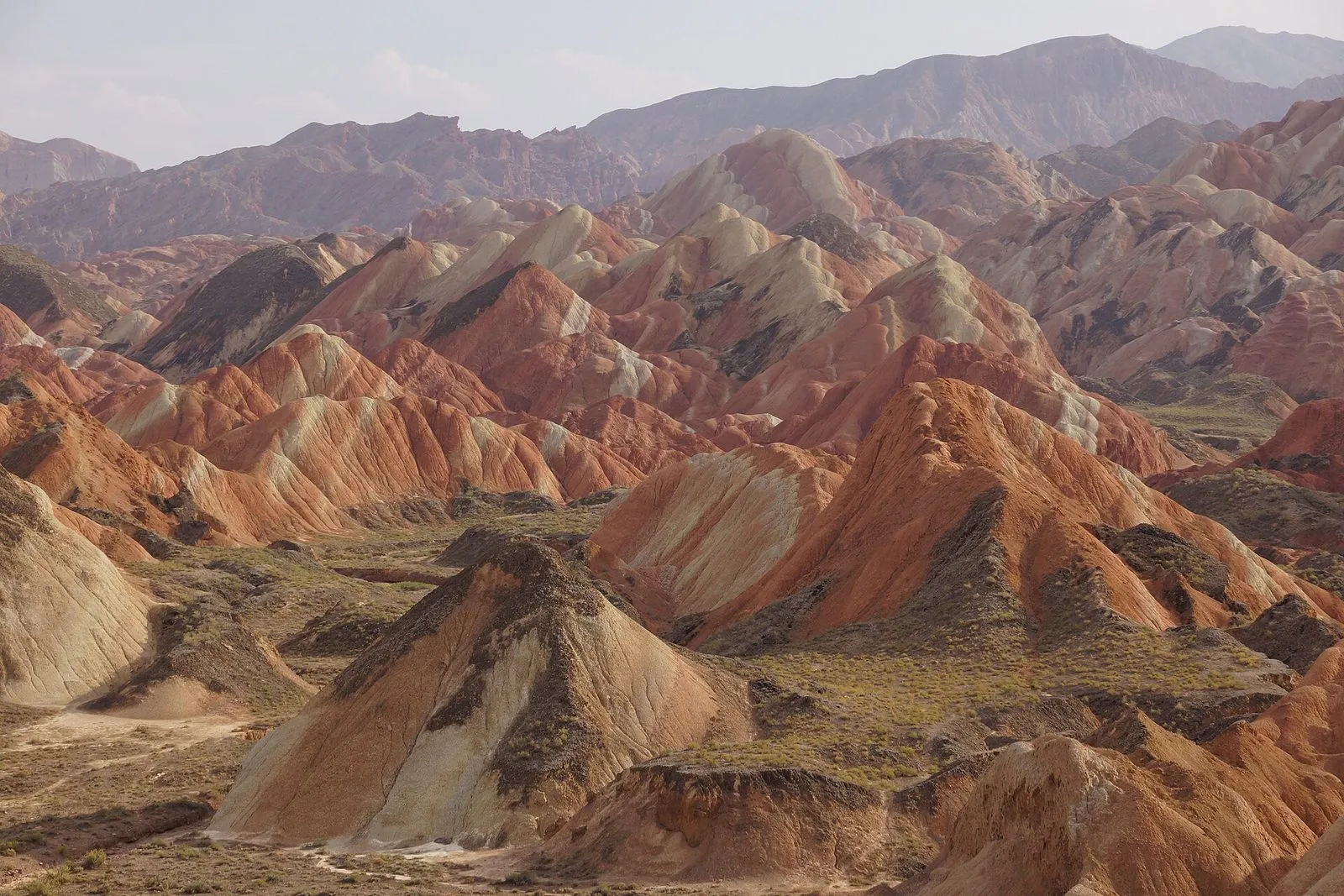
Zhangye sits at the green waist of the Hexi Corridor, the 1,000-kilometer channel of oases between the Qilian Mountains and the Gobi that carried the Silk Road through Gansu — and two eras of its wealth survive in one day trip. In the city, the Giant Buddha Temple preserves the largest indoor reclining Buddha in China, a 34.5-meter marvel of Western Xia clay and timber from 1098. An hour west, the Rainbow Danxia hills — banded candy-stripes of 24-million-year-old sandstone, now a UNESCO Global Geopark — draw the crowds, and honestly the sunsets too. This page covers the 2026 ticket-package math (entry plus mandatory shuttle), the gate and viewing-platform order that saves your evening, and the honest choice between the famous colored hills and the castle-like formations of Binggou, all fitted into the classic corridor run — Lanzhou, Zhangye, Jiayuguan, Dunhuang — by high-speed rail.
Top sights at a glance
No. 1
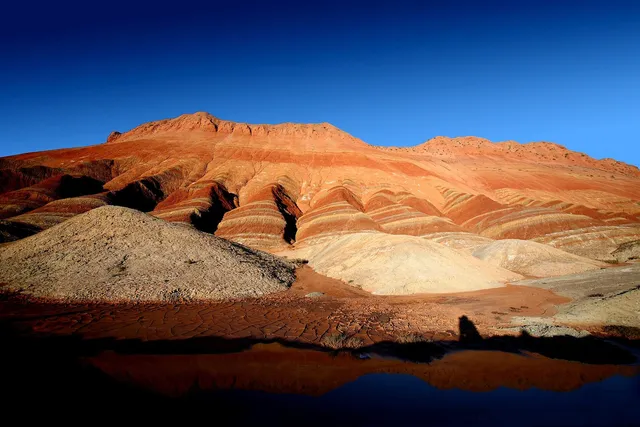
The Rainbow Danxia Landform
The hills that broke the Chinese internet: rolling ridges banded rust, gold, ochre, and gray-green — sandstone and mudstone laid down over 24 million years, tilted by the same tectonics that raised the Himalayas and scoured by wind into a palette with no equal in China. Four boardwalk viewing platforms string along the ridgelines; a mandatory shuttle links them every 20 minutes. Hollywood has noticed — Disney's Mulan shot here — and so has every tour bus in Gansu, which is why timing is everything.
Good to know · Entry plus the mandatory sightseeing bus runs ¥108 (¥70 + ¥38 shuttle), open about 6:00 AM–8:00 PM May–October (as of September 2026). Enter from the west gate in the afternoon and follow platform 1 to 4, saving the best ridge for sunset (around 7:30–8:00 PM in season). Fingerprint-register to re-enter next morning before 8:00 AM for just the bus fare.
No. 2
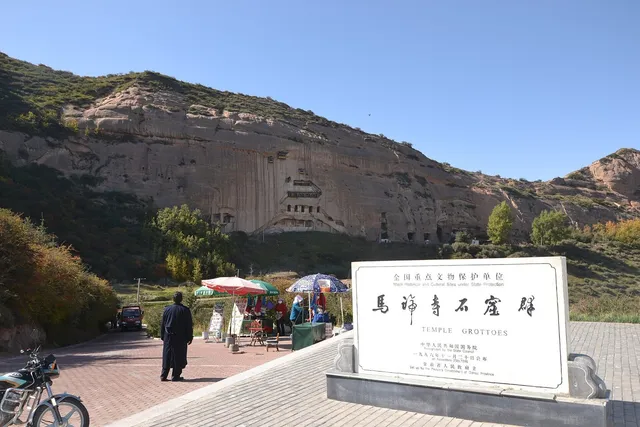
Mati Temple Grottoes
A cliff face an hour south in the Qilian foothills is honeycombed at Mati — 'Horse Hoof' — with grottoes begun in the Northern Liang era, 16 centuries ago. The thrill is vertical: the Thirty-three Heavens temple stacks seven stories of chambers up a sheer rock face, linked by tunnels and hand-worn steps you climb through, not walk past. Statues were mutilated in the 1960s, but the architecture, Yuan-era murals, and juniper-slope setting survive in force. A heavenly steed of the Gesar epic left the hoofprint that names the site.
Good to know · Tickets run about ¥73, open 8:00 AM–6:00 PM with the North Temple area as the main visit (as of September 2026). Wear real shoes for the vertical passages — they are tight, steep, and one-person wide. Two-hour horse treks across the grassland cost ¥150–200; pair the temple with a homestay in Sunan's Yugur county for a full day.
No. 3
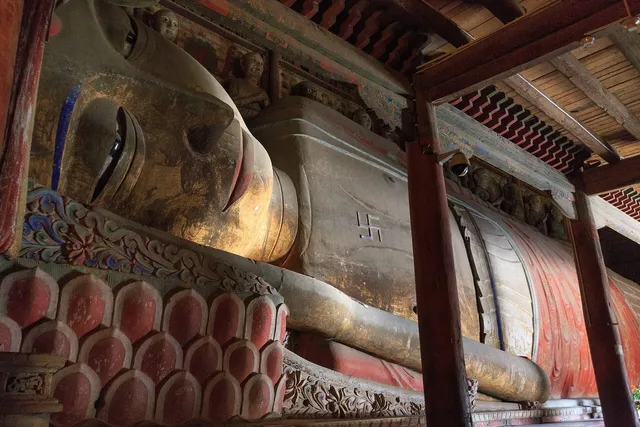
The Giant Buddha Temple
Dafo Si, raised in 1098 under the Western Xia dynasty, holds the reclining Buddha — at 34.5 meters, the largest indoor wooden-and-clay statue of its kind in China: toes the size of a person, a serene face that took craftsmen years to model. The murals behind the altar paint Journey to the West scenes claimed to predate the novel itself, and the sutra library preserves thousands of Ming-era scriptures, some in gold ink. Marco Polo claimed a year in this town; legend even places Kublai Khan's birth here.
Good to know · Tickets are ¥40, open about 8:30 AM–6:00 PM in the city's southwest corner, walkable from the Drum Tower (as of September 2026). Go in the morning for quiet and the best light on the Buddha's face. Photography rules are enforced — check at the door before raising a camera anywhere inside.
No. 4
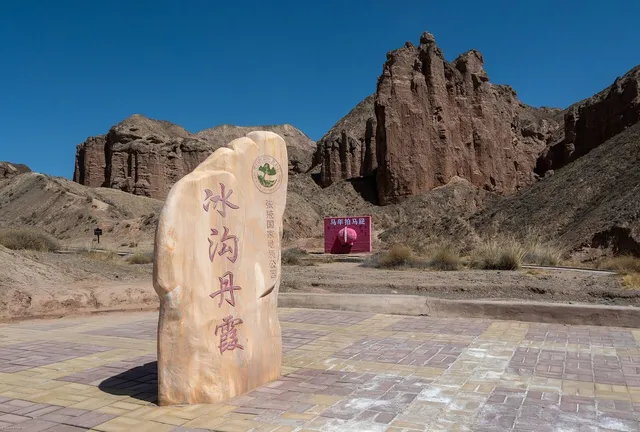
Binggou Danxia
Twenty minutes farther west than the Rainbow hills, in the Qilian foothills of Sunan county, Binggou trades color for form: the same 24-million-year-old sandstone eroded not into ribbons but into castles, columns, ramparts, and windowed walls — 'palace-type' danxia, 300 square kilometers of it, at 1,500–2,500 meters. Fewer buses come here, which is the charm: fortress-like stone cities, viewpoints named Little and Great Western Heaven, and the wind as your main companion.
Good to know · Entry is ¥40 plus a ¥20 park shuttle, open about 6:30 AM–7:00 PM (as of September 2026). Choose between the parks honestly: Rainbow Danxia for color and the classic sunset, Binggou for shape and solitude — many full-day tours chain both. Bring sun protection; shade is theoretical out here.
No. 5
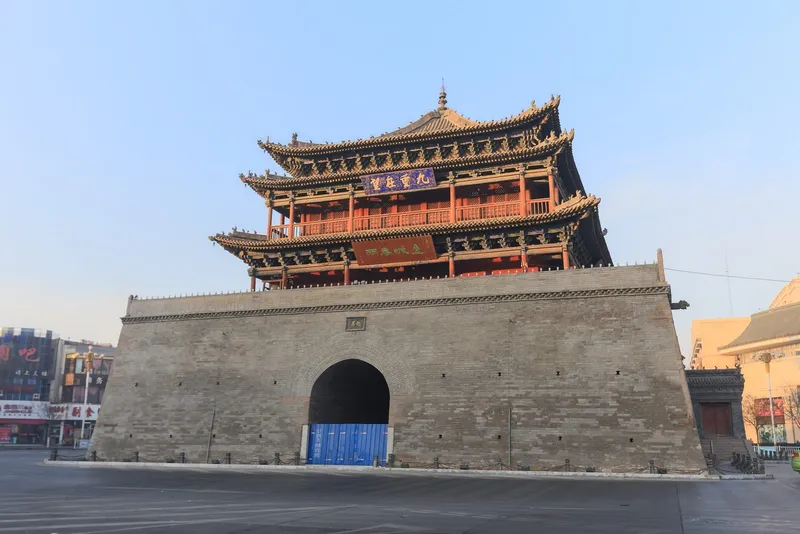
Zhenyuan Tower
At the exact crossroads of Zhangye's four main streets rises Zhenyuan Tower — the biggest drum tower of the Hexi Corridor, built in 1507 and rebuilt in 1668 after war damage, a three-story pavilion on a massive rammed-earth base. For five centuries it has marked the city's center the way a Silk Road waypoint should; a 600-kilogram bronze bell hangs on its corner. It is a half-hour stop, and the tower's greatest show is the town flowing around the four living streets below.
Good to know · The tower stands at the Dongfeng–Nanjie crossroads in the city center; admiring it from the corner is free, and tower access — when open — has historically been about ¥10 (as of September 2026). Note it has been wrapped in scaffolding for restoration work recently; check on the ground whether the upper pavilion is open before planning a visit.
Some cities you visit for one thing, and the thing is enough. Zhangye’s thing is one of the strangest, most beautiful landscapes in China: the Rainbow Danxia hills, where 24 million years of colored sandstone stripe mountain flanks like poured candy. The gateway town, though, is no afterthought. Zhangye sits at the green middle of the Hexi Corridor — the oasis strip between snow mountains and Gobi that every caravan and monk crossing between central China and Central Asia had to pass — and its oldest treasure is indoors: a 34.5-meter reclining Buddha, the largest of its kind under a roof in China, modeled in 1098 and still resting in the same hall. High-speed rail moves you here from Lanzhou in under three hours, and the Danxia sunset delivers nightly at 7:30 in season. Give the place two days: one for the hills at dusk, one for the Buddha, the grottoes, and the noodles.
A Bit of History
The Han dynasty built its western frontier around Zhangye — literally. A commandery was established here by 111 BC — the name means “extending the arm of the country through to the Western Realm” — and General Huo Qubing’s campaigns made the corridor garrison country. The oasis — watered by the Hei River off the Qilian snows, fertile enough that old China nicknamed the city “Golden Zhangye” — became one of the reliable resupply points of the Silk Road, where merchants swapped loads and monks paused between Chang’an and India.
The town’s most tangible relic came from the interregnum between empires. In 1098, under the Western Xia dynasty, work began on the Giant Buddha Temple, and the reclining Buddha modeled there still anchors the hall. Marco Polo claimed to have spent a year in the city (he called it Campichu); legend adds that Kublai Khan was born in the temple precincts, which historians file under stories too good to verify. The Ming left the drum tower at the crossroads in 1507; the Qing rebuilt it after war damage in 1668; and when the sea swallowed the Silk Road’s trade, Zhangye settled back into being what geography always intended: a superbly watered farm town in the middle of a desert corridor.
The 21st-century chapter is geological. China’s media voted the Danxia landform among the country’s most beautiful landscapes, film crews followed — Disney’s Mulan used the hills as a backdrop — and in 2019 the park was inscribed as a UNESCO Global Geopark. The visitor economy reorganized the city around sunsets: the park’s evening light show now dictates bus timetables, hotel prices, and the rhythm of the town. It is, honestly, a better business than camels.
Culture & Daily Life
Zhangye is a working oasis city first and a sight second, and daily life follows water and wheat. The Hei River’s snowmelt feeds orchards, corn, and the famous Linze jujubes; in autumn the markets pile up with dates, walnuts, and dried fruit stacked with sugar by the corridor’s brutal sunshine. The population is overwhelmingly Han, with one remarkable exception south: Sunan county is home to the Yugur, a Turkic-origin mountain people found nowhere else in China — herders whose festivals and archery give the county its autonomous status, and whose crafts appear if you push on to Mati Temple.
The city grid is broad, flat, and built for bikes and buses rather than strolls — distances that look small on the map take real time on foot, and summer noon or January dusk make the outdoors serious business. Life concentrates around the Drum Tower and the Giant Buddha Temple: tea houses, noodle shops, night markets, and the evening promenade every Chinese city of this size performs. Payments run on Alipay or WeChat Pay everywhere; note one 2026 quirk — city buses take cash from foreigners, because registering a transit card in Alipay wants a Chinese ID number.
English is scarce; a translation app and a smile cover the ground, as anywhere in the corridor. And mind the climate, which shapes everything: a cold desert regime where January averages sit around -9°C, July afternoons push past 30°C, and the 15-degree daily swings catch newcomers out. The visitor season runs June through September; the light is cleanest in spring and autumn.
Nature & Day Trips
Zhangye’s setting is a study in contrasts compressed into an hour’s drive. The city sits on a green oasis — poplar windbreaks, irrigation canals, market gardens — while directly south the Qilian Mountains lift snow-covered ridges over the farmland. The Danxia parks occupy the low foothills where that uplift meets the desert: the Rainbow hills for color, Binggou for fortress shapes, both within easy reach (details below).
For a third landscape, the Pingshanhu Grand Canyon northeast of town carves a red-rock labyrinth — slots, spires, and ridge walks — about 60 kilometers out; it is the local adventure favorite, sees a fraction of Danxia’s crowds, and pairs well with a second overnight. The grasslands around Sunan and the Mati Temple valley add a high-pasture afternoon: horse treks across meadow under the peaks, with Yugur herder country beyond.
North of the city, the desert takes over — the Blackwater State ruins of a pre-Han settlement lie 13 kilometers out in the gravel. And the corridor itself is the day trip that justifies the rail ticket: westward, Jiayuguan’s Ming fortress guards the corridor’s throat; farther on, Dunhuang’s Mogao Caves hold the art that this stretch of road paid for. Whichever direction you point, carry water, sun protection, and a windproof layer — the Gobi does not negotiate.
Food & Drink
Gansu eats noodles the way coastal cities eat seafood — with regional pride and technical one-upmanship — and Zhangye’s bowl of choice is chao pao, “firecracker noodles”: short, chewy wheat lengths stir-fried with pork and vegetables, a dish built for corridor appetites and rarely more than ¥30 a bowl. Hand-pulled beef noodle shops (the Lanzhou canon) crowd the morning streets; dumpling and stew canteens fill the evenings, and skewer grills smoke late by the night markets, where a table, a fan, and cold drinks make summer dusk the day’s best hour.
The oasis sends its own specialties. Linze jujubes — small, dense, absurdly sweet dates — appear fresh in autumn and dried all year, alongside walnuts and apricots from the corridor’s orchards. Handmade yogurt, thick and lightly sour, comes dusted with sugar; highland barley wine from the plateau trades toasts at dinner tables. A street-food crawl here rarely clears ¥40, and a sit-down lamb or pork feast divides kindly across a group — prices run visibly below the coast.
Payments run on Alipay or WeChat Pay at every stall; cash is barely needed. Drink bottled water or tea, as everywhere in China, and go easy on the first evening’s alcohol — the corridor’s altitude is modest, but the dry air is deceptively dehydrating. Vegetarians manage fine: noodle shops will build meat-free bowls, and the tomato-and-egg stir-fry is the national vegetarian guarantee.
Top Sights
One evening and one full day cover the essentials. Ticketed sites run on passport ID and Alipay or WeChat Pay; the two Danxia parks and Mati all sell entry-plus-shuttle packages, so read the gateboards before paying twice.
The Rainbow Danxia Landform
Plan the day around sunset — that is when the hills earn their name. The park — the Linze scenic area of the wider UNESCO-listed geopark, about 30–40 kilometers west of the city — strings four boardwalk viewing platforms along its ridgelines: platform 1, the broad opener; platform 2 and its 666-step climb to the panorama; platform 3’s fan-shaped folds; platform 4, the ridge-top finale where the banded hills run to the horizon and the tour buses park themselves an hour early. From the north and east gates the shuttle sequence runs 2-1-3-4; from the west gate it runs 1-3-4-2, which is why late-day visitors favor the west — you end on the best terrace as the light goes vertical (sunset around 7:30 PM in spring and autumn, 8:00 PM midsummer, as of September 2026). Tickets plus the mandatory shuttle run ¥108 total; hours stretch 6:00 AM–8:00 PM May–October. Two local mechanics save real money: buses from the city’s West Bus Station cost ¥15 each way (first bus 7:45 AM, last return 6:30 PM from the north-gate lot), and if you fingerprint-register at a scanner on the loop, you can re-enter next morning before 8:00 AM paying only the shuttle — the smart play for sunrise, when the hills are empty and cool. Honest notes: you cannot wander freely — boardwalks and shuttles only — and the midday park is a baking, jostling scrum; the magic is at the edges of the day.
Mati Temple Grottoes
About 65 kilometers and an hour and a half south into the Qilian foothills, the Mati cliffs hold one of China’s more thrilling temple visits. Grottoes have been cut into the rock here since the Northern Liang era, 1,600-odd years ago, and the showpiece is the Thirty-three Heavens temple: seven stories of chambers stacked up the cliff face, threaded together by tunnels, footholds, and stair-notches worn by centuries of pilgrims’ feet. You climb through it single-file, hearts beating, past niches where statues stand damaged from the 1960s — the vandalism is part of the story — and out onto ledges with the valley and its prayer flags below. Around the main cliff, the site spreads across several zones: the Thousand Buddha Caves, a King Gesar hall honoring the epic hero whose heavenly steed left the hoofprint that named the place, and Yuan-era murals that survived the worst. Tickets run about ¥73 with the shuttle zones sold separately, open 8:00 AM–6:00 PM (as of September 2026); two-hour horse treks across the grassland run ¥150–200 and suit the landscape perfectly. Wear grippy shoes for the vertical passages, avoid the caves after heavy rain, and consider overnighting in Sunan to make it a full high-valley day rather than a dash.
The Giant Buddha Temple
In the city’s quiet southwest corner, behind walls planted with old trees, waits the best interior in Zhangye. The Giant Buddha Temple — Dafo Si — was raised in 1098 under the Western Xia, and its hall is sized to its occupant: the reclining Buddha stretches 34.5 meters, the largest indoor wooden-and-clay reclining figure in China, eyes closed, feet the height of a standing person, the whole form modeled over a timber armature and repainted across nine centuries. Stand at the feet first and walk the length of the hall; the perspective shift is the visit. Behind the Buddha, murals paint Journey to the West episodes — famously claimed to predate the novel by centuries — and the sutra library preserves thousands of scriptures from a 1445 imperial gift, some copied in gold ink. Tickets are ¥40, hours about 8:30 AM–6:00 PM, a flat walk from the Drum Tower (as of September 2026); mornings are quietest and kindest to the Buddha’s painted face. Mind the photography rules posted at the door. Marco Polo claimed a year in this town and legend birthed Kublai Khan here — standing in the hall, you stop entirely ruling either out.
Binggou Danxia
Twenty minutes past the Rainbow hills, the landscape changes argument. Binggou — the second scenic area of the geopark, up in Sunan county’s foothills at 1,500–2,500 meters — has the same ancient sandstone but none of the candy stripes: here wind has carved the rock into castles, columns, ramparts, and windowed walls, the “palace-type” danxia that looks less like geology than the ruins of an abandoned empire. Viewpoints named Little and Great Western Heaven link by trails and shuttle through two valleys; Great Western Heaven’s high terraces give the postcard fortress panorama. Entry is ¥40 plus a ¥20 shuttle, open about 6:30 AM–7:00 PM (as of September 2026). The honest comparison, since every traveler asks: Rainbow Danxia wins on color and is engineered for crowds at sunset; Binggou wins on form, silence, and sky — midweek you may share it with nobody. Shapes photograph best in raking morning and late-afternoon light, and there is no shade to speak of — carry water and a hat. If you have one day only, the hills at sunset win; if you have two, do them both and thank yourself.
Zhenyuan Tower
Every crossroads city needs its center, and Zhangye’s has stood on the same spot since 1507, when the Ming raised the drum tower that today is called Zhenyuan Tower — the largest drum tower in the Hexi Corridor. Rebuilt in 1668 after war damage, it is a three-story wooden pavilion on a fortress-like rammed-earth base, straddling the exact meeting point of the four main streets, with a bronze bell cast centuries ago hung at its corner. The tower is a 30-minute stop, best slotted between the Giant Buddha Temple and dinner, when the crossing fills with bikes, strollers, and the evening light warming the eaves (as of September 2026). Viewing from the street corner is free; pavilion access, when open, has historically cost about ¥10 — but note the structure has been under restoration wraps recently, so check on the ground whether you can climb before counting on it. Come anyway: a Silk Road waypoint at a living crossroads is the corridor in one image.
Getting There & Around
The corridor is a rail line now, and Zhangye sits on it. Zhangye West station, opened on the Lanzhou–Urumqi high-speed railway in 2014, puts Lanzhou 2 hours 15 minutes to 3.5 hours away (around 31 departures daily, fares from roughly ¥60) and Xining about two hours east (as of September 2026) — book on the official 12306 app or Trip.com with your passport. Westbound, Jiayuguan’s Ming fort is 1 to 2 hours by train; Dunhuang riders usually continue to Liuyuan South and cover the last stretch by road, the classic corridor sequence. Zhangye Ganzhou Airport, 13 kilometers south, has limited and seasonal flights; most visitors arrive by rail.
In town, taxis and DiDi are cheap and everywhere; city buses cost ¥1 but want cash from foreign visitors (the Alipay transit card needs a Chinese ID). The practical legs are the two Danxia parks: frequent buses leave the West Bus Station for the Rainbow park (¥15, about an hour), and Mati Temple is best reached by chartered car or a small-group day tour. Plan your evenings around the center — everything worth eating is within a short walk of the tower.
Where to Stay
Two sensible bases. The city center around the Drum Tower and the Giant Buddha Temple is the character pick: mid-range hotels on honest budgets, night markets and the tower’s crossroads downstairs, and the morning Danxia bus a short ride away — right for nearly every first-timer. The area near Zhangye West station suits rail arrivals and early departures, trading atmosphere for convenience — the efficient choice for a single overnight between trains.
A third option buys you the light: small hotels and guesthouses cluster near the Rainbow park’s gates, right for photographers who want sunrise and sunset on the hills without an 11 PM highway run — accept thinner services and book early for summer weekends. However you choose, remember the park’s own rhythm: the fingerprint re-entry trick makes a one-night, city-hotel plan work perfectly — sunset with the crowds, sunrise without them.
Sources & verification (13)
- https://en.wikipedia.org/wiki/Zhangye
- https://en.wikipedia.org/wiki/Zhangye_National_Geopark
- https://en.wikivoyage.org/wiki/Zhangye
- https://www.travelchinaguide.com/attraction/gansu/zhangye/danxia-landform-geopark.htm
- https://www.travelchinaguide.com/attraction/gansu/zhangye/giant-buddha-temple.htm
- https://www.travelchinaguide.com/attraction/gansu/zhangye/bell-and-drum-tower.htm
- https://www.chinahighlights.com/zhangye/
- https://www.chinahighlights.com/zhangye/attraction/danxia-landform-geological-park.htm
- https://www.chinahighlights.com/zhangye/attraction/grand-buddha-temple.htm
- https://us.trip.com/travel-guide/attraction/sunan/mati-grottoes-tourism-area-78403/
- https://us.trip.com/travel-guide/attraction/sunan/binggou-danxia-96339/
- https://www.trip.com/trains/china/route/lanzhou-to-zhangye/
- https://www.trip.com/trains/china/route/zhangye-to-jiayuguan/