China Etiquette: Table Manners, Temples, Face, and How Not to Offend
China is one of the easiest countries to travel politely: nobody expects you to know the script, and effort counts double. But a handful of unwritten rules explain almost everything confusing about a Chinese day — why nobody eats before the honored guest, why the table spins against you, why the restaurant erupts into a fight over who pays, why your 'no thanks' needs repeating three times, and why nobody wants a tip. This guide covers lazy-susan mechanics and toasting culture, how to behave in temples, queueing and crowd realities, the logic of face and indirect communication, how to bargain without being either a victim or a bully, and where a quiet step back is wiser than a question. Etiquette as practiced, as of September 2026.
The short version
- Don't eat or drink before the host or honored guest starts; take food from the dishes nearest you and never dig through a shared plate
- Ganbei (干杯) means 'dry the glass' — clink lower than elders, sip freely if you must, and know the bill is a polite fight you will lose
- In temples: quiet voices, covered shoulders, follow posted incense rules, and expect crowds on lunar calendar the 1st and 15th
- Nobody says a direct no — hesitation, a smile, or 'maybe' often means no; pushing causes loss of face, the thing to avoid at all costs
- Tipping is not expected anywhere in mainland China; upscale restaurants add a 10-15% service charge instead
The standard warning about Chinese etiquette is overblown. Nobody expects a tourist to run a formal banquet, and the occasional gaffe — yours will be spotted a mile away — is met with amusement, not offense. What actually helps is understanding the small number of unwritten rules that explain the confusing parts of a Chinese day: why the meal hasn’t started, why the table is spinning, why three people are physically wrestling over a restaurant bill, and why the shopkeeper’s “maybe” isn’t a maybe. Learn those and you will travel more gracefully than most. As of September 2026, here is the working version.
At the Table: The Lazy Susan Rules
Shared dishes arrive and land on a turntable; the meal is a slow rotation. The mechanics:
- Wait for the signal. Nobody eats or drinks before the host or the guest of honor starts — the host says something like “chī hǎo, hē hǎo” and picks up chopsticks. As a guest you will be urged to start early; a token pause for the signal is polite.
- Take from the dish in front of you. Spin gently, serve yourself from what is directly before you, and never reach across the table or lift a plate off the turntable. Never spin while someone is mid-serving.
- Don’t rummage. Chinese table manners specifically call out “digging for treasure” — sorting through a dish for the best piece. Take from the top.
- Serve your elders first. If you’re serving others (a gesture of warmth when done for you), rice and tea go to the oldest person first. If someone serves you, a small nod or a two-finger tap on the table — the silent “thank you” when someone pours your tea — lands well.
- Chopstick taboos are about death and germs. Never stand chopsticks upright in rice (it mirrors funeral incense), don’t point with them, and use the serving chopsticks or the thick end of your own for shared plates when none are provided.
- Bones go on the side plate (or the tabletop where a plate would be) — never back in the shared dish, and never on your rice.
- Taste everything; eat your rice last. Leaving most of the rice untouched while picking at dishes signals the food didn’t land. The old rule was to leave a little food to honor the host’s generosity; the current anti-waste campaigns have flipped the ending — cleaning your plate is now the polite close.
Dietary needs at a shared table are a solvable problem: 不要辣 (not spicy), allergies, and vegetarian workarounds are covered in our food and dietary guide.
Toasts, Ganbei, and the Fight for the Bill
The first toast comes from the seat of honor and travels down the seniority ladder; as a foreign guest you’ll be toasted early and often. When clinking with someone senior, hold your glass rim lower than theirs — a small gesture of respect that locals notice. 干杯 (gānbēi) literally means “dry the cup,” and at banquets built on baijiu it is taken literally. You are never obligated: pace yourself, sip with beer and wine, say “suíyì” (随意, “as I please”) to signal a polite sip instead of a drain, and state any non-drinking early and cheerfully — health and driving are respected reasons. tea keeps you in the game either way.
Then comes the bill, and with it the most confusing performance of the trip: friends race to pay, and “racing” means physically wrestling, slipping away to the register mid-meal, or paying under the table while everyone protests. As a guest you will lose this fight, and that is fine — the fight itself is the point, a ritual of generosity. Offer once, sincerely; let yourself be treated; reciprocate by hosting the next round of drinks or the next meal.
Temple Manners
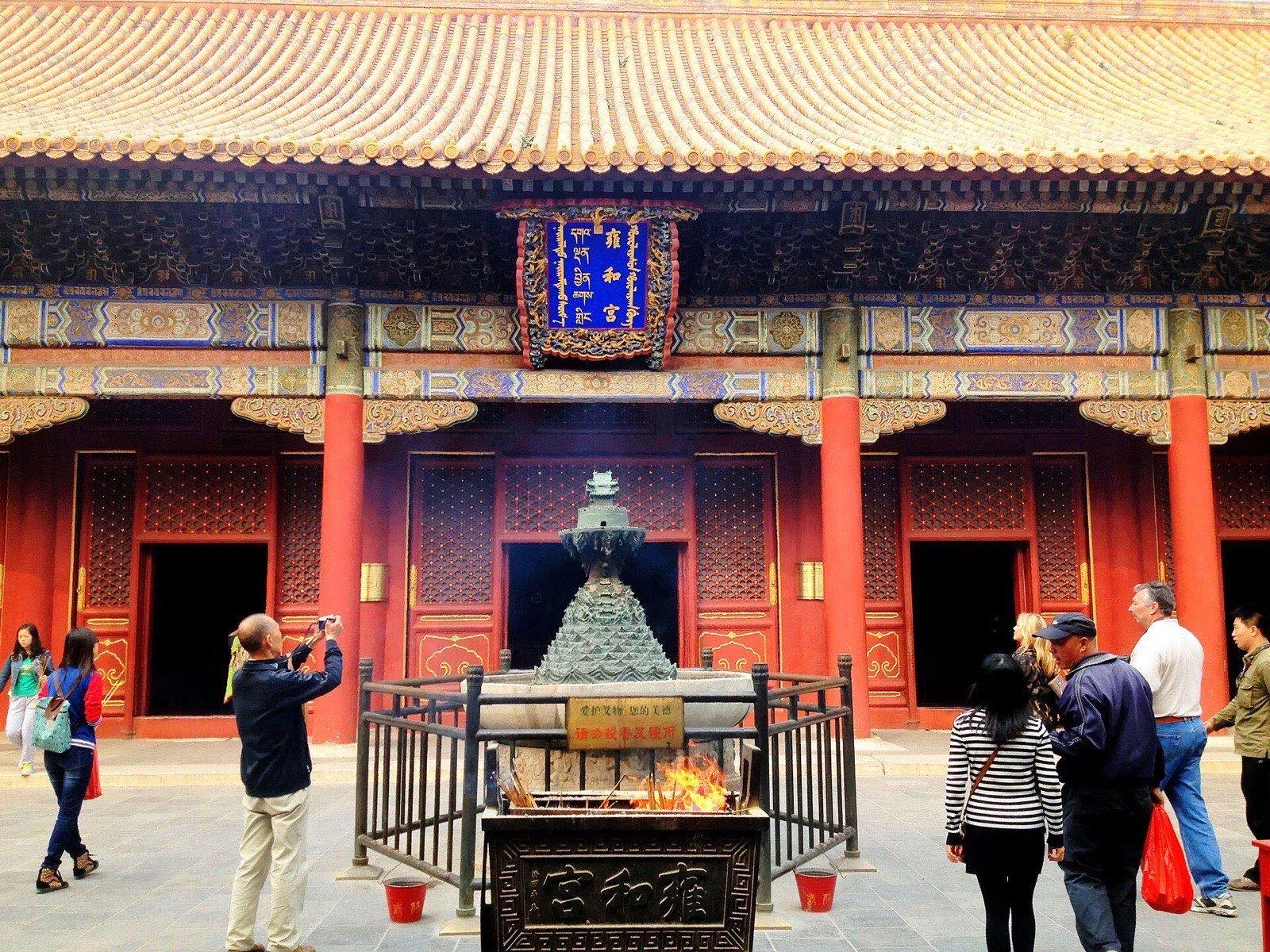
China’s active temples — Buddhist and Taoist — are places of worship first and sights second, and locals will forgive a foreigner’s ignorance more readily than a foreigner’s loudness. The working rules:
- Dress like a guest, not a beachgoer. Covered shoulders and knees are the safe standard, especially at working monasteries off the tourist circuit.
- Follow the posted incense rules. Many large temples supply free incense sticks at the entrance and discourage outside incense; light from the communal flame or an electric lamp where posted, never from a neighbor’s burning sticks, and look for signage — incense etiquette is usually posted right at the entrance passage.
- Photograph with restraint. The courtyard is generally fine; the interior of halls, the Buddha statues, and worshippers mid-prayer deserve your camera’s absence. If a sign prohibits photos, that is the rule; where it’s ambiguous, ask or skip it.
- Mind the architecture and the flow. Step over — not on — the high wooden thresholds at hall entrances, keep to a quiet voice, and at Tibetan Buddhist sites circumambulate clockwise, following the pilgrims rather than cutting against them.
- Time your visit. Temples are calmest early in the morning and busiest on the first and fifteenth of each lunar month, when local worshippers fill the halls — wonderful to witness, less ideal for a first visit. Expect to remove shoes in a few inner halls; wear socks you don’t mind standing in, and flat shoes for uneven stone.
For specific sites — Hangzhou’s Lingyin Temple, Beijing’s Yonghe Temple, or the Jokhang in Lhasa — reservation systems apply on top of etiquette; the city guides cover those mechanics.
Queues, Crowds, and Personal Space
Two truths coexist: China has real queues — at metro platforms, bank counters, and high-speed rail gates — and the concept of a personal bubble is thinner than back home. In crowds, expect gentle pushing without apology; it signals nothing about you. Practical calibration:
- At ticket windows and counters, expect queue-jumping occasionally. A polite “excuse me, the line is here” works better than outrage; the young are increasingly assertive about lines too, so backing a local who objects is safe.
- Crowds, noise, and clatter in restaurants and cinemas are normal volume, not rudeness. Staring at foreigners, especially in smaller cities, is curiosity — a smile or nǐ hǎo converts it into friendliness.
- Keep an arm’s-plus distance when talking; touching is minimal between strangers. Don’t point at people with a raised foot, put your feet on furniture, or hand things over with a single hand to someone senior — two hands reads as respect.
- Indoor smoking persists in smaller establishments despite bans; if it bothers you, choose mall restaurants and chains, which enforce smoke-free rules reliably.
Face, Indirectness, and Sensitive Ground
“Face” (面子, miànzi) is social standing — and the key to decoding Chinese communication. People avoid causing loss of face, yours or their own, which is why direct refusals are rare. “Maybe,” “perhaps not convenient,” hesitation, or a change of subject usually means no; a direct “no” to a request can feel like a slap, so hosts and staff route around it. Do the same: instead of refusing flatly, thank, soften, and defer (“maybe next time”). And when someone declines your offer two or three times before accepting, that is ritual politeness, not indecision — offer again, then accept their acceptance.
In conflict — a wrong order, a taxi dispute — escalation costs face on both sides and hardens positions. A calm tone, a suggestion that “maybe the mistake is ours,” and a request to “help me solve this” gets further than any lecture. Raise your voice and everyone loses.
On sensitive ground, the traveler’s rule is simple: follow your host’s lead, and don’t be the one to raise politics, territorial questions, or the problems of any ethnic region. Ordinary Chinese conversation with visitors runs on food, family, hometowns, housing prices, and whether you can use chopsticks — match that register. Declining to weigh in, warmly and briefly, is a completely ordinary move and ends the topic without awkwardness. (Our advice is about manners, not politics: be a guest, not a journalist.)
Bargaining and Tipping
Bargaining is expected in markets, not in shops with price tags. Department stores, chains, restaurants, and convenience stores have fixed prices; tourist markets, antique stalls, and independent clothing stalls don’t, and the opening quote assumes negotiation. Counter cheerfully at roughly a third of the ask and settle somewhere between — at Beijing’s Silk Street–style tourist markets, paying 20-30% of the opening number is a common landing zone, though treat that as a benchmark, not a right. Two etiquette notes: the haggling is a game played with smiles, and walking away is a legitimate move — but once you agree to a price, the deal is binding; reneging after the vendor wraps it is a face-losing foul. For fakes, know that “genuine” claims at tourist markets are theater; buy what you enjoy at a price you like.
Tipping: don’t. Mainland China has no tipping culture — not for taxi drivers, waiters, or hotel staff — and offering cash can create genuine confusion (see our payments guide for how bills actually work). The exceptions: upscale restaurants add a 10-15% service charge to the bill, so nothing extra is owed; bellhops appreciating ¥10-30 is a kind gesture, not an obligation; and travelers on organized tours should note that guide and driver tips — roughly ¥100-300 per day for a guide, about half that for a driver — remain an unwritten expectation of the group-tour industry, bundled separately from the tour price. Independent travelers on their own itinerary owe nobody anything.
Common Mistakes
- Starting to eat before the host or honored guest. One second of restraint buys outsized goodwill.
- Spinning the lazy susan while someone is serving, or reaching across it. Wait, then take what’s in front of you.
- Standing chopsticks upright in rice. It mirrors funeral incense — the single fastest table gaffe in China.
- Treating “maybe” as maybe. Indirect refusals are polite refusals. Pushing for a direct answer costs face and gets you the same no, colder.
- Getting loud in a dispute. Volume turns a fixable problem into a standoff. Quiet persistence plus a “please help me” beats a scene.
- Photographing worshippers or statue halls without checking. The courtyard is yours; the interior may not be. Posted rules win every time.
- Tipping out of politeness. It confuses more than it delights, and service charges already cover the upscale cases.
- Bargaining after the deal. The agreed price is sacred; everything before it is theater.
Sources & verification (7)
- https://www.chinahighlights.com/travelguide/chinese-food/dining-etiquette.htm
- https://theculturalatlas.org/chinese-culture/chinese-culture-etiquette
- https://theculturalatlas.org/chinese-culture/chinese-culture-communication
- https://www.travelchinaguide.com/essential/tipping.htm
- https://chinawondersguide.com/en/cwg_video/post/QETbYJpp
- https://chinawondersguide.com/half-day-temple-tour-china/
- https://chinawondersguide.com/zh-Hans/xiushui-street-shopping/