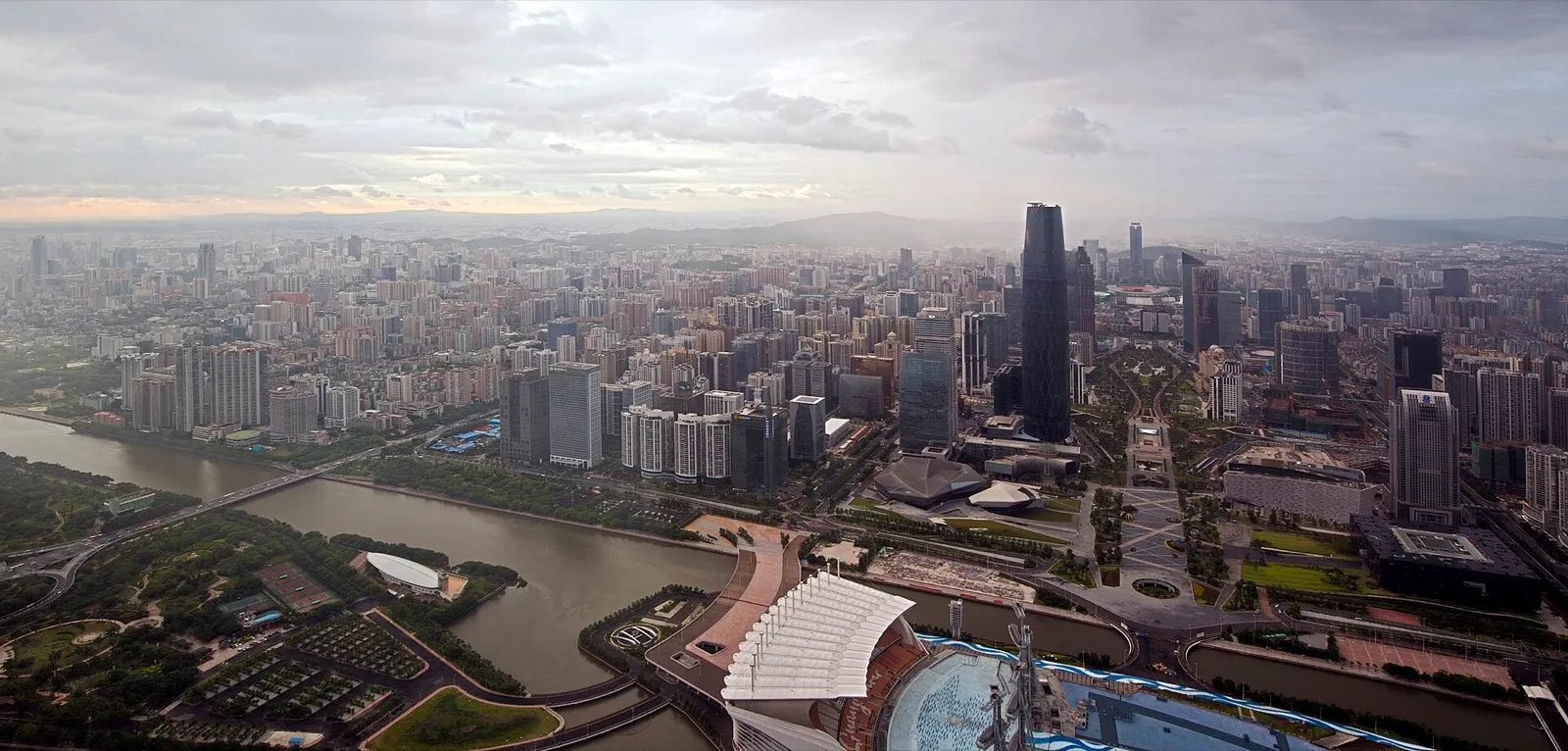
Guangzhou — Canton, in the old spelling — is China's original food city and the two-thousand-year-old port that anchored the sea route to the West. The 2020 census counted nearly 18.7 million people here, yet the city moves at a pace Shanghai would call unhurried: it exists around the table. The core experiences are a long morning of yum cha among retirees reading newspapers over har gow, an afternoon wandering the plane-tree boulevards of colonial Shamian Island, and a dusk ascent of the 600-meter Canton Tower as the Pearl River lights up. Guangzhou suits travelers who care more about eating well than ticking monuments — and it pairs naturally with Hong Kong, just 48 minutes away by high-speed rail. Come for two or three days, ideally October through December.
Top sights at a glance
No. 1
Canton Tower
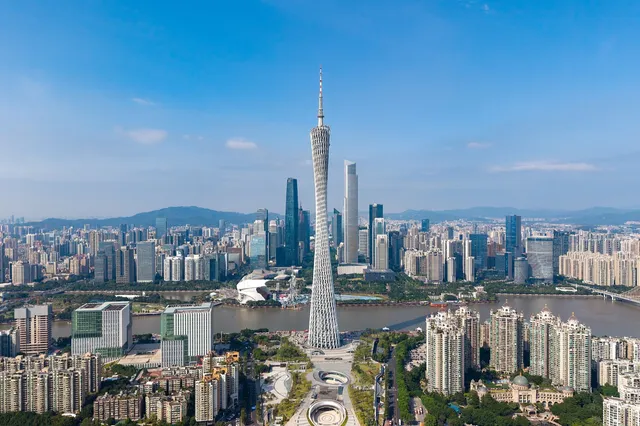
The 600-meter 'slim waist' that anchors Guangzhou's riverfront skyline is the city's single most photogenic vantage. Glass observation decks on floors 107 and 108 hang over the Pearl River, a fleet of 16 crystal cabins trundles horizontally around the tower's top at 455 meters, and the view after dark — bridges, barges and towers lit along the river's bend — is the best skyline moment in southern China. Built for the 2010 Asian Games, it remains China's tallest TV tower.
Good to know · Observation-deck tickets cost about RMB 150 (combination packages with the Bubble Tram and Sky Drop ride run to roughly RMB 398), with hours around 9:30 am–10:30 pm as of September 2026. Book online in advance via the official mini-program or an OTA and take Metro Line 3 to Canton Tower station. Go for the last hour of daylight.
No. 2
Shamian Island
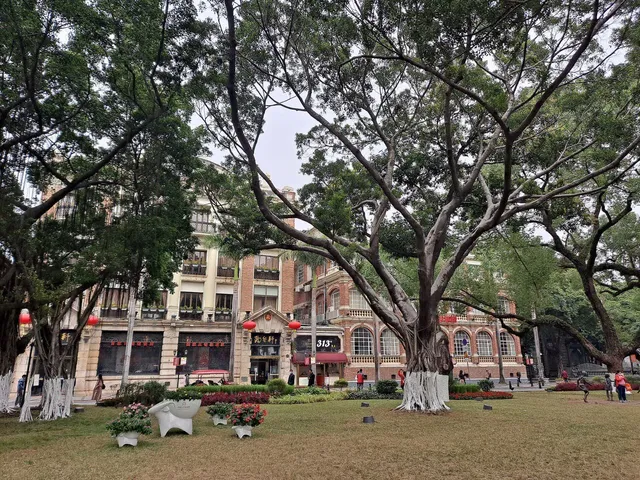
A sandbar in the Pearl River carved into a European concession after the Second Opium War, Shamian is a 900-meter-long island of neoclassical banks, consulates and churches under a canopy of banyans. About 150 buildings survive, many with plaques explaining their treaty-port past, and the riverside promenade along its south edge is one of the most atmospheric free walks in any Chinese city. Cafes in the old buildings make it an easy half-day.
Good to know · Free and open all day; arrive early morning or at dusk for the light and quiet. Take Metro Line 1 or 6 to Huangsha station and cross the pedestrian bridge. Pair it with the old quarter of Liwan across the canal.
No. 3
Chen Clan Ancestral Hall
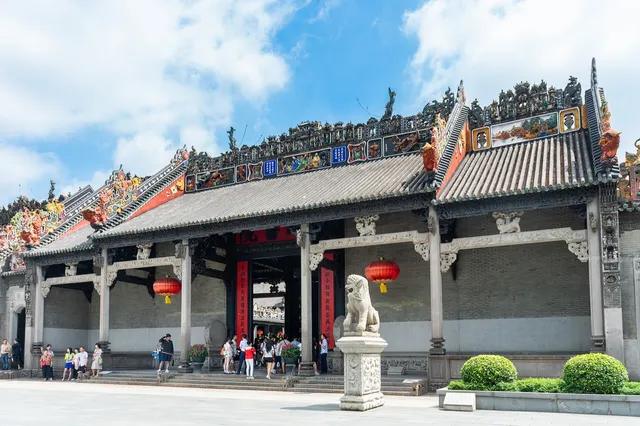
Built in 1888–1894 by seventy-two Chen family branches to house clan members sitting the imperial examinations, this compound is the masterpiece of Lingnan decorative art: roof ridges crowded with hundreds of ceramic figures, carved wooden screens, brick friezes and stucco reliefs packed into nine halls and six courtyards. It now holds the Guangdong Folk Art Museum, and at RMB 10 it is the best-value ticket in the city.
Good to know · Tickets are about RMB 10 (passport works at the ticketing or via official channels), open roughly 8:30 am–5:30 pm as of September 2026; a real-name reservation may apply on busy days. Take Metro Line 1 to Chen Clan Academy station — the entrance sits beside the exit. Mornings have the best light on the roof figures.
No. 4
Yuexiu Park
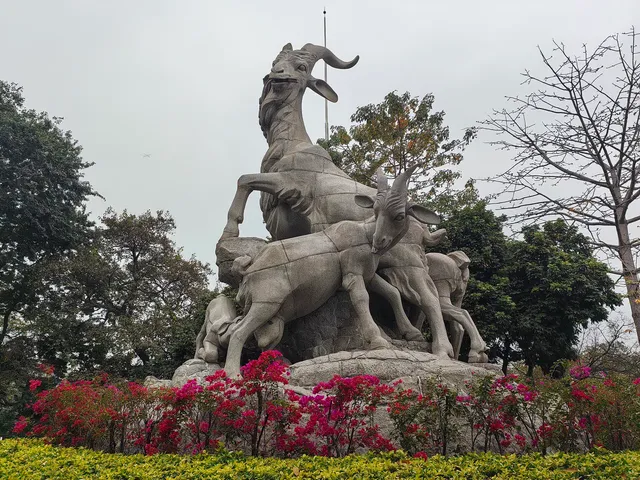
Guangzhou's largest downtown park spreads across seven hills and three artificial lakes around the old Ming-era city walls. Its star is the Five Rams statue, a 1960 granite sculpture of the five immortals who, legend says, brought grain to the city — the five-goat emblem is Guangzhou's official symbol. The 28-meter Zhenhai Tower within the park has watched over the city since 1380 and houses the Guangzhou Museum.
Good to know · Park entry is free, open about 6 am–10 pm; the Zhenhai Tower museum charges a small separate fee. Take Metro Line 2 to Yuexiu Park station. Allow half a morning, ideally combined with the nearby Sun Yat-sen Memorial Hall.
No. 5
The Dim Sum Pilgrimage
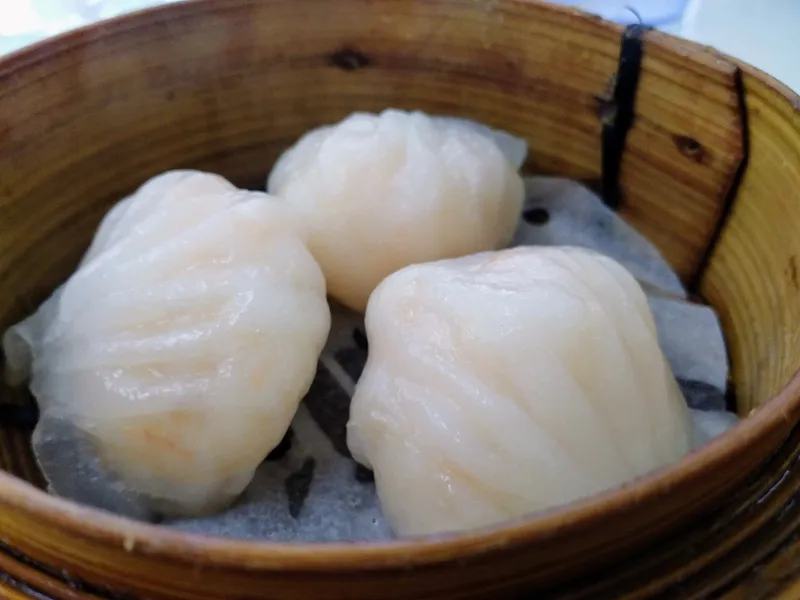
Not a single sight but the city's defining ritual: yum cha, 'drinking tea,' the leisurely morning meal of dim sum and strong tea that Guangzhou invented and still does best. In the old teahouses of Liwan district, families colonize big round tables from seven in the morning; carts and order sheets circulate with translucent shrimp dumplings, barbecue-pork buns and rice rolls. This is the closest thing Guangzhou has to a must-do monument — except it takes three hours and costs a few dollars.
Good to know · Go to a large, old-school teahouse in Liwan or on Shangxiajiu's side streets before 9 am on a weekend — or any weekday — and expect queues; the bill for a full table rarely tops US$10 a head. Order from the paper sheet at the table, and pay with Alipay or WeChat Pay. No reservation needed.
Guangzhou does not perform for tourists, and that is precisely its appeal. This is Canton — the two-thousand-year-old port that gave the sea route to the West its name, that ran the only legal China trade for a century, and that still judges every city, including its glitzier neighbors, by one standard: can you eat well here? By that measure Guangzhou is untouchable. The city’s true monument is not a palace or a wall but the morning teahouse, where the ritual of yum cha has run uninterrupted since before the American Revolution. Around it sits a genuinely pleasant city: a colonial island of plane trees and arcades, a folk-art palace built by a single clan, a 600-meter tower on the river bend, and a skyline racing toward Hong Kong, which is now just 48 minutes away by high-speed rail. Come hungry, come unhurried, and give it two or three days in the autumn.
A Bit of History
Guangzhou is one of the few great Chinese cities whose founding story is trade rather than dynasty. Set on the Pearl River delta, it appears in records from 214 BC, and by the Tang dynasty it was the terminus of the maritime Silk Road, home to Arab and Persian merchants a millennium before any European ship arrived. From 1757 until the Opium War, the Canton System made Guangzhou the only Chinese port where Western trade was legal, funneled through a row of riverside warehouses called the Thirteen Factories.
That monopoly built the city’s fortune and then broke its peace. In 1842 the Treaty of Nanjing ended the system and forced Guangzhou open alongside four other treaty ports — a humiliation the city remembers as the start of a turbulent century. It was here that Sun Yat-sen, the founder of modern China, staged uprisings against the Qing and later against the warlords; the city carries his name on memorial halls and universities.
Trade came back in a new form. In 1957, with the country largely closed to the West, Beijing chose Guangzhou to host the China Import and Export Fair — the Canton Fair — which ran even through the chaos of the following decades and remains the world’s largest trade fair, now staged at the Pazhou complex each April and October–November. When Deng Xiaoping opened China in 1978, Guangdong was the laboratory: Shenzhen was the special zone, but Guangzhou was the established capital, port and market that made the whole delta work.
The 2010 Asian Games brought the Canton Tower and a rebuilt riverfront, and the last decade folded the city into the Greater Bay Area — the stitched-together megaregion of Guangdong, Hong Kong and Macau. Through every era, one continuity holds: the 2020 national census counted nearly 18.7 million residents, and the city has always cared more about commerce at the table than ideology on the wall.
Culture & Daily Life
Guangzhou is the capital of Cantonese culture, and its first language is still Cantonese — as different from Mandarin as Portuguese from Spanish. You will hear it in the markets, over the mahjong tiles in the parks and behind the counters of the tea shops; nearly everyone speaks Mandarin too, and younger people often manage some English. The local identity is confident and famously practical: Cantonese culture prizes the deal, the meal and the family, in roughly that order.
The organizing ritual of daily life is yum cha — “drinking tea” — the long morning meal of dim sum that doubles as the city’s social infrastructure. Retirees claim the big tables at seven; families follow on weekends; business still gets done between pots of pu’er and baskets of dumplings. The habit runs deep: dim sum — dianxin, literally “touch the heart” — evolved in Guangzhou’s roadside teahouses, and the city’s grand teahouses formalized it into an institution more than a century ago.
Physically, the old city is built for shade. The Liwan district preserves the qilou, the arcade-fronted shophouses of the treaty-port era, where the upper floors overhang sidewalks so shoppers can walk dry through the subtropical rain. Daily life is tidy and green by Chinese megacity standards, dominated by the river, the parks and the humidity. Practical notes: expect fierce, wet summers and mild winters when locals wear puffer jackets at 15°C; payments run through Alipay and WeChat Pay everywhere, including teahouse tables (see our payments guide); and set your schedule around food — the best hour of the day is whichever one ends at a table.
Nature & Day Trips
Guangzhou is flatter and more urban than most visitors expect, but it keeps its green lungs. Baiyun Mountain, the forested ridge at the city’s northern edge, is the classic weekend climb — cable car, stone paths and hazy city views, all within metro distance. Yuexiu Park covers the old city’s hills with lakes and banyans (see below), and the Pearl River itself is the city’s great linear park: evening cruises pass under bridges and lit towers, or you can simply walk the Ersha Island promenades.
The real day trips lie on the high-speed network. Foshan, twenty minutes west, is the home of southern martial arts — its Ancestral Temple honors the kung fu master Wong Fei-hung. And then there is the obvious one: Hong Kong. The express rail link runs from Guangzhou South station to Hong Kong West Kowloon in 48 minutes on the fastest services, with dozens of departures daily — which makes a Guangzhou-plus-Hong-Kong combination the most sensible way to see both, in either direction.
Food & Drink
The Chinese saying is unambiguous: 食在广州 — “eat in Guangzhou.” Cantonese cooking is the country’s most influential cuisine, built on a doctrine the rest of China borrows without crediting: freshness over spice, the ingredient over the sauce, nothing masked. The classics are simple and exacting — white cut chicken with ginger-scallion oil, roast goose with crackling skin, won ton noodles in an opaque broth simmered from flounder and pork bones, silken congee dressed with lean pork and century egg. Seafood arrives live in tanks and dies briefly; vegetables are picked over daily. A solid restaurant meal costs US$8–15 a head; street-side bowls run a couple of dollars.
The spiritual center of it all is dim sum, covered in depth under Top Sights below, but the city rewards specific grazing: the roast-meat shops with crimson lacquered ducks hanging in windows; dessert houses serving double-skin milk pudding and ginger milk curd; the evening congee stalls of Liwan; the old Qingping market area, where the trade in herbs and dried seafood has run since the Ming dynasty. For a food walk, the formula that never fails is Shangxiajiu’s arcades and their feeder alleys in the old city — eat where the queue is local and the menu has no pictures.
Cantonese teahouses are where the culture concentrates, but tea also stands alone: the city drinks pu’er, chrysanthemum and tieguanyin through the afternoon, and shops selling Yunnan cakes and Chaozhou gongfu sets occupy whole streets. Carry your appetite; the city will do the rest.
Top Sights
Canton Tower
The twisted, waisted hyperboloid on the river’s south bank is the image of modern Guangzhou — locals call it xiaomanyao, the “slim waist” — and it remains China’s tallest TV tower at 600 meters. Built for the 2010 Asian Games, it is best understood as a viewpoint rather than an attraction: the enclosed observation decks on floors 107 and 108 give a full panorama of the Pearl River’s bend and, on clear days, the far hills of the delta. The signature experience is the Bubble Tram, sixteen crystal cabins that crawl horizontally around the tower’s top ring at about 455 meters; the brave add the Sky Drop, a free-fall ride from near the top that is advertised as among the world’s highest.
Go in the last hour of daylight and stay through dusk — the river lights up bridge by bridge, and the tower itself becomes the spectacle, recolored nightly. Tickets start at about RMB 150 for the two main decks as of September 2026, with combination packages including the tram and rides up to roughly RMB 398; hours run around 9:30 am to 10:30 pm, with last entry earlier. Book ahead on the official mini-program or an OTA with Alipay/WeChat; Metro Line 3 to Canton Tower station, exit A, puts you at the base.
Shamian Island
When the Opium War ended in 1859–61, the foreign traders of Canton moved off the dreaded mainland quays onto a sandbank they reclaimed in the river: Shamian, divided — with colonial geometry — four-fifths British, one-fifth French. For eighty years it was the only place in the city where foreigners lived, a compound of banks, consulates, trading houses and churches on streets named and paved like home. The treaty port is long gone; the island is what remains, and it is the best-preserved European townscape in China — about 150 buildings from the late nineteenth and early twentieth centuries, many marked with plaques naming their old tenants.
Shamian rewards a slow loop: the central avenue under mature banyans, the Neo-Gothic and neoclassical facades on Shamian North Street, the Catholic church of Our Lady of Lourdes at the French end, and the promenade along the river, where couples photograph weddings and old men fish. Cafes occupy several of the restored buildings, which makes the island the city’s most pleasant place to do nothing for an hour. It is free and open all day; come at opening for quiet or at dusk for the light. Metro Line 1 or 6 to Huangsha station puts you at the pedestrian bridge; the old Liwan quarter across the canal pairs naturally with it.
Chen Clan Ancestral Hall
If you doubt that a building can out-shout a palace, come here. The Chen clans of Guangdong’s seventy-two counties pooled money in 1888 to build an ancestral hall and study house for their sons traveling to the imperial examinations, and finished in 1894 what is now called the “pearl of Lingnan architecture” — nineteen buildings and nine halls around six courtyards, every surface carried by one of the seven decorative arts of the region: wood, brick, stone, lime stucco, ceramics, iron and painting. The roof ridges alone are opera — hundreds of glazed figures from Shiwan kilns frozen mid-battle, the longest ridge 27 meters with 224 characters on it.
Inside, the halls hold the Guangdong Folk Art Museum — ivory carving, embroidery, olive-pit miniatures — though honestly the building is the collection. The compound is compact: about 13,200 square meters, an easy ninety minutes to two hours, which makes it perfect before lunch. Admission is about RMB 10 as of September 2026, open roughly 8:30 am–5:30 pm, with a possible real-name reservation on busy days via the museum’s official channels — a passport works. Metro Line 1 to Chen Clan Academy station leaves you at the door. Go in the morning, when the low sun lights the roof figures.
Yuexiu Park
Guangzhou’s old city huddled under a hill called Yuexiu, and the hill is now the city’s central park — more than 80 hectares of lakes, banyans, running tracks and Ming-dynasty wall snaking up the slope. The emblem of the city stands here: the Five Rams statue, carved from granite in 1960, depicting the five immortals who rode into town on goats carrying rice ears and founded Guangzhou’s legend as a city that would never lack food. It is to Guangzhou what the Little Mermaid is to Copenhagen — obligatory, photographed, beloved.
Higher on the hill stands the better sight: Zhenhai Tower, first raised in 1380 on the city wall, rebuilt five times, and now housing the Guangzhou Museum’s telling of the city’s 2,000-year story — a good primer on everything else you will see. The park is free, open from about 6 am to 10 pm, with a small separate museum fee at the tower; Metro Line 2 stops at Yuexiu Park station. Come early, when the park belongs to taiji groups and paper-drum choirs, and pair it with the Sun Yat-sen Memorial Hall next door.
The Dim Sum Pilgrimage
This is why you came. Yum cha — “drinking tea” — is Guangzhou’s native institution: the unhurried morning meal of dim sum (“touch the heart” morsels) and bottomless pots of tea, invented in this city’s teahouses and exported by the Cantonese diaspora to every Chinatown on earth. Eating it here, at its source, is the single most Guangzhou thing you can do, and it is easy: find a large, busy teahouse in Liwan district — the old city west of the canal — ideally before 9 am, take a numbered card, and wait for a table under fluorescent light and clatter.
The mechanics: you mark an order sheet for each steamer basket that arrives, and the bill is scanned from it at the end. Work through the canonical four — har gow, the translucent shrimp dumpling whose wrapper must be thin but unbroken; siu mai, the open-topped pork-and-shrimp basket; cha siu bao, the fluffy bun of sweet barbecue pork; and chang fen, rice-noodle sheets rolled around shrimp or beef. Order a pot of pu’er or chrysanthemum, and when someone pours your cup, tap two bent fingers on the table — the gesture, a hand-bow that legend traces to Qianlong-era servants unable to kneel to their incognito emperor, is the local thank-you. A generous feast costs a few dollars a head, paid with Alipay or WeChat. Three hours, and you will understand the city completely.
Getting There & Around
Guangzhou Baiyun International Airport (CAN) is a major hub about thirty kilometers north of downtown; Metro Line 3 runs from the terminals into the city for around RMB 9 in roughly 40–60 minutes, while a taxi takes 45–60 minutes for roughly RMB 120–150 as of September 2026. By rail you will most likely arrive at Guangzhou South, on the high-speed network: Hong Kong West Kowloon is 48 minutes away on the fastest trains (about 61 departures daily, fares from roughly US$29), with direct services to Wuhan, Changsha, Guilin and Xiamen.
In town, the metro is enormous, signed in English and cheap — most rides cost RMB 2–8 — with a Line 3 spur to Canton Tower and lines to every sight in this guide. Didi works with international cards through Alipay and covers the gaps; rides across the center rarely exceed RMB 40. The practical trap is timing: during each Canton Fair phase the Pazhou area and the metro’s east side jam up, so allow extra time.
Where to Stay
Three areas cover most travelers. Zhujiang New Town in Tianhe is the modern CBD — glass towers, the opera house, the best hotels and the easiest airport transfers; choose it for business-adjacent comfort, but note it is a taxi ride from the old city’s food streets. The Liwan side of the old city, around Shangxiajiu and Changshou Lu, is the atmospheric choice: arcade streets, teahouses at the door and Shamian Island a short walk away — best for first-time visitors whose priority is the dim sum pilgrimage. Around Canton Tower in Haizhu puts you on the quiet south bank with river views and direct metro to both.
One warning belongs in bold: during the Canton Fair — in 2026, Phase 1 runs October 15–19, Phase 2 October 23–27 and Phase 3 October 31–November 4 — hotel prices across the city multiply, sometimes several times over, and rooms sell out weeks ahead. Book months in advance or schedule your trip between phases.
Sources & verification (8)
- https://www.travelchinaguide.com/attraction/guangdong/guangzhou/canton-tower.htm
- https://www.chinadiscovery.com/guangdong/guangzhou/chen-clan-ancestral-hall.html
- https://en.wikipedia.org/wiki/Chen_Clan_Ancestral_Hall
- https://www.travelchinaguide.com/attraction/guangdong/guangzhou/shamian-island.htm
- https://en.wikipedia.org/wiki/Yuexiu_Park
- https://is.mofcom.gov.cn/ExhibitionInfo/art/2026/art_b6ce9bedf8f04544b62fa44ed0f5add0.html
- https://www.trip.com/trains/china/route/hong-kong-to-guangzhou/
- https://en.wikipedia.org/wiki/Dim_sum