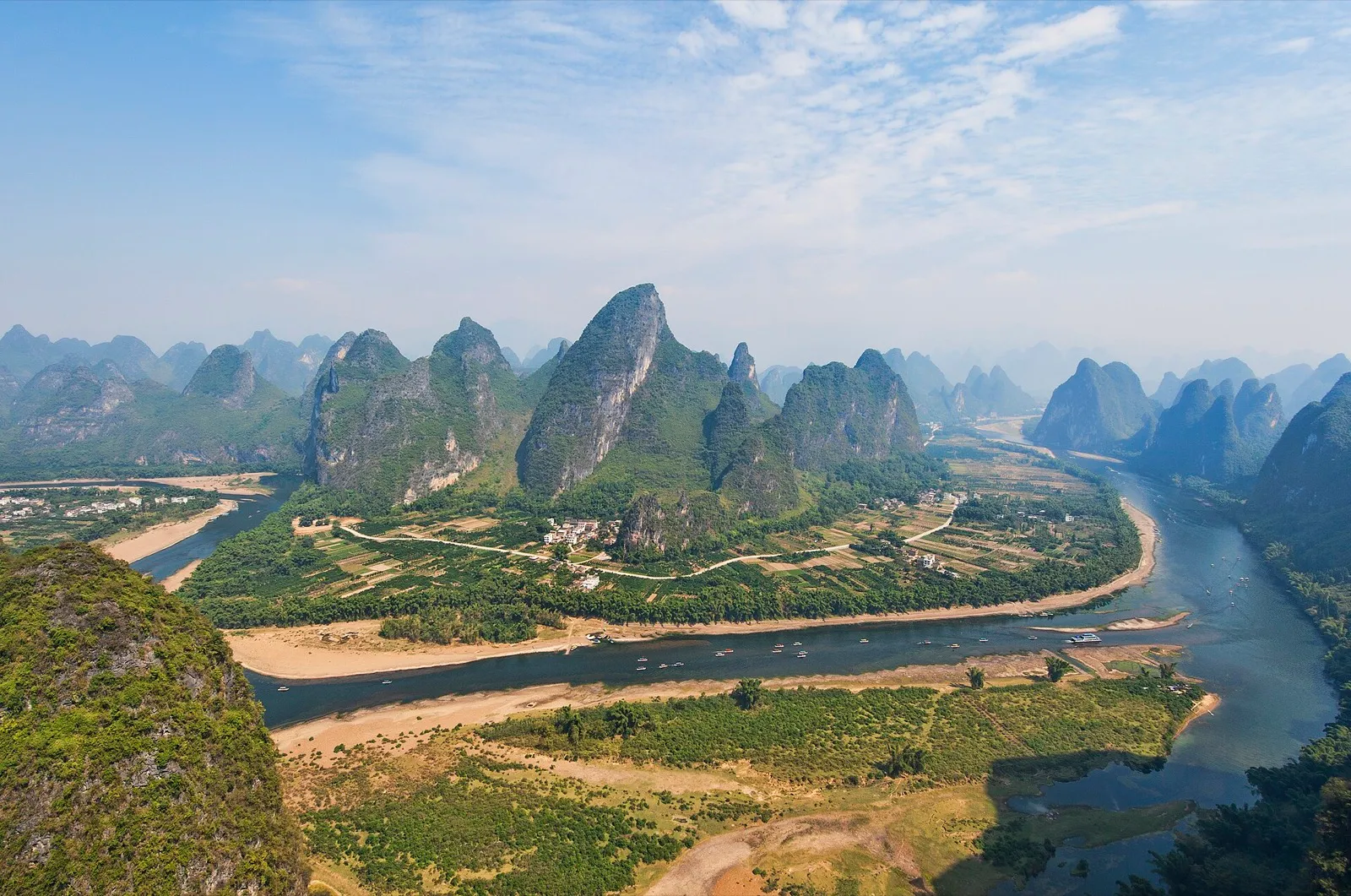
Guilin, in the Guangxi region of southern China, guards the country's most celebrated landscape: a plain of limestone karst towers threaded by the Li River. Most travelers come for the four-hour cruise to Yangshuo, then stay for everything around it — bamboo rafting on the Yulong River, cycling between villages and rice paddies, sport climbing on world-class cliffs, and day trips north to the sculpted hillsides of the Longji Rice Terraces. The city itself is pleasant rather than spectacular, which is why the smart move is to sleep in Yangshuo and treat Guilin as a transport hub. Come for big scenery without big altitudes, for outdoor days rather than museums, and for some of the most photogenic farmland in Asia. First-timers, photographers, hikers, and anyone burned out on Chinese city-hopping will find this the easiest win in the country.
Top sights at a glance
No. 1
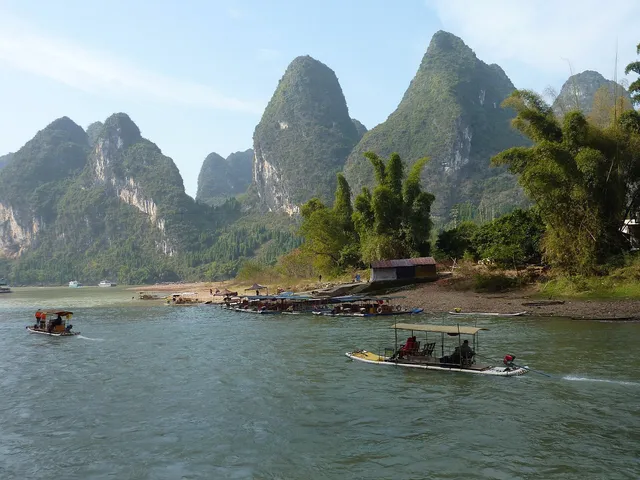
Li River Cruise
The full-day cruise from Guilin to Yangshuo is the classic way to see the karst: roughly four to four and a half hours gliding past peaks that Tang-dynasty poets were already rhapsodizing about 1,300 years ago. Water buffalo doze on the banks, fishing villages slide by, and the river narrows dramatically through the Xingping gorge — the exact stretch printed on the back of the 20-yuan note, which everyone aboard holds up for comparison. It is a packaged, big-boat experience, but the scenery earns every minute.
Good to know · Boats leave from Mopanshan or Zhujiang piers, about 40 minutes from Guilin, generally between 9:00 and 9:30 AM. Book at least a day ahead with your passport via Trip.com or the official mini-program (3-star boats from around ¥215, 4-star with lunch around ¥360, as of September 2026); transfers from your hotel are usually included.
No. 2
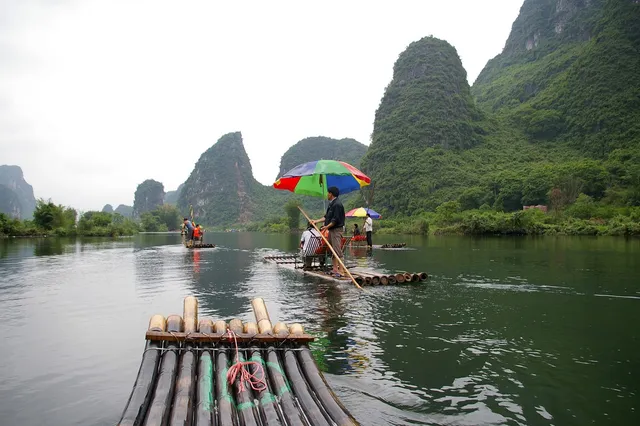
Yulong River Bamboo Rafting
If the Li River cruise is the postcard, the Yulong River is the love letter. This shallow tributary south of Yangshuo town is run the old way: flat-bottomed rafts poled by hand (no motors), drifting under stone bridges and between banana groves with the karst mirrored dead-still in the water. Small weirs give you a couple of splashy little drops, and water buffalo cool off at the banks. It is quieter, closer, and far more intimate than the big cruise — an hour or two of pure slow-motion scenery.
Good to know · Rafts take a maximum of two people and cost roughly ¥200–300 per raft depending on the section, as of September 2026. The Jinlong Bridge stretch is the quietest and most rural; the lower section near the Ten-Mile Gallery has the fun drops. Book morning slots a day ahead via Trip.com or the official Yangshuo mini-program — they sell out in season.
No. 3
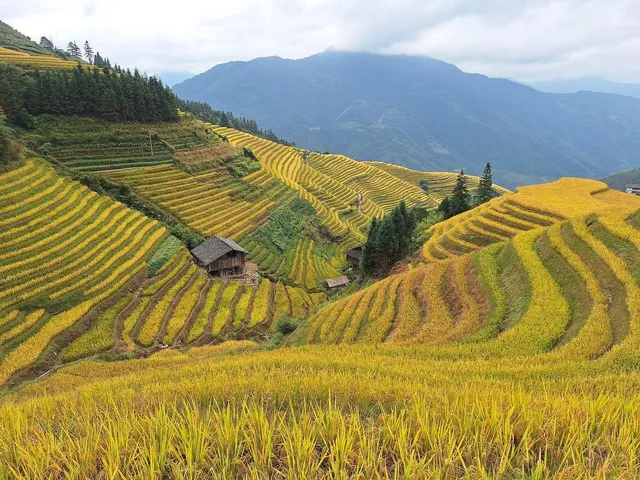
Longji Rice Terraces
Two and a half hours north of Guilin, the mountainsides around Longji have been carved into rice terraces by Zhuang and Yao farming families since the Yuan dynasty — hundreds of years of coiling contour lines stacked to the ridgelines. Timing is everything: in May and June the paddies are flooded and behave like a shattered mirror at sunrise; from late September into early October the same slopes turn gold before harvest. Villages like Ping'an and Dazhai offer viewpoints, creaky wooden guesthouses, and genuinely memorable farmhouse dinners.
Good to know · A through ticket of around ¥80 covers Ping'an, Dazhai/Jinkeng and Huangluo villages (as of September 2026); the Dazhai cable car is around ¥55 one-way or ¥100 return if you want to skip the climb. Direct shuttles run from both Guilin and Yangshuo — book a day ahead. The mountain road is seriously winding; sit toward the front if you get carsick.
No. 4
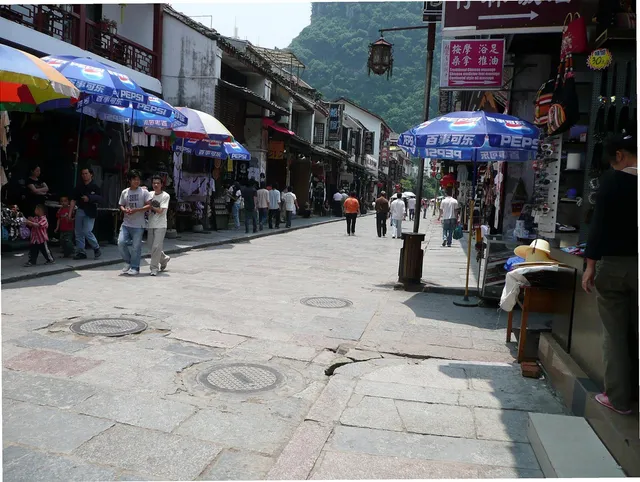
Yangshuo West Street & Countryside
West Street is Yangshuo's 1,400-year-old spine, now a pedestrian strip of bars, bubble tea, and English menus — a legacy of the backpacker scene that put the town on the map in the 1980s. Fun for an evening, but the real Yangshuo starts where the pavement ends. Rent a bike or e-bike and ride the Ten-Mile Gallery road and the lanes beyond it: villages drying chili peppers, banyan trees over fish ponds, egrets trailing water buffalo. Climbers have made these cliffs one of Asia's best sport-climbing destinations since the 1990s.
Good to know · Bikes rent for around ¥15–20 per day and e-bikes for ¥20–30 (as of September 2026); the gallery road itself is free to ride. Start before 9 AM to beat tour buses and heat. Beginner-friendly half-day climbing courses are booked through outfits along West Street — no experience needed.
No. 5
Moon Hill
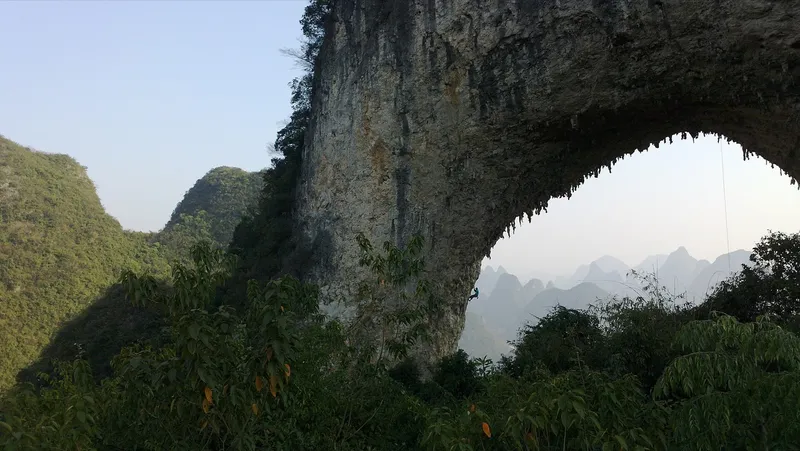
A single colossal limestone arch crowns the ridge at the end of the Ten-Mile Gallery, with a moon-shaped hole the size of a building punched clean through it. A stone staircase climbs through orange trees to a viewpoint just below the arch, looking back over a sea of karst peaks and the road you cycled in on. American climber Todd Skinner's 1992 free ascent of the arch helped launch Yangshuo's entire climbing scene. It is a short, satisfying hike with a disproportionately grand payoff.
Good to know · Entry has been reported anywhere from around ¥18 to ¥60 depending on packaging — check on site (as of September 2026), and the climb takes about 20–30 minutes each way — go early or after 4 PM to dodge heat and crowds. Combine it with a Ten-Mile Gallery ride, stopping at the Big Banyan Tree on the way back.
See it in motion
Some places earn a moving picture
Stills can't show how this place moves — the drift, the light show, the crowd flow. We picked a recent, high-quality walkthrough rather than a promotional cut.
Li River Cruise, Guangxi, China in 4K
Amazing Places on Our Planet · YouTube · plays on click
Embedded via YouTube's official player (privacy-enhanced mode). Video: Li River Cruise, Guangxi, China in 4K by Amazing Places on Our Planet. Not affiliated with China Travel Copilot; screened for quality and accuracy on 2026-09-28.
Few landscapes anywhere are as thoroughly painted, poem-annotated, and banknote-famous as the stretch of the Li River between Guilin and Yangshuo. Hundreds of limestone towers rise straight out of rice paddies and riverside bamboo, dissolving into the haze downriver like a Song-dynasty ink painting you can bicycle through. That combination — monumental scenery at zero altitude, villages still working the fields between the peaks, and an easygoing traveler town at the center of it all — is what makes this corner of Guangxi the most forgiving nature trip in China. The experience is centered on Yangshuo, not Guilin itself: the city is your arrival point, Yangshuo is your base, and the Longji Rice Terraces make a worthy detour north. It suits first-timers, photographers, climbers, cyclists, and anyone who wants China’s most famous scenery without a single cable car mandatory.
A Bit of History
The story starts with geology. Roughly 300 million years ago this region was a shallow tropical sea that deposited thick beds of limestone; tectonic uplift later raised the seabed, and centuries of rain and groundwater dissolved the rock into towers, cones, and caves. Geologists call the result tower karst, and Guilin’s version is considered the textbook example — significant enough that the South China Karst World Heritage listing was extended to include Guilin in 2014. The 20-yuan note view near Xingping is, quite literally, national-currency geology.
Humans arrived early. The name Guilin means “forest of sweet osmanthus,” and the city’s strategic weight dates to 214 BC, when Qin dynasty engineers dug the Lingqu Canal just north of the city, linking the Yangtze and Pearl river systems. It is one of the world’s oldest transport canals still in existence, and it turned the region into a southern crossroads for two millennia. The Ming dynasty left the Jingjiang Princes’ Palace, a walled princely compound at the foot of Solitary Beauty Peak that now functions as the city’s historical core.
The twentieth century brought turbulence. In the late 1930s and early 1940s Guilin became a refuge for writers, painters, and publishers fleeing the Japanese advance — briefly one of the most culturally productive cities in wartime China — before Japanese occupation in 1944 gutted much of it. After 1949 the city rebuilt around two pillars: industry, and scenery.
The scenery won. In 1973 Guilin was among the very first Chinese cities opened to foreign tourists, decades before most of the country; Richard Nixon visited in 1976, and Bill Clinton brought his family down the Li River in 1998. That head start explains why the tourism machinery here — bilingual signage, airport procedures, tour logistics — feels decades more polished than in comparable Chinese regions. Yangshuo, a 1,400-year-old county town downriver, was discovered by Western backpackers in the 1980s, when West Street famously sprouted English-language menus before most of China had heard of them. Rock climbers arrived in the 1990s and never left. Today tourism is the region’s economic engine, and the peaks you photograph are the same ones farmers plow around.
Culture & Daily Life
Guilin sits in the Guangxi Zhuang Autonomous Region, and the hills around it are home to Zhuang, Yao, Miao, and Dong communities. At Longji, Zhuang villages like Ping’an and Dazhai farm the terraces their ancestors cut, and Huangluo’s Red Yao women — famous for waist-length hair kept jet black into old age — have turned a centuries-old tradition into a small performance economy. Go as a guest of a village guesthouse rather than only a day-tripper and the culture side of the trip deepens considerably.
On the rivers, you will meet the cormorant fishermen — elderly men fishing with trained birds by lamplight. Be honest with yourself about what this is: it was once real work, but today it survives mostly as an evening performance for cameras, and it is usually fine to pay for the photo. The genuine rhythm of daily life here is agricultural and slow. From any bike path around Yangshuo you will pass farmers transplanting rice, ducks being herded between ponds, and chili peppers drying on village basketball courts.
The traveler culture is unusually mature for a Chinese town of this size. Two generations of foreign backpackers, climbers, and runners have left behind bilingual menus, decent coffee, hostels that know what a visa run is, and an overall ease with outsiders that makes this one of the least stressful places in China for a first visit. Mandarin still rules, English survives on West Street, and life runs on rice noodles: breakfast here is a standing bowl at a plastic table, eaten fast and hot, before the day’s real business — on the water, on the bike, or up the terraces.
Time your dates loosely and you may catch something local: the San Yue San festival in the third lunar month brings Zhuang singing gatherings to the region, Longji villages hold their Red Yao hair-washing festival and autumn harvest celebrations, and whenever the terraces are flooded or golden, village courtyards fill with visiting relatives, laughter, and home-brewed rice wine. None of it is staged for tourists — which is precisely the appeal.
Nature & Day Trips
This region gives you two utterly different landscapes within a couple of hours of each other, which is why nature deserves the bulk of your time here.
The first is the karst, best understood from water level. The Li River runs about 83 kilometers from Guilin to Yangshuo, and its most photogenic stretch is the middle section between Yangdi and Xingping, where the peaks crowd closest and the river bends hard around folds of rock. The full cruise covers all of it; the short bamboo-raft runs at Xingping cover just the famous gorge. For intimacy, the Yulong River near Yangshuo trades grandeur for stillness — a stream so clear you can count the fish, with the peaks doubled in it.
The second landscape is highland: the Longji Rice Terraces, two and a half hours north near Longsheng. These are not natural scenery but farmland so sculptural it out-performs most parks — flooded mirrors in May–June, liquid gold in late September. An overnight in a terrace-view guesthouse, with morning mist rolling through the paddies, is one of the best nature stays in China.
In Guilin city itself, save a rainy half-day for the flooded chambers of Reed Flute Cave and a stroll around Elephant Trunk Hill, the city’s riverside symbol. But the best day trip of all costs nothing but pedal power: the valley roads west and south of Yangshuo, where the scenery-to-effort ratio is unbeatable. Bring a swimsuit — the Yulong is swimmable in summer, and locals will wave.
Food & Drink
Guilin’s signature dish is deceptively plain: rice noodles. Unlike the soupy noodle bowls of most of China, Guilin mifen are drained, dressed in a mysterious aged brine (the house lu, a closely guarded recipe), and topped with pickled long beans, peanuts, and chili oil. A filling bowl costs ¥8–12, and locals eat them for breakfast daily — follow the crowd to any busy noodle shop off the main drags and point at what neighbors are having.
In Yangshuo, the dish to know is beer fish: chunks of river fish stir-fried, skin on, braised in local beer with tomatoes and peppers. It arrives whole on a platter and it is priced by weight — the jin (500 g) — so confirm the price of your specific fish before it hits the wok, especially on West Street where tourist pricing lives. The same dish costs noticeably less a few streets back.
Up at Longji, order the farmhouse classics: bamboo tubes of sticky rice roasted over fire, cured pork, and oil tea — a bitter, smoky tea broth whisked with ginger and poured over puffed rice and peanuts, the traditional breakfast of the mountain villages. It is an acquired taste worth acquiring. Guesthouse dinners are the move: the family cooks whatever came up the mountain that morning, dinner lands on a fire-lit terrace overlooking the paddies, and the bill rarely reaches city prices.
Osmanthus is the region’s flavor signature — the city is named for it. Try osmanthus cake, osmanthus wine, and the perfumed osmanthus jelly sold in little steamed squares. Price levels are gentle: noodles for ¥10, a hearty farmhouse dinner for ¥40–70 per person, a good West Street dinner with drinks for ¥80–120. Craft beer and coffee culture in Yangshuo punch above the town’s size. Vegetarians manage fine here — tofu dishes and mountain greens abound.
Top Sights
Order matters here: do the river first, then the villages, then the terraces, and keep one flexible day for weather. Everything below is real-name ticketed and cheaper booked a day ahead.
Li River Cruise
The through-cruise from Guilin to Yangshuo is the one unmissable packaged experience in China’s south. Boats depart the Mopanshan and Zhujiang piers (about 40 minutes from the city) between roughly 9:00 and 9:30 AM, and chug the full 4–4.5 hours downriver to Longtoushan Pier in Yangshuo. Aboard, the routine is simple: stake out rail space on the upper deck, and rotate inside for lunch. Three-star boats cost from around ¥215; four-star boats with buffet lunch run around ¥360 (as of September 2026). Book at least a day ahead with your passport — tickets are real-name — via Trip.com or the official WeChat mini-program, paying with Alipay or WeChat Pay; hotel transfers are normally bundled. The highlight stretch is Yangdi to Xingping, where the river bends beneath the densest cluster of peaks and tour boats slow down. Expect camera crowds, not solitude — this is a shared barge, not a private junk — but the landscape quietly embarrasses every photo you have seen.
Yulong River Bamboo Rafting
Twenty minutes by bike from Yangshuo town, the Yulong is the antidote to the cruise’s crowds. Each flat-bottomed raft takes just two passengers and is poled by hand the entire way — no motors, no roar, just the gurgle of shallows and the splash of a weir every so often. Sections range from about one to two hours; the Jinlong Bridge stretch is the quietest and most rural, running past old stone bridges and water buffalo, while the lower section near Gongnong Bridge links neatly onto a Ten-Mile Gallery bike ride and adds a couple of small, scream-worthy drops. Rafts cost roughly ¥200–300 each depending on the section (as of September 2026), bookable via Trip.com or the official mini-program with your passport. Go in the first morning slot: the light is soft, the water cool, and the raft queues short. Wear sandals; you will get splashed at the weirs.
Longji Rice Terraces
Give Longji a full day — or better, an overnight. From Guilin it is a 2.5-hour shuttle into the mountains near Longsheng; the final hour climbs hairpins past villages to the terrace zone, where a ¥80 through ticket covers the Ping’an, Dazhai/Jinkeng, and Huangluo Yao villages (as of September 2026). The two headline viewpoints are Ping’an’s Seven Stars and Moon, and Dazhai’s towering Nine Dragons and Five Tigers, reached by stone steps past stilted wooden houses; the Dazhai cable car (around ¥55 one-way or ¥100 return) spares your legs on the biggest climb. Season decides everything: flooded May–June, the terraces mirror the sky; from late September into early October the rice turns gold, with harvest following soon after. Direct shuttles from Guilin and Yangshuo must be booked a day ahead via official channels or your guesthouse. Sleep up there if you can — sunset, and mist at dawn over the paddies, beat any day trip.
Yangshuo West Street & Countryside
Give West Street its evening and the countryside your days. By night, the old stone street becomes a pedestrian carnival of bars, street food, and bubble tea — loud, touristy, and honest fun after a day outdoors. In the morning, rent a bike (¥15–20) or e-bike (¥20–30) and ride out the Ten-Mile Gallery, the valley road flanked wall-to-wall by peaks, past the Big Banyan Tree and tiny villages where the daily rice of life happens in plain view (as of September 2026 prices). The road is free; side lanes toward the Yulong River are quieter still. Yangshuo is also Asia’s storied sport-climbing hub — the limestone here offers hundreds of bolted routes from baby walls to hard classics, and the outfits along West Street run beginner courses with gear and guides. Rock shoes optional; curiosity mandatory.
Moon Hill
At the southern end of the Ten-Mile Gallery, one of Guangxi’s most photographed rock formations does exactly what the name promises: a vast limestone arch, a near-perfect crescent punched through the ridge. The hike up is short but sweaty — roughly 800 stone steps and 20–30 minutes through orange orchards — to a platform directly beneath the arch, with a panorama back over the peaks you have been cycling among. Entry runs reported anywhere from around ¥18 to ¥60 depending on packaging (as of September 2026) — check on site. Arrive early or after 4 PM, when the heat drops and the arch catches golden light; vendors at the base sell cold drinks and sugar cane. Climbers know it as the crag that started it all — the arch was free-climbed in 1992 — and if you look closely at the surrounding walls you will spot bolts from three decades of ascents. Cycle in, hike up, drink a coconut, ride home happy.
Getting There & Around
Guilin Liangjiang International Airport (KWL) sits about 28 kilometers southwest of the city — roughly 45 minutes by taxi, with airport buses running to the center and Guilin’s main rail stations. There are no direct long-haul flights from Europe or the Americas; connect domestically through Guangzhou, Shanghai, Chengdu, or Xi’an. By rail, Guilin sits on a major high-speed corridor: around 3 hours from Guangzhou or Changsha, with direct trains also running from Hong Kong West Kowloon and other hubs. Book tickets on the official 12306 app or Trip.com with your passport.
Within the region, logistics are simple. There is no metro; use buses and DiDi (cheap and universal). Cruise shuttles handle the pier transfer automatically. The high-speed train labeled “Yangshuo” actually stops out at Xingping — about 40 minutes by shuttle from Yangshuo town — which can save or sabotage a plan, so check before booking. Guilin–Yangshuo direct buses take about 1.5 hours. Around Yangshuo itself, a rented bike or e-bike remains the best transport in China; DiDi covers everything else. Longji shuttles run from both cities — reserve a day ahead.
Where to Stay
Sleep in Yangshuo, not Guilin — that is the single best planning decision available here. Three base styles cover everyone. West Street and the riverside in town put you steps from food and nightlife; it is convenient and noisy, so choose an upper-floor room off the main strip. The Yulong River valley, ten minutes away by bike, is the romantic choice: small guesthouses with balconies over rice paddies, herons at breakfast, dark-sky evenings — ideal for couples and anyone prioritizing quiet. Xingping, upriver, suits photographers who want dawn light on the famous bend without a boat charter, plus easy access to the Li River rafts.
Guilin city deserves at most a night on arrival or departure; pick somewhere near the Two Rivers and Four Lakes district for the evening light show on the pagodas and painless train connections. If Longji has stolen your heart — it will — add a night in a wooden guesthouse in Dazhai or Ping’an, where terrace-view rooms cost little and sunrise comes with mist. Book terraces accommodation a day or two ahead in peak season; everything else here is flexible.