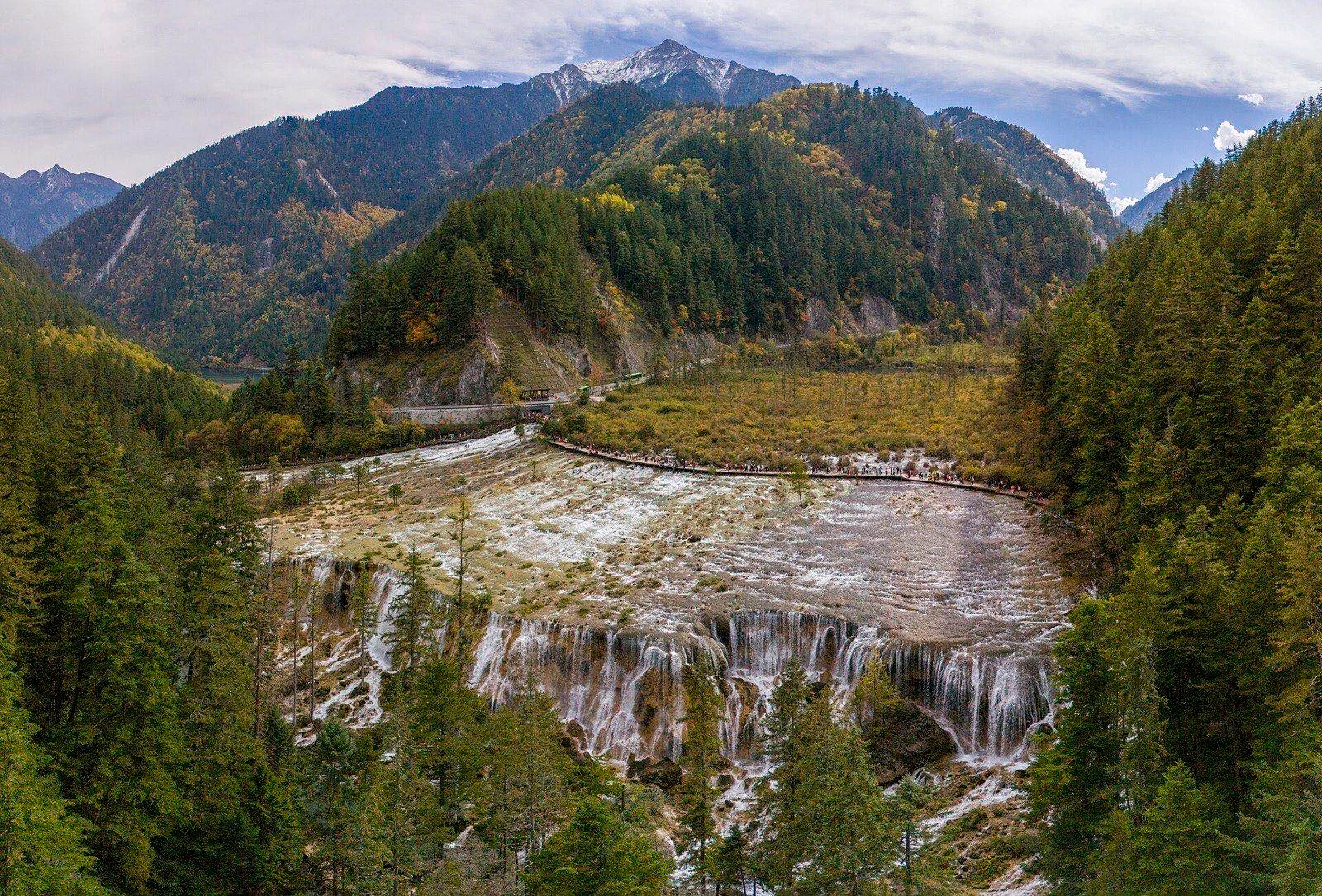
Jiuzhaigou is China's most theatrical landscape: a high valley in northern Sichuan where more than a hundred lakes stack in impossible blues and greens, waterfalls curtain over travertine dams, and Tibetan villages sit beside the water as they have for centuries. A UNESCO World Heritage Site since 1992 and one of the country's flagship national parks, it is now a strictly managed experience — daily visitor numbers are capped, tickets are sold online only, and shuttle buses carry everyone along a Y-shaped valley road. That machinery keeps the fairy tale watchable, and the payoff is real: Five Flower Lake's jeweled water, the wide plunge of Nuorilang Falls, and autumn color that peaks in October. This is a park you visit, not a town you wander — you will sleep in the gateway town of Zhangzha and give the valley one full, early-starting day, with Huanglong's travertine terraces as the classic second day.
Top sights at a glance
No. 1
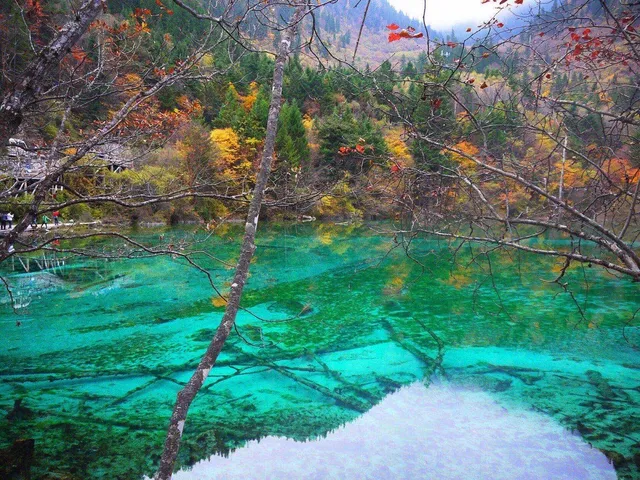
Five Flower Lake
The valley's postcard and its masterpiece: a shallow lake whose water shifts across jade, turquoise, sapphire, and amber as depth, algae, and calcium carbonate play with the light. Fallen tree trunks lie preserved on the lakebed like fossils under glass, visible from the boardwalk above. On a still morning, with autumn hillsides doubled in the water, it is one of the great views in Chinese landscape.
Good to know · Come mid-morning for the best light, walking downhill from nearby Panda Lake along the boardwalk so the views unfold in the right order. The lakeside path is one-way in spirit and crowded at peak — keep moving, then circle back via the shuttle stops (as of September 2026).
No. 2
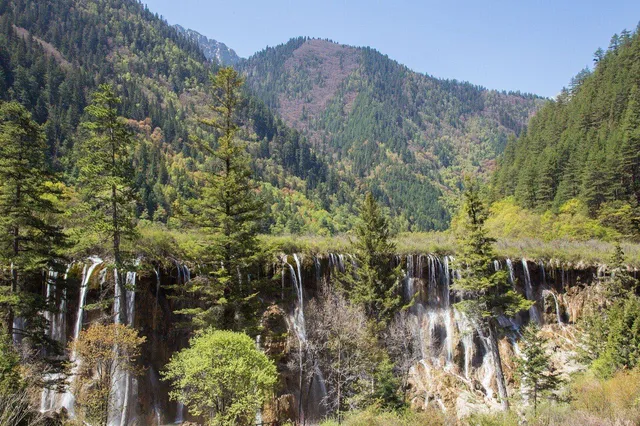
Nuorilang Waterfall
Where the valley's arms meet, the water exits a lake in a single vast curtain — Nuorilang, generally cited as the widest travertine waterfall in China at roughly 300 meters across. The name means 'majestic and magnificent' in Tibetan, and the setting delivers: a broad lip of water spilling into a pine-ringed amphitheater you can circle on footpaths from both sides. Largely rebuilt after the 2017 earthquake, it is the valley's landmark.
Good to know · The falls sit beside the Nuorilang tourist center, the hub where shuttle routes branch — pair your visit with lunch or a rest there. Bottom-up views from the main road side are the classic shot; morning light falls best on the curtain (as of September 2026).
No. 3
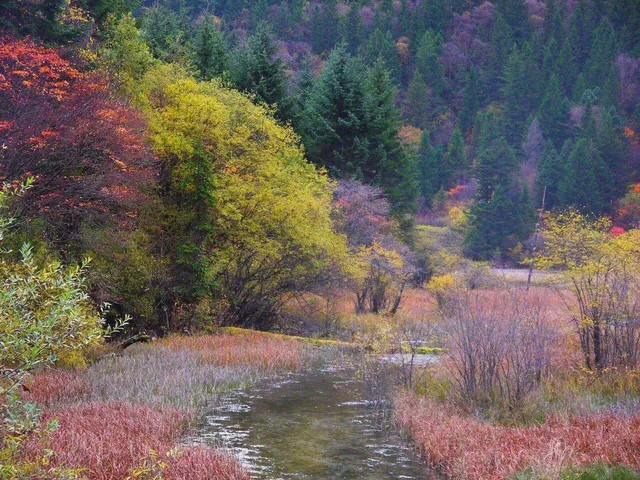
The Y-Shaped Valley Route
Jiuzhaigou is shaped like a giant Y: the Shuzheng valley forms the stem from the entrance, splitting at Nuorilang into the Rize arm — the scenic heavyweights, including Five Flower Lake and Pearl Shoal — and the Zechawa arm, home to Long Lake and the Five-Color Pond. Private cars are banned; hop-on hop-off shuttles run the roads and boardwalks stitch the lakes. The winning strategy is simple: ride to the farthest point first, then walk downhill all day.
Good to know · Enter at the morning opening, ride straight to the top of the Rize arm, and work down: Primeval Forest or Arrow Bamboo Lake, then Panda Lake, Five Flower Lake, Pearl Shoal, and Mirror Lake. Cross to Zechawa for Long Lake and the Five-Color Pond, then drift down the Shuzheng stem as the crowds thin (as of September 2026).
No. 4
Shuzheng Villages
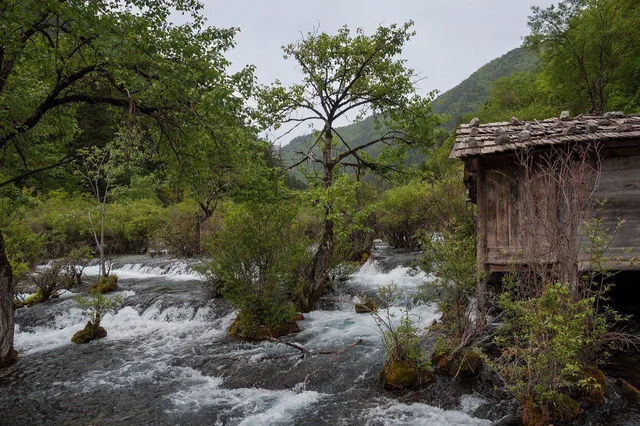
Jiuzhaigou means 'Valley of Nine Villages,' named for the Tibetan hamlets that farmed this valley for centuries — and Shuzheng, the largest still inhabited, sits directly beside the lake staircase that carries its name. Prayer wheels, whitewashed walls, and wooden farmhouses stand above a chain of terraced pools and cascades, giving the valley's water a human frame. It is the one place inside the park where the fairy tale still has residents.
Good to know · The village and lake chain sit on the Shuzheng stem, so most visitors pass them on the afternoon ride back to the gate — allow time to hop off. Boardwalks run between the terraced lakes; please respect that homes here are private, and photography of residents deserves an ask-first rule (as of September 2026).
No. 5
Huanglong Day Trip
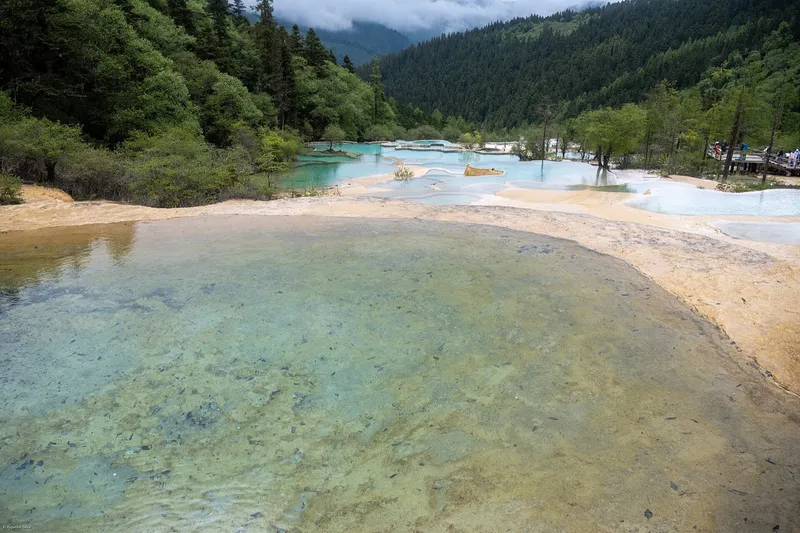
Two hours west, in the next valley system, Huanglong — 'Yellow Dragon' — unspools a kilometer-long staircase of travertine terraces in golds and jewel tones, its summit pool, the Five-Color Pond, sitting near 3,570 meters. A UNESCO World Heritage Site in its own right, it pairs naturally with Jiuzhaigou: smaller, quieter, higher, and best done as a single day with a cableway assist and a slow pace.
Good to know · Take the cableway up, walk the boardwalk to the Five-Color Pond, and descend on foot — around four to five hours total. The trail sits above 3,000 meters throughout: pace yourself, hydrate, and skip it if altitude has hit you hard. Entry and cableway prices are seasonal; confirm current rates when you book (as of September 2026).
Jiuzhaigou is the single most concentrated dose of natural spectacle in China — a valley where the water does things water is not supposed to do. Lakes grade from bottle-green to electric blue to a gold that looks poured in; waterfalls slide over dams built by minerals, not men; and the whole system sits in forested mountains at 2,000 to 3,000 meters in the Tibetan corners of northern Sichuan. Chinese superlatives call it a fairy tale unfallen, and for once the marketing is honest. The catch is management — capped daily numbers, online-only ticketing, and a mandatory shuttle system — none of which ruins it, because the machinery is what keeps a place this fragile watchable at all. Come for one long, early day in the valley, sleep well in the gateway town, and add Huanglong for the second act. Travelers who want wild solitude should look elsewhere; travelers who want the most beautiful water in Asia should book ahead.
A Bit of History
For most of its story, this valley belonged to itself. Nine Tibetan villages farmed and herded the valley floors — the settlement names survive in the park’s own geography, and “Jiuzhaigou” simply means Valley of Nine Villages — while Han China’s mapmakers barely bothered with the mountains of Aba prefecture. The outside world arrived in the 1970s, when government forestry surveys realized that the lakes they were cataloging were a national treasure rather than timber land; the valley was protected as a nature reserve in 1978 and opened to tourism in 1984. Early visitors arrived on shaky mountain flights or long bus rides up the river valleys; the idea of an ordinary family holiday here would have seemed absurd. UNESCO inscribed it as a World Heritage Site in 1992 and as a biosphere reserve in 1997, and domestic tourism did the rest: Jiuzhaigou became one of the most famous landscapes in China, the standard against which the country measures scenic beauty. Its lakes entered school textbooks, and the valley’s name became national shorthand for any impossible shade of blue.
The modern history has one deep scar. On August 8, 2017, a magnitude 7.0 earthquake struck the valley, damaging lakes, trails, and the Nuorilang waterfall’s travertine lip, and the park closed almost entirely. What followed was one of the most closely watched restorations in world heritage: engineers and ecologists rebuilt walkways and repaired lake dams using the valley’s own mineral-deposition processes where possible, reopening sections in stages from 2018 and restoring full access in 2021. The park that reopened is more strictly managed than before — daily visitor caps, timed tickets, and shuttle-only roads — a bargain most visitors accept the moment they see what the limits protect. Today the valley draws millions a year, and a 2024 figure of more than five million visitors made headlines precisely because the cap holds even in peak season.
Culture & Daily Life
Jiuzhaigou sits in Aba Tibetan and Qiang Autonomous Prefecture, and the cultural texture is Tibetan first. The valley’s villagers practiced a Tibetan Buddhism braided with older mountain beliefs: prayer wheels turned by water, whitewashed farmhouses hung with prayer flags, stupas above the fields. Several villages still stand inside the park — Shuzheng, Heye, and Zechawa remain inhabited — and their residents live a double life of farming heritage and park employment, their homes among the most photographed in China.
Outside the gate, the gateway strip of Zhangzha runs on the tourist economy: hotels on a grand scale, restaurants and bars aimed at tour groups, and a nightly traffic of visitors comparing lake photos. Evenings run simple: dinner, a stroll past hotel lobbies full of waiting tour groups, an early night — because the valley opens early and rewards the first shuttles. It is a functional, cheerful town rather than a charming one, and the region’s deeper culture takes a little effort — Tibetan family-run kitchens in town, Qiang villages and their watchtower architecture farther afield, and the old town of Songpan, a historic Tibetan-Han trading town with horse-trekking outfits, on the road toward Huanglong.
Practical notes for respectful and easy travel: ask before photographing residents or monks; rotate prayer wheels clockwise; and carry small bills for market stalls. Mandarin is the working language, Tibetan the home language, and English is rare outside hotel front desks — a translation app earns its keep. And remember you are at altitude: the park gate sits around 2,000 meters, but the valley rises well above that, and evenings in the mountains are cold most of the year.
Nature & the Valley Landscape
Jiuzhaigou’s scenery runs on geology. The valley is a glacial trough lined with limestone, and its water is supersaturated with calcium carbonate; where it flows, the mineral precipitates into growing dams of travertine — natural dikes that pool the water into terraced lakes and spill them into cascades. More than a hundred lakes stack along the valley floor, many held back by these dams, and the water’s famous colors come from the same chemistry: calcium-saturated water scatters blue-green light, while algae, depth, and fallen timber add the greens, golds, and patterns. The clarity is extreme — depths you would guess at two meters run closer to ten — and the preserved tree trunks carpeting the lakebeds are the valley’s signature detail.
The forests around the lakes matter as much as the water. This is transition country between the Sichuan basin and the Tibetan plateau: deciduous forest that detonates into reds and golds through October, conifer forest above, and a mammal population that includes giant pandas and golden snub-nosed monkeys — resident here in small numbers, though sightings are rare and belong to the researchers more than the tourists. Birds, squirrels, and the occasional deer are the realistic wildlife encounters.
Seasons rewrite the valley. Autumn — especially October into early November — is the classic window, when foliage color and still water coincide. Spring brings snowmelt volume and empty paths; summer is lush, green, and busiest with domestic families; winter turns partial and quiet, with ice-framed falls, frozen spray, and off-season pricing. Whatever the season, the rules protect the water: no swimming, no touching the lakes, no drones, and no leaving the boardwalks. The valley survived a major earthquake and a four-year restoration to look this good; the woodwalk etiquette is not decoration.
Food & Drink
Eating in Jiuzhaigou is fuel for the itinerary rather than a destination in itself — the valley demands a full day, and the gateway town supplies calories accordingly. Zhangzha’s restaurant strips run to Tibetan-Sichuanese comfort food at mountain prices: yak-meat hotpot with mushrooms, hearty stews, Sichuan classics executed with varying fidelity, and lots of noodles. It fills you well without ever aiming at refinement, and portions are sized for tour tables.
The regional signatures worth seeking out are yak in its forms — jerky to buy, hotpot to share, burgers for the kids — highland barley flatbreads, and butter tea, an acquired taste worth acquiring once. Mushroom dishes appear seasonally, drawing on the same forests you walked through. Hotel restaurants, especially in the bigger properties, serve extensive breakfast buffets; load up there, because the park’s mid-route options are limited to a large self-service cafeteria at the Nuorilang tourist center and snack kiosks — eating inside the valley is possible but unremarkable.
Two honest notes: prices in Zhangzha run noticeably above Chengdu for the same dish, particularly during October, and quality tracks the crowd — the busiest places turn tables fast enough to keep things fresh. Stock fruit, nuts, and water from a town supermarket the evening before your park day; the boardwalks are long, and lunch happens when it happens. Town markets sell flatbreads, fruit, and yak jerky that pack well. Beer and barley wine flow freely in the evening strips; altitude adds a multiplier, so drink a glass of water for every glass of anything else.
Top Sights
Jiuzhaigou’s sightseeing is one integrated system — ticket, shuttle, boardwalks — so plan the day around the Y-shaped route. Entry is by timed ticket only, bought online in advance; sales open at 8:00 AM and entry closes at 2:00 PM, with the park open 8:00 AM–6:00 PM (as of September 2026).
Five Flower Lake
This is the lake you came for. Shallow, multicolored, and famously clear, Five Flower Lake shows every trick of the valley’s chemistry at once: sapphire channels over submerged meadow, jade shallows, gold-green margins, and a gallery of fallen trunks preserved on the bottom in uncanny detail — look, and you can count branches. From the boardwalk above, the effect is of looking down through glass. The lake sits mid-way up the Rize arm, and the best approach is on foot from Panda Lake, a downhill twenty minutes along the boardwalk that lets the reveal happen gradually. Mid-morning delivers the strongest color; by afternoon the tour-group surge makes the platforms slow going. There is no bad season here — the lake’s palette shifts rather than fades — but a still morning, when the hills double in the water, is the one photographers chase.
Nuorilang Waterfall
Nuorilang is the valley’s exclamation point: a single sheet of water, roughly 300 meters across and a couple of stories high, pouring over a travertine lip into a forest amphitheater. It stands at the junction where the Y splits, next to the tourist center that bears its name, and you will almost certainly pass it more than once — which is fine, because the falls reward repetition. Paths run up both sides of the amphitheater, with the frontal platform delivering the classic wide shot and spray in the wind. The waterfall was badly damaged in the 2017 earthquake and spent years under careful reconstruction; today it reads as seamless, and its revival has become part of the park’s own story. Visit mid-morning for light on the curtain, or time it for the afternoon lull between the big shuttle waves; the cafeteria inside the tourist center makes the falls a natural lunch stop.
The Y-Shaped Valley Route
Understanding the route is understanding Jiuzhaigou. The park is one road system in a Y: the Shuzheng stem climbs from the entrance to Nuorilang, where arms branch west to Rize and north to Zechawa. Shuttles are the only transport — hop-on hop-off at signed stops — and the boards alongside make it genuinely feasible to see the whole system in one long day. The local maxim is ride high, walk down: take the first shuttle of the morning to the top of the Rize arm (roughly 18 kilometers from the gate), then descend on the boardwalks through Arrow Bamboo Lake — a filming location for the Zhang Yimou film Hero — then Panda Lake, Five Flower Lake, the cascade steps of Pearl Shoal, and Mirror Lake. Shift by shuttle to the Zechawa arm for Long Lake, the deep headwater lake, and the Five-Color Pond, then spend the afternoon drifting down the Shuzheng stem past the terraced lakes and villages toward the exit. If you have two days, split Rize and Zechawa rather than repeating the whole loop; a second-day ticket is purchased like the first, capped the same way. Sit on the right riding up the Rize arm and the left on Zechawa for the best lake views out the window.
Shuzheng Villages
The human history inside the fairy tale. Shuzheng is the largest of the valley’s remaining inhabited villages, set on a fan of land above its namesake lakes — a staircase of terraced pools stepping down the valley, spilling from one to the next in small falls. Prayer wheels line the village edge, turned by the stream; farmhouses and a whitewashed stupa complete the picture, and the boardwalk threads between water and homes closer than anywhere else in the park. Heye and Zechawa, the other villages still resident, sit along the route and repay a glance from the shuttle or a short walk. This stretch is the valley’s best late-afternoon terrain: the day crowds thin, the light goes golden, and the lakes quiet down. Remember the obvious but essential point — these are people’s homes, not stage sets. Buy a snack from the village stalls, walk softly, and treat the photography of residents as a favor to request, not a right.
Huanglong Day Trip
Huanglong is Jiuzhaigou’s sibling and its perfect counterweight: another UNESCO World Heritage Site, another valley of mineral water, but all travertine and no crowds of comparison. A boardwalk climbs a kilometers-long staircase of terraced pools — the “Yellow Dragon” of the name, its scales rendered in golds, creams, and milky blues — to the summit Five-Color Pond near 3,570 meters, above which the snow mountain Xuebaoding keeps watch. The circuit, helped by a cableway up and a walk down, takes four to five unhurried hours; the trail sits above 3,000 meters the whole way, so move slowly, drink water, and treat any headache as altitude first. From Zhangzha it is roughly two hours each way by road via Chuanzhusi, making it a clean second day — and the transfer point also connects usefully with the railway for onward travel. Entry and cableway prices are seasonal and change with the calendar; confirm current rates when booking (as of September 2026). Winter visitors should note the high sections can close in snow and ice, when the journey becomes a shorter, lower walk.
Getting There & Around
Rail changed the calculus. The Chuanqing railway’s Huanglong-Jiuzhai station, opened at the end of August 2024, puts the valley within reach of Chengdu East in under two hours at the fastest, with services running through most of the day; shuttles meet the trains for the roughly 90-minute road hop to Zhangzha, making a same-day arrival and afternoon of planning entirely realistic. Book trains on the official 12306 app or Trip.com with your passport.
Flying is the alternative: Jiuzhai Huanglong Airport, a high-altitude strip at 3,448 meters opened in 2003, receives flights from Chengdu and other cities, with the drive to the valley running roughly 90 minutes to two hours — but mountain weather delays are common, and the train has largely taken over this route. By road, expressways cover the roughly 460 kilometers from Chengdu in four to five hours; long-distance buses make the same run.
Inside the park, the shuttle system is the transport — private vehicles never enter — so your legs matter only on the boardwalks, which are well built and signed. Between Zhangzha’s hotels and the gate, walk, catch a local shuttle, or take a short taxi; the town runs a few kilometers along the valley mouth.
Where to Stay
Zhangzha town is the base — there is no tourist lodging inside the valley, and the park’s management intends it that way. The town stretches several kilometers along the road, and your choice is really about distance and altitude of comfort: hotels nearest the gate trade convenience for bustle, while properties a few kilometers out run quieter and larger, some with mountain views off the breakfast table. Mid-range rooms are plentiful; the October peak, when Chinese autumn tours converge, can fill the valley — book well ahead and expect the year’s highest rates then.
For a second base, the old town of Songpan, on the far side toward Huanglong and the railway, makes an offbeat option: cobbled streets, a working market, and horse-trekking outfits, with far quieter nights than Zhangzha — right for travelers pairing Huanglong with onward rail travel rather than a second day in the valley. However you split it, plan two nights minimum: one for the valley day that starts at opening time, one to recover, and — if October light has done its work — a third for Huanglong.