Hubei and Hunan in 9 Days: River Cities, Avatar Peaks, and Phoenix Town
The Yangtze's middle course, done properly: Wuhan's river crossings and Warring States bronzes, Changsha's midnight snack economy and the 2,000-year-old Lady Dai, then the sandstone pillar forests of Zhangjiajie — the mountains that floated in Avatar — and a lantern-lit finale in Fenghuang's stilt-house old town. Every intercity leg is high-speed rail under three hours, every day carries the booking rule that governs it — Hunan Museum's 5-day release, Zhangjiajie's 4-day park pass, Tianmen's timed entry — plus honest budgets and the pick-one choices that keep the route humane.
Route: Wuhan Changsha Zhangjiajie Fenghuang
Central China is the country’s middle child — skipped by first-timers beelining for the coast, adored by everyone who actually goes. This nine-day line fixes that with an unfair share of highlights: two great river capitals that eat better than almost anywhere in China, then a mountain range so improbable that a Hollywood franchise borrowed it, and an ancient town where the day ends on a boat under lanterns. It is also one of the easiest long routes in China to run: every intercity hop is high-speed rail under three hours, the cities are cheap, and the food — Wuhan’s breakfast republic, Changsha’s midnight crayfish — could carry the trip on its own. City guides for Wuhan, Changsha, Zhangjiajie, and Fenghuang go deeper on every stop.
Day 1: Arrive in Wuhan, the Hankow Bund at Dusk
Land at Tianhe or roll in on the rail spine, then cross straight into the city’s best register: the former concession riverfront, where the customs house and its neighbors stand in for a century of Yangtze trade. Walk Jianghan Road to the water, watch the freight barges slide past, and eat your first hot-dry noodles standing up like a local — this is a city that takes breakfast seriously enough to call it “prematurely morning.”
Practical tip: Sort the digital kit at arrival (essential apps guide): eSIM live (connectivity guide), Alipay charging your foreign card (payments guide), 12306 installed — three intercity trains book through it (train guide). Sleep near the Hankow side; the metro makes the whole city 30 minutes wide.
Day 2: Bronzes, Bells, and East Lake
Morning at the Hubei Provincial Museum for the A-game of Chinese antiquity: the Sword of Goujian, still bright after 2,400 years, and the full 65-piece Zenghouyi chime-bell set, cast in 433 BC and still played at recitals in the hall (a small extra ticket). Afternoon drifts into East Lake, the green lung beside it — rent a bike, or let the lakeside breeze decide the route.
Practical tip: The museum is free but reservation-only — book ahead on its official WeChat account or Trip.com with your passport, and note it closes Mondays; if Day 2 lands on one, swap with Day 3 now, not on the day. The chime-bell performance runs several times daily for around ¥30 — worth it, the sound is the exhibit.
Day 3: Yellow Crane Tower, the First Bridge, and the Train to Changsha
The classic Wuhan morning: climb Yellow Crane Tower (¥70) for the river panorama poets couldn’t stop writing about, then walk the First Yangtze River Bridge’s deck straight off the tower’s doorstep — rail below, road above, the whole 1957 miracle underfoot. Ride the commuter ferry back across the river for pocket change, eat one last breakfast crawl, and take an afternoon train south.
Practical tip: The tower opens 8:00-18:00 (to 17:00 in winter); the bridge walk is free and the bridgehead elevator costs about ¥2. Trains to Changsha South run constantly — 1.5 hours or less, second class roughly ¥65-130 depending on the train — so book a 15:00-16:00 departure and land in time for Pozi Street’s first shift of stinky tofu.
Day 4: Lady Dai and the Mao Statue at Sunset
Morning at the Hunan Museum, the trip’s best ticket: the 2,100-year-old Lady Xin Zhui, preserved so completely that her joints still bend, plus the gauze robe that weighs less than an orange. Afternoon builds to Orange Isle at golden hour — the young-Mao statue at the sandbar’s tip, the river wide around it, night runners passing all the way out.
Practical tip: The museum is free but releases tickets up to 5 days ahead at 20:00 on its official WeChat account or Alipay mini-program (closed Mondays) — set the alarm for your date; foreign passports book fine with the passport number. Orange Isle is free and open late; the sightseeing shuttle (~¥40, multiple rides) saves the four-kilometer walk in summer heat.
Day 5: Yuelu Academy and Changsha’s Midnight Economy
West bank morning: Yuelu Academy (¥50), teaching on this site since 976, its courtyards climbing into one of China’s great university campuses, then the forest paths of Yuelu Mountain above it. Afternoon is deliberate rest — a Chayan Yuese milk-tea queue you’ll actually enjoy, Taiping Street’s snacks — because Changsha’s real show starts after 22:00: crayfish, queues, and a nightlife that treats midnight as an opening bell.
Practical tip: The academy opens 7:30-18:00 May-October; go before 9 for empty courtyards. Tonight, pack — tomorrow’s train is the trip’s hinge — and book the Zhangjiajie hotel tonight if you haven’t: the mountain towns sell out around Chinese holidays weeks ahead (hotels guide).
Day 6: The Rail to Zhangjiajie, Golden Whip Stream at Dusk
Morning train to Zhangjiajie West (as fast as 1 hour 39 minutes, about 47 trains a day), then the transfer to Wulingyuan, the gateway district at the park’s north edge — bus or taxi, 40-60 minutes. Check in, and walk Golden Whip Stream in the late light: a flat, shaded trail along cold water, with macaques conducting their snack-theft economy from the trees.
Practical tip: The core ticket runs about ¥227-236 and is valid four consecutive days including the internal green buses — buy it with your passport on Trip.com or the official mini-program and treat it as a four-day pass, not a single entry. Keep food zipped and bags closed: the monkeys are professionals.
Day 7: Yuanjiajie and Tianzi — the Avatar Day
The full-mountain day. Ride the Bailong Elevator — 326 meters up a cliff in about two minutes — into Yuanjiajie, where the Hallelujah platform looks across at the quartzite pillar that inspired Avatar’s floating peaks. Bus on to Tianzi Mountain for the ridge-top sea of stone, and ride the cableway down as the light goes long.
Practical tip: The park opens early; be at the Wulingyuan gate by 07:30 to stay ahead of the coaches. Inside, buses and this itinerary’s two paid rides (elevator ¥65 up, Tianzi cableway ¥72 down) are all you need — skip the add-on cableways until you see how your legs feel at 15:00.
Day 8: Tianmen Mountain, Then the Train to Fenghuang
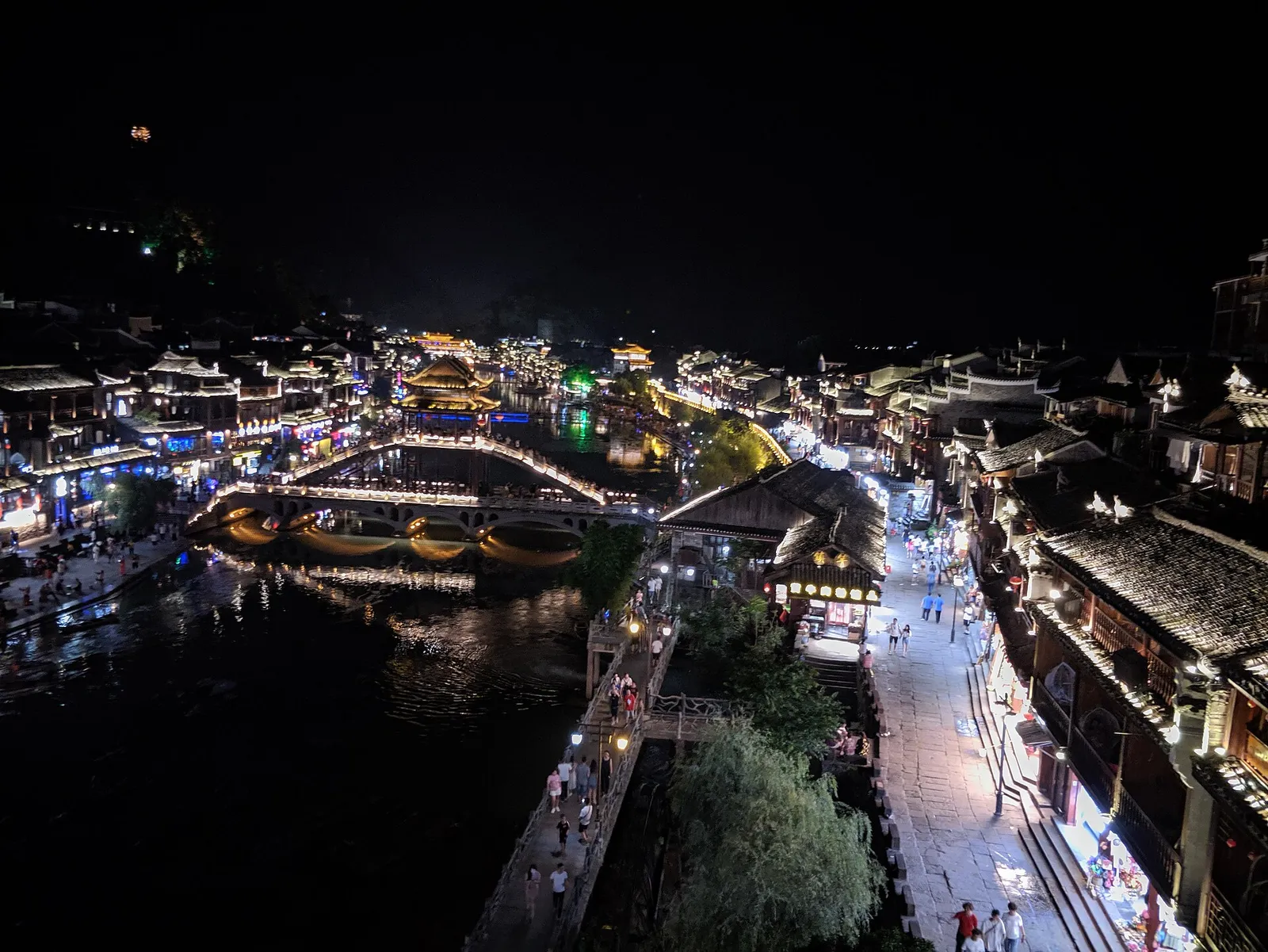
A different mountain, a different logic: Tianmen presides directly over the city, reached by one of the world’s longest cableways or the serpentine road’s 99 bends, with the 999-step “Heaven’s Gate” stairway piercing the arch at the top. Four hours covers the plank walks and the cave; by late afternoon you’re on the train south to Fenghuang (about an hour) and, by night, on the Tuojiang riverbank as the stilt houses switch on.
Practical tip: Tianmen’s through-ticket runs about ¥288 (all routes) with timed, passport-linked entry — book a morning slot a day or two ahead via Trip.com or the official channels, and note the main cableway’s upper section has been under maintenance since late 2025, which changes the up/down logistics; check the current routing when you book. Keep the heaviest luggage storage-smart: carry one night’s bag to Fenghuang and leave the rest for the return pass through Zhangjiajie if you’re looping back.
Day 9: Fenghuang Dawn, and the Rail Home
Fenghuang repays the early riser: before 7:30 the river holds mist instead of crowds, the jumping stones are dry, and the night’s neon has washed back into slate-and-timber tones. Take the morning boat, graze the lanes while residents still outnumber cameras, then board an afternoon train to Changsha South (roughly two hours) for the flight home — or linger one more night and let the lanterns have the last word.
Practical tip: The town is free to enter; the heritage package (river cruise plus the old courtyard houses) has run about ¥128 at the tourist centers. Boats also sell separately for around ¥90 — same water, shorter commitment. For the exit: Fenghuang Gucheng station sits a 15-20 minute ride from the old town, with about ten trains a day to Changsha South (second class from about ¥207); book the 15:00-17:00 window to make an evening flight with buffer.
Practical Notes
Intercity transport
| Leg | Mode | Time | Second-class fare (approx.) |
|---|---|---|---|
| Wuhan → Changsha South | G train | 1-1.5 hours | ¥65-130 |
| Changsha → Zhangjiajie West | G/D train | 1.5-3 hours | from about ¥68 |
| Zhangjiajie West → Fenghuang Gucheng | G train | about 1 hour | from about ¥75 |
| Fenghuang Gucheng → Changsha South | G train | 2-2.5 hours | from about ¥207 |
Four rail legs, zero flights, one province-pair line. Trains book 15 days out on 12306 (train guide); the Changsha-Zhangjiajie corridor sells out first around holidays. Fares as of September 2026, floating pricing.
Budget estimate (per person, excluding international flights)
- Backpacker: US$500-650 — hostels and guesthouses, street food all day, buses and second-class seats, park tickets but no premium rides (~US$55-75/day)
- Mid-range: US$850-1,100 — 3-4-star hotels, restaurant meals, all tickets including Bailong and Tianzi, Tianmen morning slot (~US$95-120/day)
- Comfort: US$1,500-2,100 — design hotels, private drivers between trailheads and stations, glass bridge and shows included (~US$170-230/day)
This is one of China’s best-value routes: museums are free, the street food is a meal for a few dollars, and the mountains price like theme parks but include four days of walking for it. See our budget guide for the daily math.
Booking calendar (the part that makes or breaks it)
- 5 days ahead, 20:00 Beijing time: Hunan Museum release (closed Mondays) — the trip’s tightest regular ticket
- 2-3 days ahead: Tianmen Mountain timed slot; glass bridge if you add the canyon day; Hubei Museum reservation
- 15 days out: all four trains; the Changsha-Zhangjiajie leg first
- Rolling: Yellow Crane Tower, Yuelu Academy, Orange Isle, Golden Whip Stream (all walk-up friendly); Zhangjiajie core ticket any time before entry
- Best months: April-June and September-November (best-time-to-visit guide). Home setup: 12306, Alipay, Didi, Amap, a translate app (essential apps guide)
Sources & verification (11)
- https://www.hnmuseum.com/
- https://www.travelchinaguide.com/attraction/hunan/changsha/museum.htm
- https://www.travelchinaguide.com/attraction/hubei/wuhan/yellowcrane.htm
- https://www.travelchinaguide.com/attraction/hubei/wuhan/bronze_music.htm
- https://www.travelchinaguide.com/attraction/hunan/zhangjiajie-national-forest-park.htm
- https://www.chinahighlights.com/zhangjiajie/attraction/tianmen-mountain.htm
- https://www.trip.com/trains/china/route/wuhan-to-changsha/
- https://www.trip.com/trains/china/route/changsha-to-zhangjiajie/
- https://www.trip.com/trains/china/route/zhangjiajie-to-fenghuang/
- https://www.trip.com/trains/china/route/fenghuang-to-changsha/
- https://www.chinahighlights.com/zhangjiajie/transportation.htm