Porcelain, Tea, and Tulou: 13 Days from Shanghai to Xiamen
The southeast's craft spine: Shanghai's skyline start, a Yangzhou pause for the Grand Canal and China's most civilized breakfast culture, then the working workshops of Jingdezhen — porcelain thrown and fired nightly for a thousand years — the bamboo-raft rivers and rock-tea cliffs of Wuyishan, and the medieval port of Quanzhou, where mosques, pagodas, and oyster-shell lanes mark the maritime Silk Road. Ends in Xiamen with the UNESCO tulou villages. Every leg runs on high-speed rail; the booking that matters most is Wuyishan's raft, reserved together with the park ticket.
Route: Shanghai Yangzhou Jingdezhen Wuyishan Quanzhou Xiamen
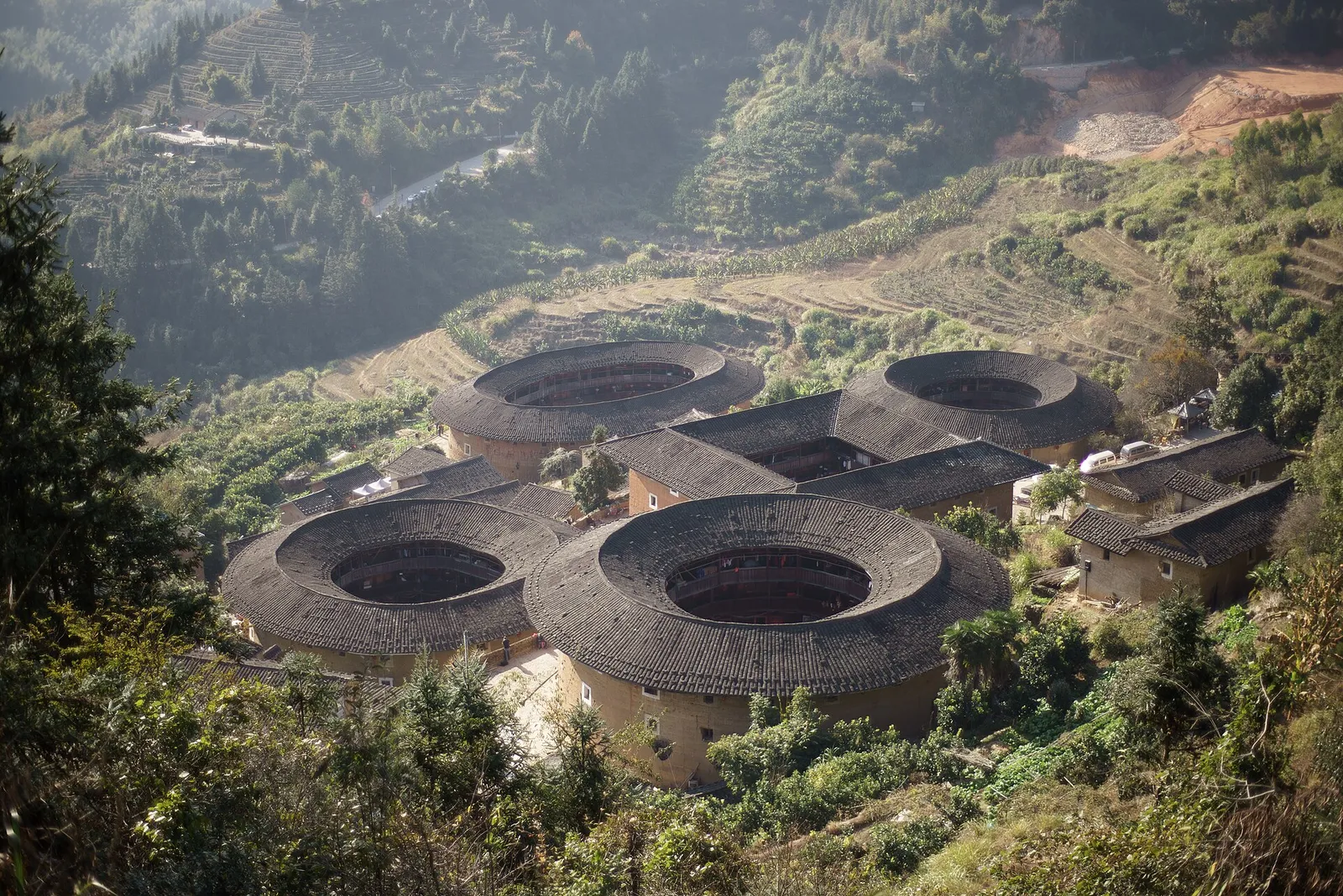
South of the Yangtze, China gets gentler and more specific: cities that make things — porcelain, tea, silk, salt — and still make them where you can watch. This line follows the craft coast from Shanghai’s skyline to Xiamen’s harbor islands, stopping where the making happens: a canal capital where breakfast is a three-hour institution, a kiln city that throws pots at midnight, a mountain where tea trees cling to cliff seams above a raft river, and the port that sent porcelain and tea to the world and kept the mosques and pagodas to prove it. It finishes among the tulou — fortress-houses of rammed earth where a whole clan lived inside one wall. Six stops sounds like a forced march; the trains make it a stroll, and half the days are deliberately half-days. City guides for Shanghai, Yangzhou, Jingdezhen, Wuyishan, Quanzhou, and Xiamen go deeper on every stop.
Day 1: Arrive in Shanghai, the Bund at Night
Land, install the infrastructure (essential apps guide), and go straight to the waterfront after dark: Pudong’s towers switched on across the Huangpu, the Bund’s 1930s facades behind you. First-night Shanghai is a spectator sport, not a to-do list. Dim sum or noodles nearby, then sleep — the skyline keeps.
Practical tip: Stay within walking distance of the Bund or a Line 2/10 station; Shanghai taxis are easy but the airport runs are long (city transport guide). Set up Alipay and the 12306 login tonight — five rail legs book through them.
Day 2: Yu Garden, the Old Town, and the French Concession
Morning at the Ming-dynasty Yu Garden when it opens, then the bazaar lanes around it before the coaches land. Spend the afternoon deliberately slow in the former French Concession: plane-tree streets, wukang-era villas turned into cafes, one long late lunch. Shanghai rewards one unplanned hour more than any ticket in the city.
Practical tip: Yu Garden costs ¥40 in peak season and closes Mondays — if Day 2 is a Monday, swap with Day 3 now. Book via the official WeChat account with your passport or queue at opening. Leave for Yangzhou after breakfast tomorrow, not before a last xiaolongbao.
Day 3: The Rail to Yangzhou, Slender West Lake
Morning train up the Yangtze delta (from about 1 hour 25 minutes; arrive by noon), check in, and spend the golden hours at Slender West Lake — the willow-lined waterway where the Five-Pavilion Bridge and the white dagoba stack a postcard every fifty meters. Evening on Dongguan Street, the lantern-lit artery of the old town.
Practical tip: Entry runs ¥60-100 by season (¥100 in the March-May and September-November peaks); buy timed tickets via Trip.com or the official WeChat channel with your passport, and go on a weekday if the calendar allows — the bridges bottleneck by 10:30.
Day 4: Huaiyang Morning Tea and the Salt-Merchant Gardens
Do Yangzhou the right way up: a long, formal morning-tea breakfast — the city’s court-cuisine tradition, dim sum by way of an empire’s salt taxes — then Ge Garden, the scholar’s garden whose rockery walks through all four seasons in one courtyard. Afternoon He Garden for its double-decker corridors, and an evening by the Grand Canal the city grew rich on.
Practical tip: The gardens cost about ¥30-48 each depending on season and channel; both open early (Ge Garden from around 7:15), which pairs perfectly with a morning-tea start. The free Grand Canal Museum needs a reservation several days ahead via its WeChat mini-program and closes Mondays — book it before you leave home or let the canal-side walk substitute.
Day 5: The Long Leg South to the Porcelain City
The trip’s one awkward travel day, done properly: a morning train back through Nanjing (about an hour), then the connection south to Jingdezhen North — only about three trains a day run that leg, the fastest in about three hours, so the whole crossing eats the middle of the day. Arrive by evening and walk into Taoxichuan, the ceramic-art district that goes electric after dark.
Practical tip: Book both train legs on 12306 the day tickets open — the Nanjing South to Jingdezhen North seats are the constraint, not the frequent Yangzhou-Nanjing hops. If the connection fails, the alternate route runs via Nanchang; add an hour. Taoxichuan’s markets peak on weekend evenings — plan Jingdezhen around a Saturday if you can.
Day 6: Kilns, Museums, and Throwing Your Own
Morning in Taoyangli, the heritage quarter where the Imperial Kiln Museum’s brick vaults rise over the excavated works that fired for the emperors; six hundred years of imperial-quality porcelain, read in shards and rebuilt vaults. Afternoon: get clay under your nails — the studio districts around town run two-hour throwing classes for travelers, wheel included.
Practical tip: The Taoyangli district ticket starts around ¥51 and the museum inside is free but needs timed reservation (closed Mondays outside holidays) — book via official channels with your passport. Studios charge from about ¥100-300 per session; hotel front desks book them the day before. Whatever you make ships home in about two weeks — the city has been exporting this way since the Song.
Day 7: The Ancient Kilns, Then the Rail to the Mountains
Morning at the Ancient Kiln & Folk Museum, a working heritage park where wood-fired dragon kilns are fed for real and the unglazed sweat of the craft is on display — time your visit to a firing demonstration if the schedule allows. Late afternoon, the short rail hop southeast to Wuyishan (about 1 hour 20 minutes on the fastest runs), arriving into the resort district at the park’s edge.
Practical tip: Entry lists around ¥95 with online discounts common (about ¥75-95 in practice), open roughly 8:00-17:00; kiln-firing demos run on a fixed daily schedule at the gate. Tonight, buy tomorrow’s park ticket and the day-after raft together — see Day 9’s tip before you sleep.
Day 8: Tianyou Peak and the Da Hong Pao Trail
The mountain day. Climb Tianyou Peak before 9 a.m. — an hour or so of stone steps to the great river-bend view, nine bends of green water coiling through Danxia cliffs — then drop to the valley trails toward the six mother trees of Da Hong Pao, the original bushes of China’s most famous rock tea, clinging to a cliff seam with their own guardrail and legend. End with a tasting at an honest shop in the resort district; good sellers brew before they sell.
Practical tip: Peak and trails sit inside the main scenic ticket; the free green shuttle buses hop between trailheads every few minutes — plan walks point-to-point and let the bus close the loop. Steps turn slick after rain; the cheap rubber-soled “hiking slippers” sold at the gates actually work.
Day 9: The Nine-Bend Raft
The reason poets came: a bamboo raft, eight seats and a pole-man, drifting 90-odd minutes down the Nine-Bend River beneath the cliffs you climbed yesterday — reversed, slower, better. Afternoon in Xiamei, the brick-laned tea village where the Great Tea Road began, or just the riverbank and a second pot of tea.
Practical tip: The raft is ticketed separately (about ¥130) and must be reserved at the same time as your park ticket — one-day entry ¥140 plus the ¥70 shuttle as of September 2026, all on the official Wuyishan booking platform or Trip.com with your passport; departures sell out around holidays, when extra rafts get added. Boats run from early morning; the 8:00-9:30 light is the postcard.
Day 10: The Rail to Quanzhou, Pagodas at Dusk
The longest ride of the trip: Wuyishan North to Quanzhou, about two and a half to three hours direct as the line drops out of the mountains to the sea. Check in near the old town and walk to Kaiyuan Temple as the light drops — twin stone pagodas, a thousand years old, glowing above roofs that haven’t changed their silhouette in centuries.
Practical tip: About a dozen trains run the route daily from Wuyishan North or nearby Nanping Shi; book a mid-afternoon departure so the evening belongs to the pagodas. Kaiyuan is free and stays open into early evening — dusk, not noon, is the hour.
Day 11: The Port of Empires
Quanzhou’s medieval skyline in one morning: Kaiyuan’s Great Hall, the Qingjing Mosque — China’s oldest, granite and quiet — and the incense-roaring Guandi temple next door, three faiths on one street exactly as the port left them. Afternoon by the sea at Xunpu village, where oyster-shell walls meet the flower-crowded hair tradition of the local fishing women; evening back in town for a marionette show, the city’s ocular obsession.
Practical tip: The mosque charges a token few yuan; Xunpu is free to wander, with photo outfits renting costume-and-crown packages from about ¥40-199 — agree on the package before the pins go in. Marionette tickets run roughly ¥78-108; the old-town theaters sell same-day. Taxis thin out in Xunpu after dark — arrange the return before sunset.
Day 12: The Bridge and the Island City
Morning at Luoyang Bridge, the 950-year-old stone span ship-anchored into the riverbed with oyster concrete — walk it with the low tide for the oyster beds and wading birds. Then the short hop to Xiamen (from about 18 minutes on the fastest trains): afternoon along the Island Ring Road’s palm-lined bike lanes, and the night market appetite you’ve earned.
Practical tip: The bridge is free, 20 minutes by taxi from the old town. Bikes rent for ¥20-40 an hour around Baicheng Beach, or grab a shared bike for pocket change. Tonight, book tomorrow’s Gulangyu ferry or the tulou day tour — both sell their best slots ahead (hotels and booking guide).
Day 13: Gulangyu or the Tulou — Then Home
A pick-one finale. Option A: Gulangyu, the car-free heritage island — ferry over early, walk the lanes while the day-trippers are still queuing, piano museums and colonial verandas, ferry back by late afternoon for the airport. Option B: the tulou — a small-group day trip into the mountains to stand inside a rammed-earth ring village like Tianluokeng’s cluster, UNESCO-listed and nothing else on earth like it.
Practical tip: Tourists must take the ferry from the Dongdu Cruise Center (about ¥35 round trip, 15-20 minutes), booked in advance on the official Xiamen Ferry mini-program or Trip.com with your passport — the historic pier near Zhongshan Road is residents-only by day. For the tulou, entry runs ¥50-130 depending on the cluster and day tours handle the two-hour drive each way. Evening flights from Xiamen fit either option; allow an hour to the airport.
Short on Time? The 9-Day Cut
Drop Yangzhou and Wuyishan: Shanghai (2 days) straight to Jingdezhen by direct high-speed train (about 3.5 hours), then Quanzhou and Xiamen as written. You lose the canal breakfast and the raft and keep the kilns, the port, and the tulou — a fair trade if the calendar, not the map, is boss.
Practical Notes
Intercity transport
| Leg | Mode | Time | Second-class fare (approx.) |
|---|---|---|---|
| Shanghai → Yangzhou | G train | 1.5-2.5 hours | from about ¥150 |
| Yangzhou → Jingdezhen (via Nanjing South) | G train × 2 | 4.5-5.5 hours total | ¥100-200 combined, varies |
| Jingdezhen → Wuyishan | G train | 1.5 hours | from about ¥113 |
| Wuyishan → Quanzhou | D/G train | 2.5-3 hours | varies by train |
| Quanzhou → Xiamen | G train | 0.5-1 hour | from about ¥26 |
Five rail legs, no flights. Trains book 15 days out on 12306 (train guide); the Nanjing South-Jingdezhen leg (about three departures daily) is the one that shapes the schedule. Fares as of September 2026, floating pricing.
Budget estimate (per person, excluding international flights)
- Backpacker: US$900-1,200 — hostels, noodle shops and market meals, metro and second-class rail, gardens and kilns but no classes (~US$70-90/day)
- Mid-range: US$1,450-1,950 — boutique hotels, the full morning-tea circuit, a pottery class, raft-and-park package, Gulangyu or tulou day trip (~US$110-150/day)
- Comfort: US$2,600-3,600 — the southeast’s design hotels, private drivers, front-row craft workshops and tastings
The southeast runs pricier than the interior but earns it: the big tickets cluster at Wuyishan and Xiamen, while Quanzhou is nearly free. See our budget guide for the daily math.
Booking calendar (the part that makes or breaks it)
- 15 days out: all train legs — especially Nanjing South to Jingdezhen North (about three a day)
- 3-7 days ahead: Wuyishan park ticket + bamboo raft together on the official platform; Grand Canal Museum reservation; tulou day tour
- 1-2 days ahead: Gulangyu ferry slot on the official mini-program or Trip.com; pottery class
- Rolling: gardens, temples, the mosque, Xunpu (all walk-up friendly); Yu Garden closes Mondays — so do the canal museum and the Imperial Kiln Museum most weeks
- Best months: March-May and October-November (best-time-to-visit guide). Home setup: 12306, Alipay, Didi, Amap, a translate app (essential apps guide)
Sources & verification (10)
- https://www.trip.com/trains/china/route/shanghai-to-yangzhou/
- https://www.trip.com/trains/china/route/nanjing-south-to-jingdezhen-north/
- https://www.trip.com/trains/china/route/jingdezhen-to-wuyishan/
- https://www.trip.com/trains/china/route/wuyishan-to-quanzhou/
- https://www.trip.com/trains/china/route/quanzhou-to-xiamen/
- https://www.travelchinaguide.com/attraction/jiangsu/yangzhou/shouxi_lake.htm
- https://www.travelchinaguide.com/attraction/fujian/wu-yi-shan.htm
- https://www.chinahighlights.com/xiamen/attraction/gulangyu-island.htm
- https://www.xmferry.com/
- https://www.chinadiscovery.com/fujian/quanzhou.html