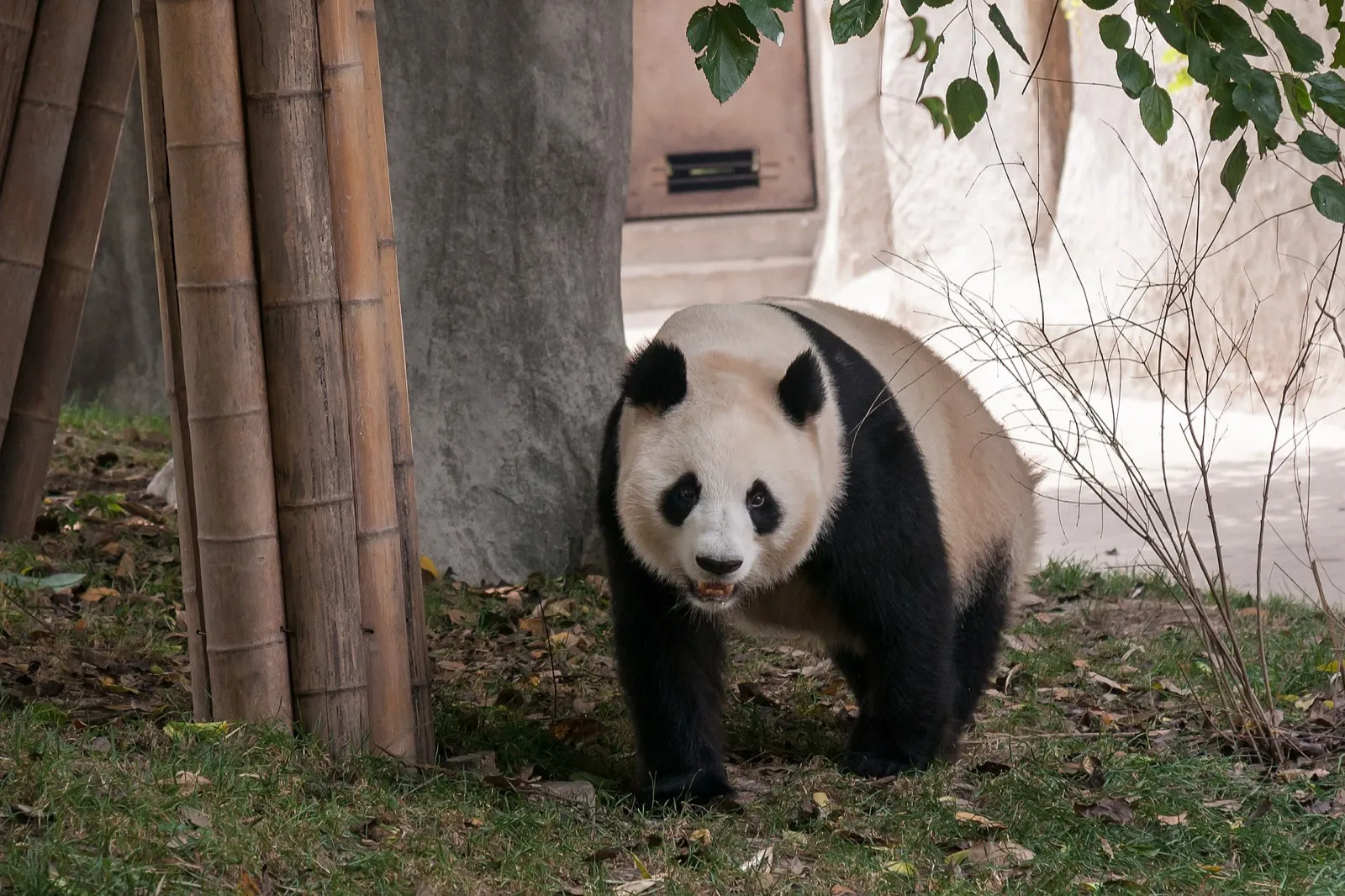
Chengdu, capital of Sichuan province and the biggest city in southwest China, has a worldwide monopoly on one thing: the best odds of seeing giant pandas up close, thanks to the famous breeding base in its northern suburbs. But the city's real appeal is its pace. While Beijing and Shanghai sprint, Chengdu putters — teahouses in the parks, mahjong in the alleys, snack stalls doing brisk business past midnight, and some of the most exciting food in China at famously low prices. Add UNESCO-listed day trips (an ancient irrigation system, a sacred Buddhist mountain, and the teal lakes of Jiuzhaigou now reachable by bullet train), a relaxed and welcoming local culture, and easy rail links to Chongqing, and you get the most low-stress big city in China. This guide covers the sights, the tickets to reserve in advance, and how to spend three to four good days.
Top sights at a glance
No. 1
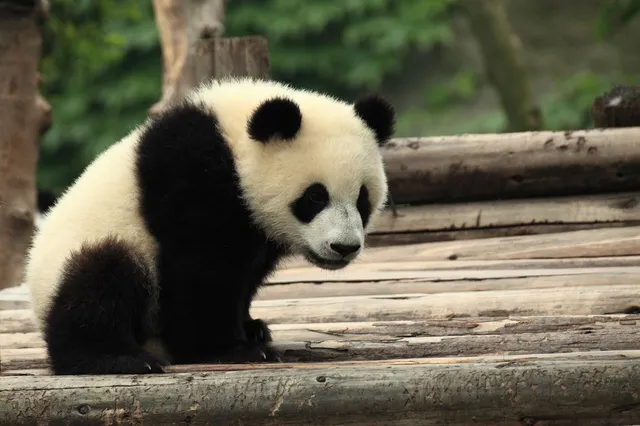
Chengdu Research Base of Giant Panda Breeding
The world's most famous panda sanctuary, home to more than 200 giant pandas on a wooded hillside in the city's northern suburbs. Arrive at opening and you will watch the animals eat, tumble, and pose through the most active hours of their day. The nursery buildings are the highlight — one of the few places on Earth where you can reliably see giant panda cubs. Boardwalks and a 30-yuan sightseeing shuttle link a dozen viewing zones across a large, leafy campus.
Good to know · Tickets cost 55 yuan as of September 2026 and are sold online only — book up to 14 days ahead via the base's official WeChat mini-program (search its Chinese name) or Trip.com with your passport, and pick the earliest morning slot. Take Metro Line 3 to Panda Avenue station, then the connecting shuttle or a short taxi; bring the passport used for booking. Pay with Alipay or WeChat Pay.
No. 2
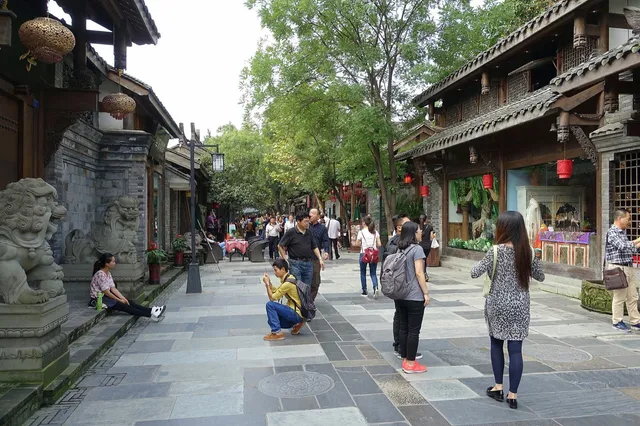
Kuanzhai Alley
Three restored Qing-dynasty lanes — Wide, Narrow, and Well Alley — where old courtyard-house architecture now hides teahouses, espresso bars, craft shops, and snack stalls. It is free to wander and best taken slowly: order a cup of tea, watch locals play cards, and graze through street food without a set plan. Come in the late afternoon for daylight photography and stay for the lantern-lit evening atmosphere. More relaxed than Jinli, though still crowded on weekends.
Good to know · Free to enter at any hour, a five-minute walk from Kuanzhai Alley station on Metro Line 4. Shops generally run from about 10 a.m. to 10 p.m.; late afternoon into evening has the best atmosphere. No booking needed, but politely decline the tea-ceremony and photo upsells pitched in the side courtyards.
No. 3
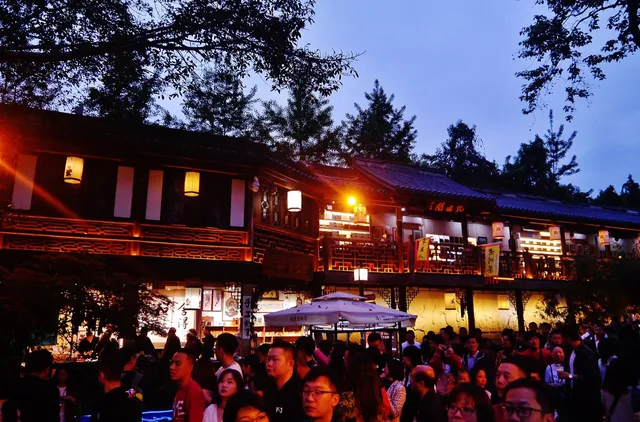
Wuhou Shrine & Jinli
A temple complex first laid out in the fifth century, honoring Liu Bei, founding emperor of the Shu Han kingdom, and his legendary chancellor Zhuge Liang — the strategist behind Romance of the Three Kingdoms. Its red-walled corridor beneath swaying bamboo is one of Chengdu's signature photographs. Directly next door, Jinli Ancient Street re-creates an old-market lane with snack stalls, craft shops, and lanterns. Visit the shrine by day, then drift into Jinli as the lights come on.
Good to know · Wuhou Shrine admission is 50 yuan as of September 2026 (Jinli street itself is free); book via the museum's official WeChat account or pay at the gate with Alipay or WeChat Pay. Opens around 8 a.m. with last entry in the late afternoon, and hours shorten in winter. Metro Line 3 to Gaoshengqiao station leaves you a ten-minute walk from both.
No. 4
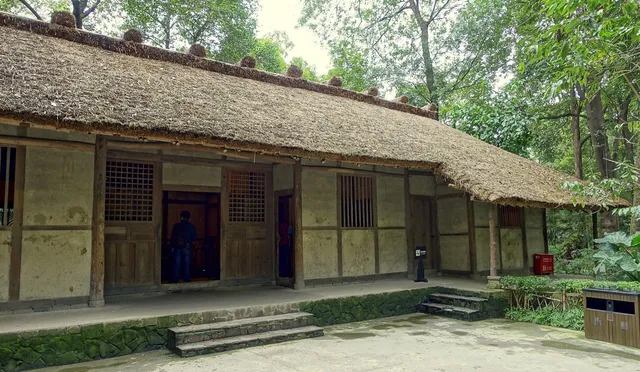
Du Fu Thatched Cottage
A museum-park built around the thatched cottage where China's greatest poet lived from 759 to 763 and wrote more than two hundred of his most famous works. Rebuilt many times since the Tang dynasty, the site mixes reconstructions, memorial halls, koi ponds, plum gardens, and quiet bamboo paths a short metro ride from the center. Even travelers indifferent to Tang poetry tend to love the greenery. Time it for late afternoon and combine with Kuanzhai Alley for dinner.
Good to know · Admission is 50 yuan as of September 2026; buy on arrival with Alipay or WeChat Pay, or reserve through the museum's WeChat account on holiday weekends. Open roughly 8 a.m. to 6 p.m., with last tickets about an hour before closing. Metro Line 4 to Caotang North Road, then a short walk.
No. 5
Teahouse Culture
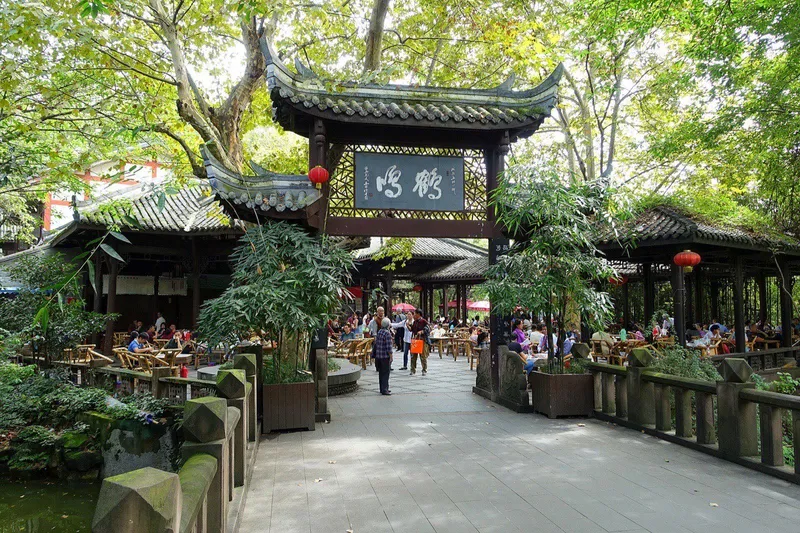
Chengdu's teahouse tradition is the city's real headline attraction, and People's Park is its main stage. At the century-old Heming Teahouse, hundreds of bamboo chairs fill open-air courtyards while attendants refill lidded gaiwan bowls all day. Ear cleaners work the aisles with tuning-fork tweezers; card games, mahjong, and snacks stretch for hours. Around the park paths: the famous marriage-matchmaking corner, choirs, and square dancers. Budget a whole afternoon and do nothing at all.
Good to know · People's Park is free; a gaiwan of tea at Heming runs roughly 20–40 yuan, refilled with hot water as long as you stay. Ear cleaning costs around 30 yuan — agree the price before the tools come out, or decline with a polite 'bu yao'. Metro Line 2 to People's Park station, exit toward the lake.
Every Chinese city has a personality, and Chengdu’s is unhurried. While Beijing runs on political schedules and Shanghai on finance, this metropolis of more than 20 million people in the Sichuan Basin has spent centuries perfecting the art of taking it easy: tea poured again and again from battered kettles into lidded bowls, mahjong tiles clacking until midnight, long meals built around the tingling bite of Sichuan pepper. It is also, quite simply, one of the best places on Earth to see giant pandas. For independent travelers Chengdu is easy mode — a flat, green, metro-connected city with cheap food, patient locals, and enough day trips to fill a second week. Plan three or four days, and do not be surprised if you slow down and stay longer.
A Bit of History
Chengdu has been a major city for more than two thousand years, and for most of that time it has been rich. The surrounding plain was the heartland of the ancient Shu kingdom, whose Bronze Age capital at Jinsha — now an excellent museum on the city’s west side — turned out gold and jade artifacts, including the flying sun-bird emblem Sichuan uses today. The turning point came around 256 BC, when the Qin administrator Li Bing built the Dujiangyan irrigation system, taming the Min River and turning the plain into China’s most dependable breadbasket. The label locals still use — Tianfu zhi guo, the Land of Abundance — dates from this era.
Han-dynasty Chengdu grew wealthy weaving brocade, and the imperial brocade workshop gave the city a poetic name that survives: the Brocade City. In the eighth century the poet Du Fu, fleeing civil war, spent four relatively contented years here and wrote more than two hundred poems — including “The Thatched Hut Wrecked by Autumn Wind,” the very poem the cottage museum is built around. Under the Song, Chengdu merchants produced jiaozi, the world’s first paper money, printed centuries before Europe tried the idea — fitting for a place that has always preferred commerce to ceremony.
The twentieth century reinforced Chengdu’s role as China’s inland refuge. When Japanese forces overran the coast in the late 1930s, universities, factories, and government agencies relocated to Sichuan; after 1949 the city industrialized, and in the reform era it boomed into the administrative and technology capital of western China, its metropolitan population now past 20 million.
What matters to visitors, though, is continuity. The teahouse you sit in this afternoon is the same institution foreign travelers described a century ago. Dujiangyan still irrigates the plain it was engineered to protect. And the pandas are the newest chapter: the breeding base opened in 1987 with six rescued pandas and has grown into the world’s leading captive-panda program, home to more than 200 animals. Chengdu’s history is less about monuments than about a way of life that has outlasted every dynasty — the old walls came down decades ago, and the alleys and parks carry the memory instead.
Culture & Daily Life
If Beijing can feel like a stage set and Shanghai like a showroom, Chengdu feels like a living room. The city’s default institution is the teahouse, and it functions as everything at once — office, parlor, chess club, gossip exchange. On any weekday afternoon, retirees, freelancers, and families hold court over lidded bowls of jasmine tea that cost less than a coffee and come with unlimited hot-water refills. Mahjong is close to a municipal religion; you will hear the tiles in parks, alleys, and roadside restaurants at all hours.
Chengdu eats the way it drinks tea: constantly and joyfully. Snacks are a civic hobby, street vendors do brisk business until late, and the city’s Sichuan opera troupes still perform the startling art of face-changing, performers flipping painted masks faster than the eye can follow. UNESCO named Chengdu a City of Gastronomy in 2010 — its first in Asia — an official blessing on something residents never doubted.
Temperamentally, the city is relaxed and a little wry. Locals speak a lilting dialect and are famously tolerant: Chengdu has a well-earned reputation as one of China’s most LGBTQ-friendly cities, with an open, visible scene around the Yulin neighborhood. Young Chengdu runs strong independent coffee, vintage shops, and a bottomless street-food economy, while its elders claim the parks — choirs, sword dancers, square-dancing troupes, and the celebrated matchmaking corner where parents trade their children’s résumés like brokers on an exchange floor.
The pace is the real culture shock, and it cuts both ways. Travelers arriving from Beijing, Shanghai, or Hong Kong routinely report feeling their shoulders drop within a day. Some overdo it — three straight days of tea and snacks is a lot for anyone — so balance the slowness with a few early alarms for the pandas and the day trips. Chengdu rewards a traveler who does nothing with conviction, but it rewards the one who gets up early, too.
Nature & Day Trips
Chengdu’s own greenery is pleasant — bamboo groves at the panda base, the riverside Wangjiang Pavilion gardens — but the region’s nature is the real draw, and the city works brilliantly as a base camp. Two UNESCO-listed day trips sit within about an hour of downtown: Dujiangyan, the 2,200-year-old irrigation works still doing its job, and Mount Qingcheng, a misty, forested Taoist mountain of pavilions and stone stairs. To the south, the city of Leshan holds a 71-meter Buddha carved into a river cliff, and the pilgrim terraces of Mount Emei rise beyond it — both reachable on frequent high-speed trains.
For genuine wilderness, 2024 changed everything. The new Chuanqing railway now runs bullet trains from Chengdu East to Huanglong Jiuzhai station in as fast as about an hour and 40 minutes, collapsing the old day-long drive to Jiuzhaigou into a half-day door-to-door trip. Jiuzhaigou’s turquoise terraced lakes and Huanglong’s travertine pools are two of the most beautiful landscapes in Asia; both parks require advance online reservations and enforce daily visitor caps, so book several days out in season. If your itinerary can stretch, add two or three nights — Jiuzhaigou and Huanglong are the kinds of places people redesign whole trips around, and Chengdu is their gateway.
Food & Drink
Chengdu is one of the great eating cities on the planet, and the flavor signature is málà: má, the mouth-numbing buzz of Sichuan pepper, and là, the heat of chili, in league together. If you are spice-averse, do not write the cuisine off — almost every dish has a gentler version, and the numbing tingle at low doses is more fascinating than painful. Say bu yao la (no spice) or wei la (mild) and vendors will usually accommodate. Order hotpot broth by description, not courage; medium here would count as fiery almost anywhere else.
Hotpot is the social event of the week: a table-side cauldron of chili-and-beef-tallow broth into which you cook thinly sliced beef, tripe, potatoes, and greens. First-timers should order a yuanyang pot, divided so one side is mild, and dip cooked pieces in sesame oil with garlic. Expect roughly 80–150 yuan per person with beer. Beyond hotpot lies the snack canon: mapo tofu, dan dan noodles, sweet-water noodles, wontons in chili oil, chuan chuan skewers, and — for the committed — braised rabbit heads, which locals consider a delicacy. Breakfast is noodle soup or dumplings for 10–20 yuan; eating well here costs less than almost anywhere in the West.
Where to eat matters less than where not to overdo. Jinli and Kuanzhai Alley are pleasant for grazing, but prices are tourist-calibrated and quality uneven; locals point you to ordinary neighborhood streets instead. The Yulin area is a reliable all-evening crawl, and the small streets around Kuixinglou, just off Kuanzhai Alley, hold some of the city’s best casual kitchens. For tea, skip the fancy salons: a park teahouse bench is the genuine article. One practical note — most small restaurants are cashless-first, so have Alipay or WeChat Pay set up before you walk out the door.
Top Sights
Chengdu Research Base of Giant Panda Breeding
The reason many visitors book flights to Chengdu at all. On a wooded hillside in the northern suburbs, the base shelters more than 200 giant pandas plus red pandas, and it is engineered for viewing: boardwalks and a paid sightseeing shuttle (30 yuan) connect a dozen zones, and the animals live in open, green enclosures rather than cages. Timing is everything. Pandas do most of their moving — and virtually all of their eating — between opening and mid-morning; by noon they nap, and by mid-afternoon the heat and the crowds win. The nursery buildings are the jackpot: depending on the season you may see newborns in incubators or year-old cubs tumbling over logs, and there are only a handful of places on Earth where baby pandas are reliably on view. The base runs summer hours of 7:30 a.m. to 6 p.m. as of September 2026, and the first entry slot is the one to fight for. Budget three to four hours, and do not skip the newer western section, which is quieter and worth the shuttle ride.
Kuanzhai Alley
Three restored Qing-dynasty lanes — Wide Alley, Narrow Alley, and Well Alley — a few metro stops from the center, and the most pleasant hour of people-watching in the city. The architecture is 2000s reconstruction in the old courtyard style, which purists will note, but the street life is genuine: tea poured on the sidewalk, card games, ear cleaners with their tuning forks, vendors drawing animals in molten sugar. Wide Alley leans toward old-Chengdu nostalgia, Narrow Alley toward cafes and boutiques, and Well Alley toward a modern brick relief wall and street art. The 2008 restoration, which saved the last courtyard blocks from demolition, is the city’s whole development story in miniature. It is free, open all day, and best in the late afternoon when the lanterns come on but tour groups have not yet peaked. An easy pairing with Du Fu Thatched Cottage, or with dinner afterward. Skip the packaged tea ceremonies marketed near the entrances; the free street theater is better.
Wuhou Shrine & Jinli
A rare double act: a solemn piece of Three Kingdoms history attached to Chengdu’s liveliest snack street. The shrine, first built in the fifth century, honors Liu Bei, emperor of the short-lived Shu Han kingdom, and his chancellor Zhuge Liang — the strategist immortalized in Romance of the Three Kingdoms. Anyone who has played a Dynasty Warriors game will recognize the names; anyone who has not will still appreciate the famous red-walled corridor beneath swaying bamboo, one of Chengdu’s signature photographs, and the Tang-era stele considered a masterpiece of Chinese calligraphy. Uniquely in China, an emperor and his minister share the same temple grounds — a measure of Zhuge Liang’s standing across fourteen centuries. Directly next door, Jinli Ancient Street re-creates a market lane with lanterns, snack stalls, and craft shops — free to enter and best after dark. Do the shrine in daylight and Jinli in the evening light, and you have a complete evening in one stop.
Du Fu Thatched Cottage
In 759, war refugee — and arguably China’s greatest poet — Du Fu built a thatched-roof cottage in a Chengdu bamboo grove and spent four years writing more than two hundred poems, among them the beloved “Song of My Thatched Hut Wrecked by Autumn Wind.” The current cottage is a Qing-era reconstruction set inside a museum-park of memorial halls, koi ponds, plum gardens, and shaded paths that feel a world away from the traffic outside. The halls hold calligraphy renditions of his verses by dynasties of admirers, and the exhibits tell his life story accessibly for non-readers. Even if Tang poetry is not your thing, this is one of the most restful hours you can spend in the city, and there is a quiet teahouse among the gardens if the wandering makes you thirsty. Come late afternoon, then walk or ride to Kuanzhai Alley for dinner.
Teahouse Culture
Chengdu’s true headline attraction is not a building but an afternoon. People’s Park, in the heart of downtown, stages it daily: at the century-old Heming Teahouse, hundreds of bamboo chairs fill open-air courtyards under plane trees while attendants pour refill after refill into lidded gaiwan bowls. For the price of a cup of tea you can sit for half a day. Ear cleaners patrol the aisles with long tweezers and tuning forks — a famous local micro-industry. Card and mahjong games stretch on for hours; snack sellers drift past. Around the park’s paths you will find the matchmaking corner, amateur choirs, and dancing troupes. Resist the urge to schedule. Order the jasmine tea, decline the ear cleaning politely if it is not for you (“bu yao” works), and watch a Chengdu afternoon do its thing. Weekdays are mellower; weekends belong to extended families, and the noise is part of the fun.
Getting There & Around
Chengdu has two airports. Shuangliu (CTU) is closer, about 20 minutes by Metro Line 10 from the center, and handles many domestic routes; Tianfu (TFU), southeast of the city, takes most international flights and connects via Line 18 in roughly 45 minutes. High-speed trains converge on Chengdu East, one of Asia’s largest rail stations: Chongqing is as fast as about an hour away, Leshan under an hour, and the Jiuzhaigou-direction bullet trains also leave from here.
The metro is modern, cheap (2–5 yuan a ride), bilingual, and covers every sight in this guide; DiDi works everywhere and is inexpensive. Shared bikes are a joy because the city is flat — ride the riverfront greenways between sights. Two exceptions to the metro rule: the panda base needs Line 3 plus a connecting shuttle or a short taxi, and day-trip trains toward Leshan and Emeishan depart from Chengdu East or Chengdu South, so double-check which station your ticket uses. As of September 2026, metro gates and most buses accept Alipay and WeChat Pay QR codes directly.
Where to Stay
Three districts cover most travelers. Around Taikoo Li and Chunxi Road is the default choice: the central shopping district, two intersecting metro lines, walking distance to Wenshu Monastery and the riverside greenways, and every hotel tier from hostels to luxury. Near Kuanzhai Alley and People’s Park you trade polish for atmosphere — older low-rise blocks, street breakfast, tea at the doorstep — and Metro Line 4 still puts everything within one transfer. The Yulin neighborhood suits food-first travelers: a local, laid-back quarter south of the river with the densest cluster of small restaurants and bars in the city. Wherever you choose, pick a place within a five-minute walk of a metro station; Chengdu is big, and a good location saves an hour a day. Budget travelers do fine around Chunxi Road too, where the competition keeps dorm beds and budget rooms cheap. Book well ahead for the Golden Week holiday in early October, when the city fills with domestic travelers and prices spike.